When you walk into a pharmacy and see two pills that look nothing alike but have the same name - one costs $4, the other $500 - it’s natural to wonder: How can they be the same? The answer isn’t magic. It’s science, law, and market competition working together to save billions every year.
Same Medicine, Different Price Tag
Generic drugs aren’t cheaper because they’re weaker. They’re not second-rate. They’re exact copies - legally required to be. The FDA says a generic drug must have the same active ingredient, strength, dosage form, and route of administration as the brand-name version. That means if you take generic atorvastatin, you’re getting the exact same molecule that’s in Lipitor. Same for omeprazole and Prilosec, metformin and Glucophage, or sertraline and Zoloft.
The only differences? Color, shape, flavor, and inactive ingredients like fillers or dyes. These don’t affect how the drug works. They’re changed simply because trademark laws prevent generics from looking exactly like the brand. But here’s the kicker: your body can’t tell the difference. The FDA requires every generic to prove it delivers the same amount of medicine into your bloodstream at the same speed as the brand. That’s called bioequivalence - and it’s not a soft standard. It’s a tight range: 80% to 125% of the brand’s absorption rate. If a generic falls outside that, it gets rejected.
Why Brand Drugs Cost So Much
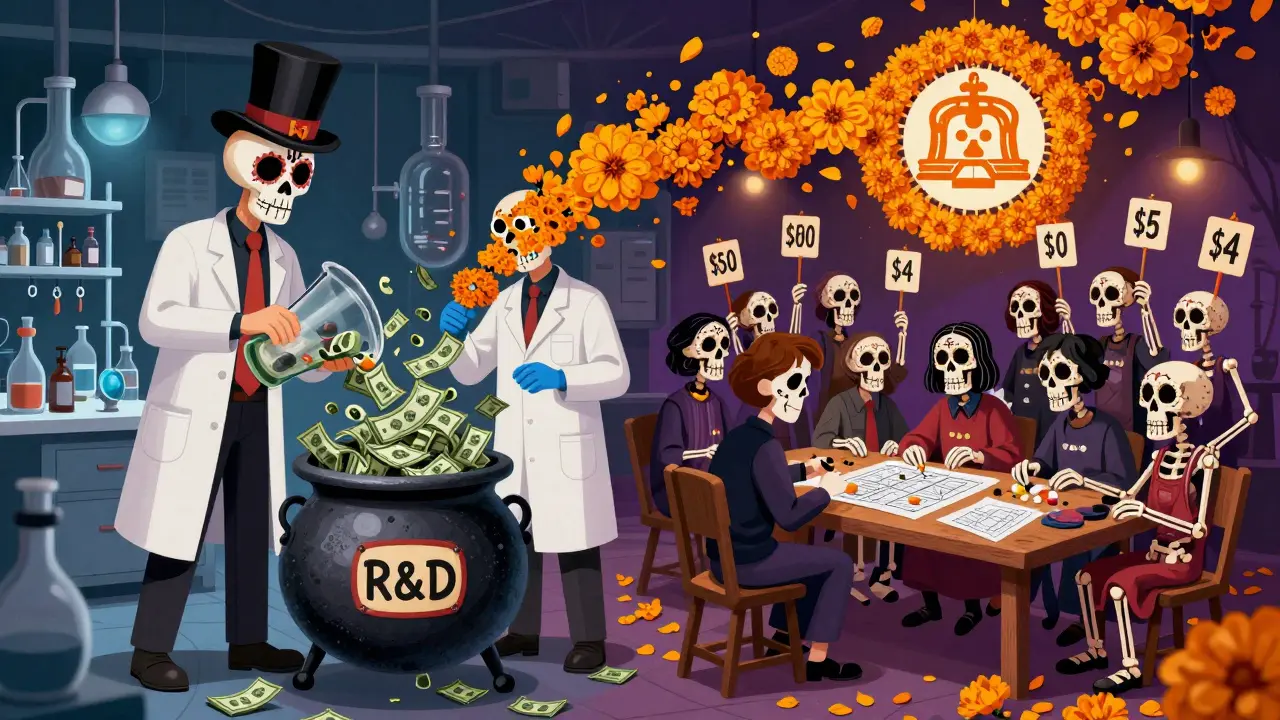
Brand-name drugs aren’t expensive because they’re better. They’re expensive because they had to pay for the research to prove they worked in the first place.
Developing a new drug takes 8 to 12 years. During that time, companies run dozens of clinical trials - testing on animals, then hundreds, then thousands of people. The average cost? Around $2.6 billion, according to the Tufts Center for the Study of Drug Development. That includes failed drugs too. For every drug that makes it to market, dozens get scrapped. That’s why pharmaceutical companies charge high prices during their patent window: they’re trying to recover those costs before competitors show up.
Patents give brand-name companies 20 years of exclusive rights from the date they file. But because clinical trials take years, the actual time they have to sell without competition is often only 7 to 12 years. That’s why many brand drugs are priced sky-high from day one - they need to make back their investment fast.
How Generics Skip the Cost
Generic manufacturers don’t have to start from scratch. Once the patent expires, they can use the brand’s existing data. They don’t need to repeat animal studies or long-term human trials. Instead, they file an Abbreviated New Drug Application (ANDA) - which literally means “abbreviated.”
That cuts development time from 10+ years to under 3 years. And costs? From $2.6 billion down to $1-5 million per drug. That’s not a typo. One company can produce a generic version of a blockbuster drug for less than the cost of a single clinical trial the brand company ran.
And here’s the thing: the FDA still inspects generic factories just like brand ones. Same rules. Same standards. Same inspections - over 12,000 a year worldwide. Generics don’t cut corners on safety. They cut corners on R&D.
Competition Drives Prices Down
Once a patent expires, it’s open season. The first generic to enter usually charges 20-30% less than the brand. But within months, others follow. The average generic drug has 14 manufacturers making it. When 10 or 15 companies are selling the same pill, they start competing on price.
The Congressional Budget Office found that within a year of generic entry, prices drop by 80-90%. In some cases, like generic statins or blood pressure meds, prices fall below $10 per month. That’s not inflation. That’s capitalism working.
And it’s not just U.S. prices. In Scotland, where I live, generics are the default unless a doctor specifically writes “do not substitute.” Most prescriptions here are filled with generics. The cost savings add up fast. A patient switching from brand-name Synthroid to generic levothyroxine might save $400 a month. That’s not a luxury - it’s survival for many.
Generics Save the System Billions
In the U.S., generics make up 90% of all prescriptions filled. But they account for only 18% of total drug spending. Brand drugs, which are only 10% of prescriptions, take up 82% of the cost.
From 2007 to 2016, generics saved the U.S. healthcare system $1.67 trillion. In 2022 alone, they saved $293 billion. That’s more than the GDP of many countries. It means more people can afford their meds. More people stick to their treatment. More people stay healthy.
And it’s not slowing down. Over 150 brand-name drugs are set to lose patent protection by 2028, with combined annual sales of $157 billion. That’s $157 billion in potential savings.
Why Do People Still Doubt Generics?
Despite all the evidence, 62% of Americans say they trust brand-name drugs more - even though 84% admit generics work just as well. Why? Because of appearance.
If you’ve been taking a blue pill for years and suddenly get a white capsule with a weird logo, your brain thinks something’s wrong. Some patients report side effects after switching - nausea, dizziness, mood changes. But studies show these are rarely caused by the drug itself. More often, it’s stress, expectation, or a change in inactive ingredients.
For drugs with a narrow therapeutic index - like warfarin, levothyroxine, or seizure meds - doctors sometimes prefer to keep patients on one brand. Not because generics are unsafe, but because even tiny variations in absorption can matter. But here’s the truth: the FDA approves every generic for these drugs. If a patient has issues switching, it’s not because the generic is bad - it’s because the body needs time to adjust. A pharmacist can help with that transition.
What You Can Do
If you’re on a brand-name drug, ask your pharmacist or doctor: “Is there a generic?” Most of the time, the answer is yes. Insurance plans push generics too. They put them in Tier 1 - with $0 to $15 copays. Brand drugs? Tier 2 or 3. You could pay $50 or more.
Some pharmacies automatically substitute generics unless the doctor says “dispense as written.” If you ask for the brand and a generic is available, your insurer might deny coverage. You’ll have to pay full price.
Don’t assume your drug has no generic. Even newer drugs often get generics within a year of patent expiry. And if you’re worried about quality - check the FDA’s website. They list every approved generic with its manufacturer and bioequivalence data.
Generics Aren’t a Compromise. They’re a Win.
Generic drugs aren’t “good enough.” They’re the same. They’re proven. They’re safe. And they’re saving millions of people from having to choose between medicine and rent.
The system isn’t perfect. Patent extensions, pay-for-delay deals, and supply chain risks are real problems. But the core idea - that a drug can be copied fairly, tested rigorously, and sold affordably - works. And it’s one of the most successful public health innovations in modern history.
Next time you see a $4 prescription, don’t think “cheap.” Think “smart.”
Are generic drugs really as effective as brand-name drugs?
Yes. The FDA requires generic drugs to have the same active ingredient, strength, dosage form, and route of administration as the brand-name version. They must also prove bioequivalence - meaning they deliver the same amount of medicine into your bloodstream at the same rate. Studies show they work the same way in real-world use. Over 90% of prescriptions in the U.S. are filled with generics, and they’re used safely every day by millions.
Why do generic drugs look different from brand-name drugs?
Trademark laws require generic manufacturers to make their pills look different from the brand-name version. That means changes in color, shape, size, or markings. These differences are only cosmetic. They don’t affect how the drug works. The active ingredient is identical. If you’re concerned about switching, talk to your pharmacist - they can explain what changed and why.
Can I switch from a brand-name drug to a generic safely?
For most medications, yes. The FDA approves all generics for therapeutic equivalence. But for drugs with a narrow therapeutic index - like warfarin, levothyroxine, or anti-seizure meds - small changes in blood levels can matter. Your doctor may recommend staying on one version. If you switch, monitor how you feel and report any changes. Most patients adjust without issue.
Why are generic drugs so much cheaper if they’re the same?
Brand-name drugs cost billions to develop - including clinical trials, research, and marketing. Generics skip those costs. They use the brand’s existing data to prove safety and effectiveness. Their development takes months, not years, and costs a fraction. Plus, once multiple companies start making the same drug, competition drives prices down. It’s not about quality - it’s about who paid for the research.
Do insurance plans prefer generic drugs?
Yes. Most insurance plans have a three-tier system. Generics are in Tier 1, with the lowest copay - often $0 to $15. Brand-name drugs are in Tier 2 or 3, with higher copays or coinsurance. If you ask for the brand when a generic is available, your insurer may deny coverage unless your doctor files an exception. Choosing generics can save you hundreds a month.
Justin Archuletta
March 19, 2026 AT 13:09PS: My pharmacist gave me a sticker that says 'GENERIC = WIN'. I put it on my fridge. It’s my new motto.
Aileen Nasywa Shabira
March 20, 2026 AT 08:21Then why does the FDA require them to be 'bioequivalent' instead of 'identical'?
Because they’re NOT identical. And if they were, why do they look like different alien artifacts?
Also, who tests these things? Some intern in a lab with a broken pipette?
I’d rather pay $500 and know I’m not playing Russian roulette with my thyroid.
Kendrick Heyward
March 20, 2026 AT 14:58First month: I cried for no reason.
Second month: I couldn’t sleep.
Third month: I felt like my soul was being slowly drained by a corporate drone.
Switched back to Zoloft. Instant peace.
Don’t tell me it’s 'the same molecule'. My emotions aren’t math.
Also, why is the generic pill green? It looks like it was made in a basement. 😭
lawanna major
March 21, 2026 AT 23:25The psychological barrier isn’t scientific. It’s cultural. We’ve been conditioned to equate price with value, appearance with quality, and branding with trust.
When you strip away the marketing, what’s left is chemistry. And chemistry doesn’t care about logos.
Generics aren’t a compromise. They’re a correction.
Ryan Voeltner
March 23, 2026 AT 03:10Generic drugs represent one of the most efficient applications of market competition in healthcare.
Patent expiration enables access. Access enables equity. Equity enables health.
It is not merely a cost-saving measure. It is a moral imperative.
Linda Olsson
March 23, 2026 AT 14:01They own the generic companies too.
They let the patent expire so they can sell the same drug under a different name for $4.
Then they buy up every single manufacturer so no one else can compete.
It’s not capitalism. It’s a monopoly with a new coat of paint.
And you’re celebrating?
Wake up. They’re still ripping you off. Just with a different label.
Ayan Khan
March 25, 2026 AT 08:22But here’s what I’ve seen: people live. People thrive. People raise families.
It’s not about trust. It’s about necessity.
And necessity has a way of revealing truth.
If a pill saves a life at $3, it doesn’t matter if it’s blue or white.
The body doesn’t care about branding. It cares about survival.
Emily Hager
March 26, 2026 AT 05:57What does that say about our values?
If a drug can be made for $1, why isn’t it free?
Because the system isn’t designed for health. It’s designed for profit.
Generics don’t fix the problem. They mask it.
And we’re applauding the bandage instead of demanding the cure.
Melissa Starks
March 26, 2026 AT 17:45Then I got laid off.
Suddenly I had a $1000 deductible and no money.
I switched to generic metformin.
And guess what? I didn’t die.
I didn’t even feel different.
Turns out, my dignity wasn’t tied to the color of the pill.
My health was.
And now I tell everyone: if your doctor says it’s safe, take the cheap one.
You’re not being cheap. You’re being smart.
Also, my cat now sleeps on my pill organizer. I think she approves.
Lauren Volpi
March 26, 2026 AT 22:56Meanwhile, in Canada, it’s $4.
So why are we still here?
Because we’ve been sold the lie that more expensive = better.
It’s not science. It’s advertising.
And we’re the suckers who keep buying it.
Kal Lambert
March 28, 2026 AT 19:31Ask your pharmacist.
They see the data every day.
Melissa Stansbury
March 30, 2026 AT 16:00I’m not saying it’s the pill - but I’m also not saying it’s not.
My doctor said it’s fine.
My husband says I’m overreacting.
My mom says I should’ve stayed on the brand.
I don’t know what to believe anymore.
Can someone just tell me if I’m crazy?