When your body turns against itself, things get complicated. That’s what happens in Graves’ disease - an autoimmune condition where your immune system mistakenly attacks your thyroid gland, forcing it to pump out too much hormone. It’s not just about feeling jittery or losing weight. It’s a full-system disruption that can change how you sleep, think, move, and even look. And if you’re one of the millions affected - mostly women between 30 and 50 - you need to know what’s really going on and what your real options are.
What Exactly Is Graves’ Disease?
Graves’ disease isn’t just another thyroid problem. It’s the #1 cause of hyperthyroidism in places where people get enough iodine, like the U.S. and Europe. About 60 to 90% of all hyperthyroidism cases come from this one condition. The trigger? Antibodies called thyroid-stimulating immunoglobulins (TSI). These rogue proteins act like fake keys, slipping into your thyroid’s TSH receptors and telling it to produce hormones nonstop - no matter how full the tank already is.
Women are hit 7 to 8 times harder than men. Why? It’s not fully understood, but hormones and genetics play a big part. If someone in your family has Hashimoto’s, lupus, or another autoimmune disease, your risk goes up. Smoking doesn’t help either - smokers are 2 to 3 times more likely to develop eye complications. And stress? It doesn’t cause Graves’ disease, but it can push it into gear.
How Do You Know You Have It?
The symptoms aren’t subtle. You might feel like you’re running on caffeine even when you’re not. Anxiety, heart palpitations, trembling hands, trouble sleeping - these are common. Up to 90% of people with Graves’ report nervousness. About 80% feel heat intolerant, sweating even in cool rooms. You might be eating more but still losing weight. Muscle weakness, especially in the hips and shoulders, shows up in nearly half of cases.
But the most telling sign? Your eyes. About one-third of people with Graves’ develop eye changes - bulging eyes (exophthalmos), redness, irritation, double vision. In severe cases, vision can be threatened. This isn’t just cosmetic. It’s inflammation in the tissue behind the eyeball, and it’s driven by the same autoimmune process.
On exam, doctors look for three things: a fast heartbeat (often over 100 bpm), a swollen thyroid (goiter) you can feel in your neck, and eye changes. But blood tests are the real proof. A suppressed TSH (below 0.4 mIU/L) with high free T4 and T3 levels is the classic pattern. And if TSI or TRAb antibodies are positive? That’s the gold standard. No guesswork. You have Graves’.
Three Main Treatment Paths - And What They Really Mean
There are three ways to treat Graves’ disease. Each has trade-offs. No single option works best for everyone. Your age, symptoms, eye involvement, and personal priorities matter.
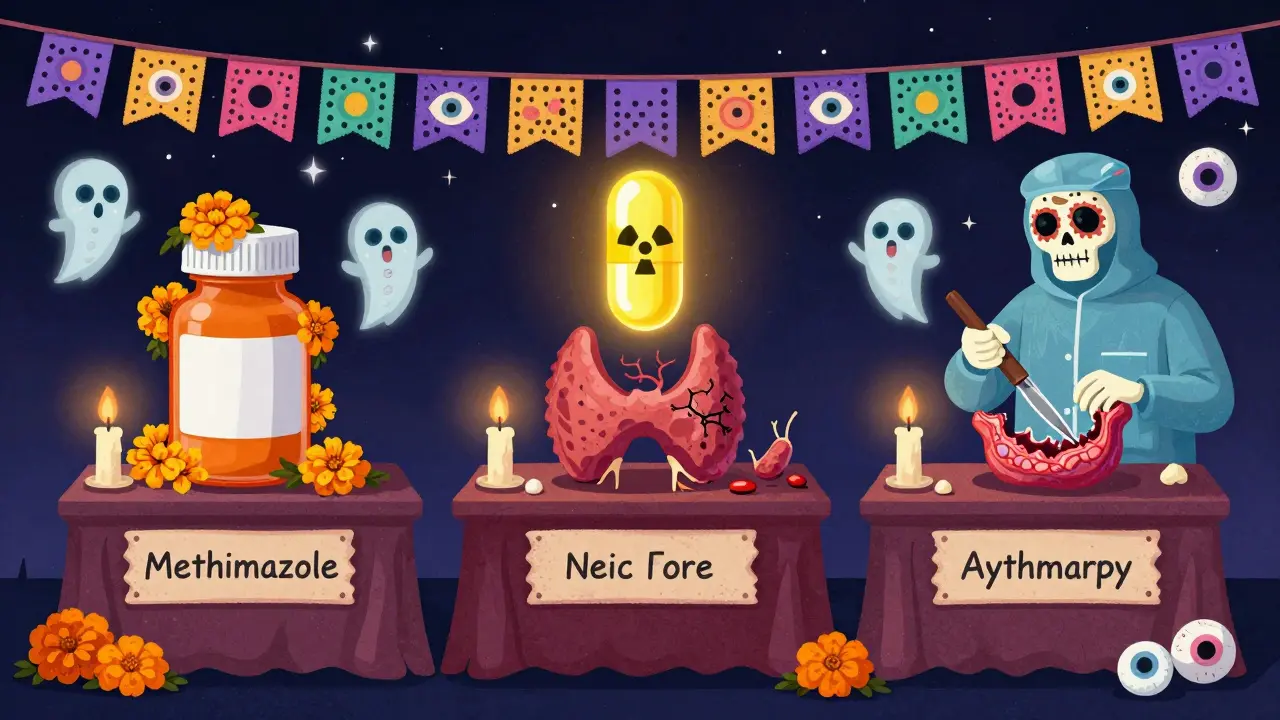
1. Antithyroid Medications - The Slow Reset
Methimazole is the go-to drug. It blocks hormone production without destroying the gland. You start with 10 to 40 mg daily. It takes weeks to feel better. Most people stabilize within 2 to 3 months. But here’s the catch: it doesn’t fix the root problem. Your immune system still makes those bad antibodies.
Remission rates? Around 30 to 50% after 12 to 18 months of treatment. Higher if your goiter is small and your antibody levels drop to zero by the end. Miss a dose? Your relapse risk jumps 40 to 50%. Side effects are rare but serious - agranulocytosis (a drop in white blood cells) can cause fever and sore throat. If that happens, stop the drug and get to a hospital immediately. Liver issues can also occur, so monthly blood tests are needed early on.
Propylthiouracil (PTU) is rarely used now. It’s riskier for the liver. Only considered in early pregnancy or if methimazole causes a bad reaction.
2. Radioactive Iodine (RAI) - The Permanent Fix
This is the most common treatment in the U.S. You swallow a capsule with I-131. The radiation destroys overactive thyroid cells. Within 6 to 12 months, your thyroid shuts down. You become hypothyroid - permanently. That means lifelong levothyroxine (usually 1.6 mcg per kg of body weight daily).
Why do people choose this? It’s simple. One treatment. No daily pills to manage. But it’s not reversible. And if you have eye disease, RAI can make it worse - unless you take steroids at the same time. It’s also not recommended for pregnant women or those planning pregnancy within 6 months.
Success rate? 80 to 90% of people end up hypothyroid. That’s the goal. But if you weren’t told this ahead of time, it can feel like a betrayal. Many patients later say they regret not knowing how permanent it is.
3. Thyroid Surgery - The Direct Approach
Total thyroidectomy means removing the whole gland. It’s 95% effective. Used when the thyroid is huge and squeezing your windpipe, if eye disease is severe and not responding, or if you can’t take meds or RAI.
But surgery has risks: damage to the vocal cords (0.5 to 1% chance) or parathyroid glands (1 to 2%), which control calcium. You’ll need lifelong thyroid hormone replacement. Recovery takes a few weeks. You’ll need a scar on your neck.
Most people avoid surgery unless necessary. But for some - especially those with large goiters or who want to avoid radiation - it’s the cleanest solution.
What About the Eyes? Graves’ Ophthalmopathy
Eye problems aren’t just a side effect - they’re part of the disease. And they can get worse even after your thyroid is under control.
For mild cases: selenium supplements (100 mcg twice daily for 6 months) can reduce swelling and discomfort. It’s cheap, safe, and backed by solid studies.
For moderate to severe: IV steroids. A 6-week course of methylprednisolone (500 mg weekly, then 250 mg weekly for another 6 weeks) helps 60 to 70% of patients. It reduces inflammation, improves vision, and can prevent permanent damage.
New hope? Teprotumumab. This monoclonal antibody, approved in 2020, targets the IGF-1 receptor behind the eye inflammation. In trials, 75 to 80% of patients saw their bulging eyes shrink. Nearly 70% had major improvement. It’s expensive and given as infusions over 6 months - but for those with severe eye disease, it’s life-changing.
And if all else fails? Orbital decompression surgery. A specialist removes bone from around the eye socket to give the eye room to sit back. It’s not cosmetic - it’s functional. Many patients say it restored their vision and confidence after months of double vision.
What No One Tells You - The Hidden Realities
One in five people with Graves’ say they were misdiagnosed at first. Anxiety gets labeled as panic disorder. Weight loss as a “good metabolism.” Fatigue as depression. It takes an average of 6 months to get the right diagnosis.
And after treatment? Many feel lost. If you took RAI and now need daily thyroid pills, you might feel like you’ve lost control. If you’re on methimazole and still tired after 3 months, you might think it’s not working - but it often takes time. And if your eyes changed? You might avoid mirrors, stop socializing, or feel ashamed.
Smoking? Quitting is the single most powerful thing you can do to protect your eyes. Smokers have 7 to 8 times higher risk of severe eye disease. Period.
And yes - stress, sleep, and diet matter. No, they won’t cure Graves’ - but they help your body cope. Many patients report better energy, less anxiety, and fewer flare-ups when they reduce sugar, cut caffeine, and prioritize sleep.
What Comes Next? Monitoring and Long-Term Care
After diagnosis, your thyroid levels need checking every 4 to 6 weeks until stable. Then every 3 to 6 months. If you’re on meds, you’ll need blood tests for liver and white blood cells. If you had RAI or surgery, you’ll need lifelong thyroid hormone monitoring.
And here’s something important: even after your thyroid is normal, your antibodies might stick around. That doesn’t mean you’re still sick - but it does mean you should stay in touch with your doctor. Relapse can happen years later.
For women: if you plan pregnancy, get your thyroid levels stable first. Graves’ can flare postpartum. And if you’ve had RAI, wait at least 6 months before trying to conceive.
Research is moving fast. Trials with rituximab (a drug that wipes out faulty immune cells) show promise for stubborn eye disease. Genetic studies have found over a dozen genes linked to Graves’ - meaning someday, we might predict who’s at risk before it starts.
Final Thoughts: It’s Manageable - But You Need to Be In Charge
Graves’ disease isn’t a death sentence. It’s not even a life sentence - if you choose wisely. You have options. You have control. The hardest part? Making the decision without fear or misinformation.
Don’t rush. Ask questions. Get a second opinion. Talk to others who’ve been there. And remember - your body didn’t fail you. It got confused. With the right treatment, it can learn again.
Can Graves’ disease be cured?
Graves’ disease can go into remission, especially with antithyroid medications - about 30 to 50% of people stop needing drugs after 12 to 18 months. But the autoimmune trigger doesn’t disappear. Radioactive iodine and surgery permanently stop hormone overproduction, but they lead to lifelong hypothyroidism, which requires daily medication. So while symptoms can be fully controlled, the underlying immune issue isn’t "cured" in the traditional sense.
Is Graves’ disease hereditary?
Yes, genetics play a strong role. If a close family member has Graves’, Hashimoto’s, lupus, or type 1 diabetes, your risk is higher. Scientists have identified over a dozen genes linked to the disease - especially HLA-DQA1, CTLA4, and TSHR. But having the genes doesn’t mean you’ll get it. Environmental triggers like stress, infection, or smoking are usually needed to start the disease.
Can you get Graves’ disease after pregnancy?
Yes. Postpartum thyroiditis is common, and in about 20 to 30% of those cases, it turns into Graves’ disease within the first year after birth. Hormonal shifts after delivery can trigger autoimmune activity. If you develop fatigue, anxiety, or heart palpitations after having a baby - especially if you have a family history of thyroid issues - get your thyroid checked.
Does smoking make Graves’ disease worse?
Absolutely. Smoking doesn’t cause Graves’ disease, but it’s the biggest modifiable risk factor for severe eye complications. Smokers are 7 to 8 times more likely to develop serious Graves’ ophthalmopathy than non-smokers. Quitting smoking is one of the most effective ways to protect your eyes - even if you’ve already been diagnosed.
Are there natural treatments for Graves’ disease?
There’s no proven natural cure. Supplements like selenium can help mild eye symptoms, and reducing stress or cutting caffeine may improve how you feel. But you can’t reverse Graves’ with diet, herbs, or acupuncture. Delaying medical treatment can lead to heart problems, bone loss, or vision damage. Always work with an endocrinologist - natural remedies can complement, not replace, science-backed care.
How long does it take to feel better after starting treatment?
It varies. With antithyroid meds, most people notice less anxiety and heart palpitations within 2 to 4 weeks. Full symptom relief often takes 2 to 3 months. Radioactive iodine takes longer - you might feel worse before you feel better, as the thyroid slowly shuts down. Surgery can bring quick relief, but recovery takes weeks. Eye symptoms can linger for months or even years, even after thyroid levels normalize.
Dylan Patrick
March 14, 2026 AT 17:57Graves’ isn’t just a thyroid issue-it’s your whole body screaming for help. I went from ‘I’m just stressed’ to ‘I can’t hold a coffee cup without shaking.’ The eye thing? Yeah, that hit hard. Saw my reflection and didn’t recognize myself. But methimazole saved me. Took 4 months, but I’m in remission now. No RAI. No surgery. Just patience and blood tests. You got this.
Kathy Leslie
March 16, 2026 AT 09:16My mom had this. She did RAI and now takes pills daily. Said she felt like she lost a part of herself. But honestly? She’s way calmer now. No more panic attacks. No more midnight sweats. Just… normal. Sometimes the ‘fix’ feels like a trade, but if it lets you sleep? Worth it.
Amisha Patel
March 18, 2026 AT 03:08Elsa Rodriguez
March 18, 2026 AT 19:55OMG I’m not the only one?? I cried when the doctor said ‘Graves’’ because I thought I was just ‘crazy’. Then my eyes bulged and I stopped taking selfies. My husband said I looked like a horror movie. Teprotumumab? I’m saving for it. If you’re reading this and you’re scared? I see you. We’re not broken. We’re fighting.
Serena Petrie
March 19, 2026 AT 18:25Buddy Nataatmadja
March 20, 2026 AT 17:17As someone from Indonesia, I’m surprised how similar this is to what we see here. Thyroid issues are rising fast. We don’t have great access to Teprotumumab, but selenium is common. My cousin took it for 6 months-her red eyes faded. Not a cure, but relief. Small wins matter.
mir yasir
March 22, 2026 AT 13:07The clinical accuracy of this article is commendable. However, one must acknowledge that the Western medical paradigm, while efficacious, often neglects holistic integration-particularly in the context of psychoneuroimmunological modulation. The omission of Ayurvedic or Traditional Chinese Medicine frameworks represents a significant epistemic limitation.
Stephanie Paluch
March 23, 2026 AT 09:00just got diagnosed last week 😭
took 6 months to get here
my doctor kept saying 'you're just anxious'
then my eyes started bulging and i cried in the mirror
seriously though-selenium? i’m trying it
also quitting smoking today 💪❤️
tynece roberts
March 25, 2026 AT 01:24so i had graves for like 3 years and no one knew. i thought i was just tired and had bad metabolism. then one day i looked in the mirror and my eyes looked like they were gonna pop out. i thought i was dying. went to er. they were like oh this is graves. i was like wait what? i read this whole thing and now i feel less alone. also i still drink coffee. sorry not sorry. ☕️
Hugh Breen
March 25, 2026 AT 09:02Man, this is why I love Reddit. Real talk, real science. I did RAI and now I’m hypothyroid. People ask if I regret it. Nah. I got my life back. Sleep. Energy. No panic attacks. Yeah, I take a pill. Big deal. I’d rather take one pill than live in fear of my own body. And if you’re scared of the eye stuff? Quit smoking. Like, right now. Your future self will thank you. 🙌
Byron Boror
March 26, 2026 AT 04:08Why are we letting this disease be treated like a personal failure? This isn’t weakness. This is biology. And if you’re not taking RAI, you’re delaying the inevitable. Stop with the ‘maybe meds will work’ nonsense. Get it done. Get your life back. No more ‘waiting to feel better.’ You’re not a lab rat. You’re a human. Take control.