When you take a statin to lower cholesterol and an antifungal for a stubborn yeast infection, you might not think twice about combining them. But this common mix can quietly push your muscles into a life-threatening breakdown called rhabdomyolysis. It’s not rare. It’s not theoretical. It’s a well-documented, preventable danger that lands people in the hospital every year.
Why This Interaction Happens
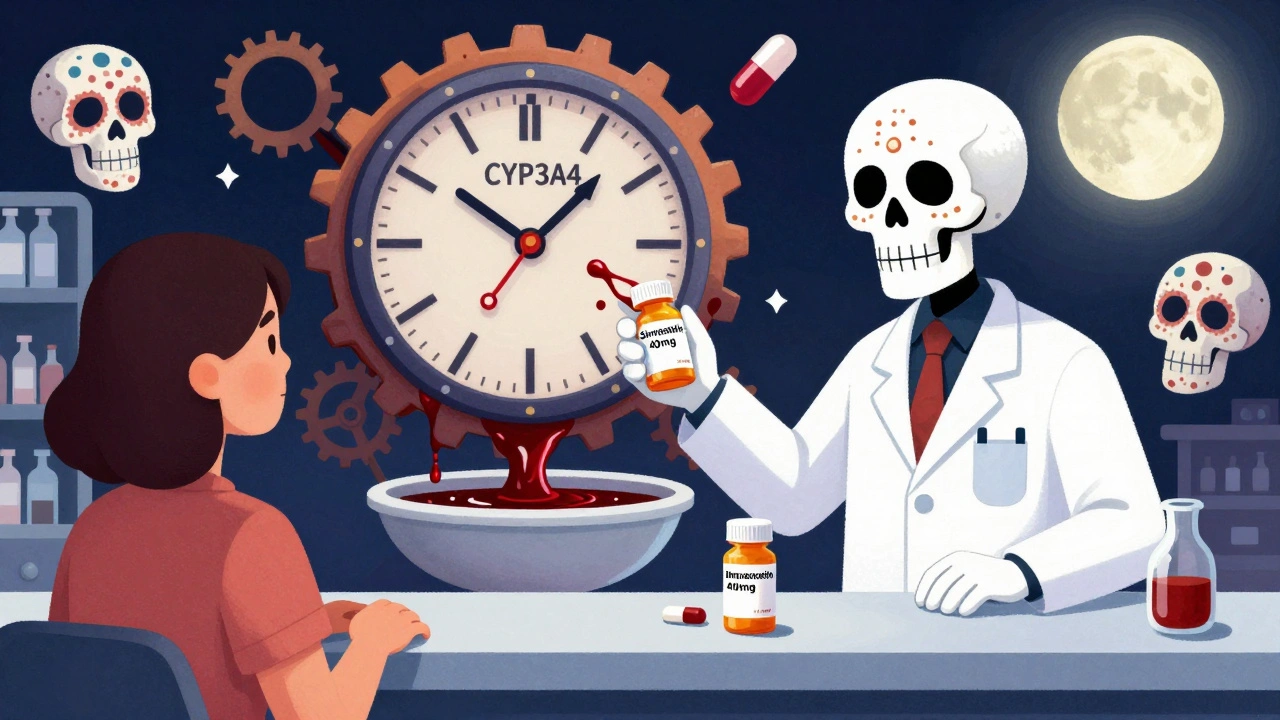
Statins like simvastatin, lovastatin, and atorvastatin don’t just work in your liver-they’re broken down by a liver enzyme called CYP3A4. That’s where antifungals like itraconazole, ketoconazole, and voriconazole step in. These drugs are powerful inhibitors of CYP3A4. Think of it like a traffic jam: the statin is trying to exit the liver, but the antifungal blocks the exit. The statin builds up, and too much of it starts attacking your muscle cells.The result? Muscle fibers break down, leaking a protein called creatine kinase (CK) into your bloodstream. High CK levels can overload your kidneys, leading to kidney failure. In extreme cases, rhabdomyolysis can be fatal.
Which Statins Are Most at Risk?
Not all statins are created equal when it comes to this interaction. The risk depends on how much they rely on CYP3A4 for clearance:- High risk: Simvastatin, lovastatin, atorvastatin - these are mostly broken down by CYP3A4. Simvastatin is the worst offender. When taken with itraconazole, its concentration can spike by more than 10 times.
- Moderate risk: Atorvastatin still carries a significant risk. With voriconazole, levels can jump 3.5 to 5 times higher than normal.
- Low risk: Pravastatin, fluvastatin, rosuvastatin, and pitavastatin use other pathways. They’re much safer to use alongside antifungals.
Here’s what the numbers look like from clinical studies:
| Statin | Antifungal | AUC Increase | Risk Level |
|---|---|---|---|
| Simvastatin | Itraconazole | 1,160% | Extreme |
| Simvastatin | Fluconazole (400 mg/day) | 350% | High |
| Lovastatin | Itraconazole | 1,550% | Extreme |
| Atorvastatin | Voriconazole | 350-520% | High |
| Atorvastatin | Fluconazole (400 mg/day) | 80% | Moderate |
| Pravastatin | Any azole | 0-15% | Low |
| Rosuvastatin | Any azole | 10-20% | Low |
Real Cases, Real Consequences
In 2018, a 68-year-old man in Scotland was prescribed fluconazole for toenail fungus. He’d been on simvastatin 40 mg for years. Within a week, he couldn’t climb stairs without pain. His urine turned dark. His creatine kinase level hit 18,400 U/L-nearly 100 times the normal range. He spent three days in the hospital. He didn’t have kidney failure, but he lost muscle strength and took months to recover.This isn’t unusual. A review of FDA data from 2010 to 2019 found over 1,200 cases of rhabdomyolysis tied to statin-azole combinations. Simvastatin with itraconazole made up nearly 40% of those cases. Fluconazole, often seen as "mild," was linked to nearly 30%.
Patients report the same symptoms over and over: severe muscle pain (92%), weakness (88%), and dark, tea-colored urine (76%). These signs usually appear 7 to 14 days after starting the antifungal. Many don’t connect the dots until it’s too late.
Who’s Most at Risk?
This isn’t just about the drugs-it’s about the person taking them. Older adults, especially those over 75, are at higher risk. Their livers and kidneys don’t clear drugs as efficiently. People with diabetes, kidney disease, or hypothyroidism are also more vulnerable. Women, particularly those on hormone therapy, may also face increased susceptibility.Genetics play a role too. People with a CYP3A5*3/*3 genotype-about 85% of Europeans-break down statins poorly even without antifungals. Add an azole, and their risk jumps 2.3 times higher.
And here’s the scary part: a 2022 study found nearly 1 in 5 patients still got a contraindicated combo. In outpatient clinics, the rate was even higher-over 21%. Many prescriptions are written without checking for interactions.
What Should You Do?
If you’re on a statin and your doctor prescribes an antifungal, don’t assume it’s safe. Ask these questions:- Is this antifungal a strong CYP3A4 inhibitor? (Ketoconazole, itraconazole, voriconazole = yes.)
- Which statin am I on? Simvastatin or lovastatin? If yes, they may need to switch.
- Can I use a safer statin like pravastatin or rosuvastatin instead?
- Should I pause my statin during antifungal treatment?
Here’s what experts recommend:
- Stop simvastatin and lovastatin completely while taking itraconazole, ketoconazole, or voriconazole. Don’t restart until 2-3 days after the antifungal ends.
- Limit simvastatin to 10 mg daily if you must take fluconazole. Never exceed that dose.
- Limit atorvastatin to 20 mg daily with fluconazole.
- Switch to pravastatin (40 mg), fluvastatin (80 mg), or rosuvastatin (20 mg)-these are safe with all azoles.
- Monitor for symptoms: muscle pain, weakness, dark urine. Get a creatine kinase test before starting the antifungal, then weekly during treatment.

Newer Options Are Safer
There’s good news: newer antifungals are being designed to avoid this problem. Isavuconazole, approved in 2015, barely touches CYP3A4. In trials, it didn’t raise simvastatin levels at all. If you need long-term antifungal treatment-like for chronic fungal lung infections-isavuconazole may be a better choice.Some hospitals now have electronic health record alerts that block prescriptions like simvastatin 40 mg with itraconazole. At Mayo Clinic, these hard stops cut dangerous combos by 87%. That’s a win.
What If You’ve Already Taken Them Together?
If you’ve taken simvastatin or lovastatin with an azole antifungal and feel fine, you’re lucky-but don’t assume you’re safe. Symptoms can appear days later. If you have muscle pain, weakness, or dark urine, stop the statin immediately and call your doctor. Don’t wait.If you’re on a low-risk statin like pravastatin or rosuvastatin and are prescribed fluconazole, you’re likely okay. But still, watch for symptoms. No drug interaction is completely risk-free.
Bottom Line
This interaction isn’t a myth. It’s a silent killer hiding in plain sight. Millions take statins. Millions more get antifungals every year. The overlap is huge. But it’s preventable.If you’re on simvastatin or lovastatin, and your doctor prescribes an antifungal, push back. Ask for an alternative. Ask for a switch. Your muscles-and your kidneys-will thank you.
Can I take fluconazole with my statin?
It depends on which statin you’re taking. Fluconazole is a moderate CYP3A4 inhibitor. If you’re on simvastatin, you must reduce the dose to 10 mg daily or switch to pravastatin, rosuvastatin, or fluvastatin. Atorvastatin can be used at 20 mg daily with fluconazole. Pravastatin, fluvastatin, and rosuvastatin are safe at standard doses. Never take simvastatin 20 mg or higher with fluconazole.
Is rhabdomyolysis common with statins and antifungals?
Rhabdomyolysis from statins alone is rare-about 0.1 to 0.5 cases per 10,000 people per year. But when combined with strong CYP3A4 inhibitors like itraconazole, the risk jumps 10 to 20 times higher. Between 2010 and 2019, over 1,200 cases were reported to the FDA linked to statin-azole combinations. Most involved simvastatin.
What antifungals are safest with statins?
Isavuconazole has minimal effect on CYP3A4 and is considered safe with all statins. Terbinafine, an allylamine antifungal used for nail fungus, doesn’t inhibit CYP3A4 and is a good alternative to azoles. Topical antifungals like clotrimazole cream or nystatin drops also carry almost no interaction risk.
How long after stopping an antifungal can I restart my statin?
For strong CYP3A4 inhibitors like itraconazole or voriconazole, wait at least 2-3 days after your last dose before restarting simvastatin or lovastatin. For fluconazole, you can usually restart within 1-2 days, but only if you’re on a low-risk statin. Always check with your doctor or pharmacist before restarting.
Are there any natural alternatives to antifungals?
There’s no proven natural alternative that reliably treats systemic fungal infections like candidiasis or aspergillosis. While some people use garlic, coconut oil, or tea tree oil for minor skin or nail fungus, these aren’t strong enough for internal infections. Relying on them instead of prescribed antifungals can lead to serious complications. Always treat fungal infections with approved medications under medical supervision.
Bill Wolfe
December 5, 2025 AT 00:25Wow. Just... wow. I mean, I knew statins were a bit sketchy, but this is next-level pharmaceutical negligence. 🤯 Like, why are we still prescribing simvastatin at all? It’s basically a time bomb wrapped in a prescription bottle. I’ve seen so many patients come in with dark urine and zero clue why-no one ever warns them. This is why I tell my friends: if your doctor prescribes anything with ‘azole’ in it, run. Not walk. Run. 🏃♂️💨
Martyn Stuart
December 5, 2025 AT 21:34Thank you for this incredibly thorough breakdown-this is exactly the kind of information that should be front and-center in every primary care office. I’m a pharmacist in Manchester, and I’ve personally intervened in at least six cases where simvastatin was prescribed alongside fluconazole. One patient, an 82-year-old woman with type 2 diabetes, had a CK level of 22,000. She didn’t know she was on simvastatin-her GP had switched her three years prior and never told her. We switched her to rosuvastatin immediately. She’s now walking without a cane. Please, if you’re reading this: ask your doctor which statin you’re on. And if it’s simvastatin or lovastatin-ask if there’s a safer alternative. Your muscles will thank you.
Shofner Lehto
December 6, 2025 AT 17:15This is a public health crisis disguised as a routine prescription. I’ve been a nurse for 18 years and I’ve seen too many patients dismissed when they complained of muscle pain. 'Oh, you’re just getting older.' No. You’re being poisoned by a drug interaction that’s been documented since the 90s. Why aren’t EHRs blocking these combos by default? Why are we still relying on clinicians to remember obscure pharmacokinetics? We need mandatory alerts. We need standardized patient handouts. We need accountability. This isn’t just about individual caution-it’s about systemic failure.
Yasmine Hajar
December 7, 2025 AT 10:00I’m so glad someone finally said this out loud. I had a friend who ended up in the ICU after taking fluconazole with her statin-she thought it was just 'a yeast pill' and didn’t even think to check. She cried for days because she couldn’t lift her grandkids. This isn’t just medical-it’s emotional. It’s about dignity. It’s about being able to live your life without your own meds turning against you. If you’re on a statin, don’t be shy. Print this out. Take it to your doctor. Say, 'I read this. Can we talk about safety?' You’re not being difficult-you’re being smart. And you deserve to be heard.
Karl Barrett
December 8, 2025 AT 09:35The CYP3A4 pathway is a classic example of pharmacokinetic vulnerability in polypharmacy. The inhibition constant (Ki) for itraconazole against CYP3A4 is approximately 0.003 µM-among the lowest recorded for any clinically used azole, meaning it’s an ultra-potent competitive inhibitor. When combined with statins that are CYP3A4-substrate-dependent-particularly simvastatin, which has a hepatic extraction ratio of 0.7-the resulting AUC increase is not merely additive but multiplicative. The clinical implications are profound: a 10-fold increase in plasma concentration equates to a near-linear increase in myotoxicity risk. This is not anecdotal-it’s pharmacodynamic inevitability. The fact that this interaction remains underrecognized in outpatient settings speaks to a broader failure in translational pharmacology education.
Jake Deeds
December 9, 2025 AT 04:49Can we all just admit that Big Pharma doesn’t want you to know this? 😔 They make billions off statins. They make billions off antifungals. But they don’t want you switching to pravastatin because it’s generic and cheap. They don’t want you asking questions. They want you to just take the pills. And when you end up in the hospital? Well, that’s just another revenue stream. I’m not paranoid-I’m just paying attention. This is why I only use natural remedies now. Garlic oil, oregano oil, coconut oil. I don’t trust pills anymore. 🤷♂️
Augusta Barlow
December 11, 2025 AT 01:57Okay, but have you considered that this whole 'rhabdomyolysis' thing might be exaggerated by the medical-industrial complex? I mean, how many people actually die from this? And isn’t it possible that the 'dark urine' is just dehydration? And what if the real issue is that we’re overprescribing statins to begin with? Like, why are we even giving them to healthy people? Maybe the real solution is to stop taking all these pills and just eat more kale. Also, I heard that the FDA has been quietly suppressing data on statin side effects since 2012. Just saying.
Jenny Rogers
December 11, 2025 AT 02:25It is imperative that patients be apprised of the pharmacological implications of concurrent administration of HMG-CoA reductase inhibitors and azole antifungals. The inhibition of cytochrome P450 3A4 constitutes a clinically significant metabolic interference, resulting in a non-linear increase in systemic exposure to the statin moiety. The resultant elevation in plasma concentrations may precipitate rhabdomyolysis, a condition characterized by the pathological lysis of skeletal muscle fibers, leading to the release of intracellular constituents-including creatine kinase and myoglobin-into the circulatory system. This may culminate in acute kidney injury, a potentially fatal sequelae. Accordingly, it is the professional responsibility of the prescriber to prioritize statins with alternative metabolic pathways, such as pravastatin and rosuvastatin, in the context of concomitant azole therapy. Failure to do so constitutes a breach of the standard of care.
Chase Brittingham
December 12, 2025 AT 09:32I really appreciate this post. I’m not a doctor, but I’ve had family members get hit with this. One of my uncles thought he was fine after taking simvastatin and fluconazole together-until he couldn’t stand up. He didn’t say anything for three days. When he finally went to the ER, they had to give him IV fluids for 48 hours. He’s okay now, but he’s terrified of meds. I just wish more people knew this was a thing. No one told him. Not his doctor, not the pharmacist. It’s crazy. Please, if you’re on a statin and get an antifungal, just ask. Even if it feels awkward. It’s worth it.
michael booth
December 13, 2025 AT 00:39Excellent summary. The data is clear. The guidelines are established. The alternatives are available. The question is not whether this interaction is dangerous-it is. The question is why we still allow it to happen. Hospitals like Mayo have implemented hard stops. Why haven’t all EHRs? Why aren’t pharmacists mandated to flag these combos at the point of sale? We have the tools. We have the evidence. We just need the will. Let’s make this a standard of care, not an afterthought.
Carolyn Ford
December 13, 2025 AT 20:02Wait-so you’re saying fluconazole is dangerous? But my doctor says it’s ‘mild’? And you’re telling me to stop my statin? That’s insane. I’ve been on simvastatin for 10 years. I’ve taken fluconazole three times. I’m fine. What about all the people who are just fine? Are they lying? Or are you just trying to scare people? I’m not switching my meds because some guy on Reddit says so. I trust my doctor. And I’m not going to be bullied into thinking my meds are poison. 😑
Rudy Van den Boogaert
December 14, 2025 AT 05:03Just want to add-terbinafine is a great alternative for nail fungus. I had athlete’s foot for years, tried everything, and when my dermatologist switched me from fluconazole to terbinafine, my CK levels stayed normal and the fungus cleared in 6 weeks. No interaction. No drama. And it’s cheaper than most azoles. If you’re treating something localized, like toenails or skin, topical or terbinafine is the way to go. Save the big guns for systemic stuff. And if you’re on simvastatin? Just switch to rosuvastatin. It’s not a big deal. Your body will thank you.