Buying medications online sounds simple: click, pay, wait, get your pills delivered. But for every legitimate pharmacy, there are hundreds that are fake, dangerous, or both. In 2025, over 35,000 websites claim to sell prescription drugs - but only about 7,000 are verified as safe by the National Association of Boards of Pharmacy (NABP). That means one in five online pharmacies you might stumble on is a risk. And the biggest danger? Generic medications. They’re cheaper, yes - but if they come from an unverified source, they could be fake, underdosed, or even laced with toxic chemicals.
Why People Turn to Online Pharmacies
Most people aren’t looking to break the law. They’re trying to save money and time. A 2024 JAMA Internal Medicine survey found that 87% of users choose online pharmacies because they’re faster and more convenient than driving to a local pharmacy. For rural residents, people with mobility issues, or those managing chronic conditions like diabetes or high blood pressure, it’s often the only practical option. Generic drugs - which are chemically identical to brand-name versions - make up 92% of all online prescriptions. And they’re typically priced 30% to 80% lower than retail. That’s real savings. But here’s the catch: those savings can be a trap. Illegitimate sites advertise 70% to 90% discounts, but what you get might not even contain the right drug. The FDA recorded 1,842 adverse events linked to fake online pharmacies in 2024 - up 27% from the year before. One user on Reddit, 'MedSavvy2023', tested pills bought from a discount site and found their sertraline (an antidepressant) contained only 18% of the labeled active ingredient. That’s not a typo. That’s dangerous.What Makes an Online Pharmacy Legitimate?
Legitimate online pharmacies don’t hide. They follow the rules. The FDA’s BeSafeRX campaign lists four non-negotiable signs of a safe site:- They require a valid prescription. Every VIPPS-accredited pharmacy insists on a prescription from a licensed provider. If a site lets you buy pills without one, walk away. Only 12% of illegal sites require prescriptions - the rest are selling illegally.
- They show a U.S. physical address. Not a PO box. Not a foreign address. A real, verifiable location. Legitimate pharmacies are licensed by state boards and must be able to be visited if needed. Ninety-eight percent of verified pharmacies provide this.
- They have licensed pharmacists on staff. These aren’t just customer service reps. They’re trained professionals who can answer your questions, check for drug interactions, and warn you about side effects. All VIPPS sites have 24/7 pharmacist access.
- They’re licensed by a U.S. state board. You can verify this yourself on the NABP’s VIPPS website. If the pharmacy isn’t listed there, it’s not verified.
The Difference Between Real and Fake Generics
Not all generics are created equal - especially when they come from unverified sources. Legitimate pharmacies source generics from FDA-approved manufacturers. The FDA tests these and finds a 99.7% authenticity rate. That means almost every pill you get from a verified site is exactly what it claims to be. Illegitimate sites? They’re a different story. A 2024 USP study found that 97% of medications from unverified online pharmacies were counterfeit or substandard. That doesn’t just mean “less effective.” It means:- Pills with no active ingredient at all - just sugar or chalk.
- Pills with too much active ingredient - up to 200% more than labeled. That’s how people end up with dangerous drops in blood pressure or blood sugar.
- Pills with the wrong ingredient entirely - one case involved diabetes medication that was actually a weight-loss drug, causing severe hypoglycemia in 89 patients.
How to Verify a Pharmacy Before You Buy
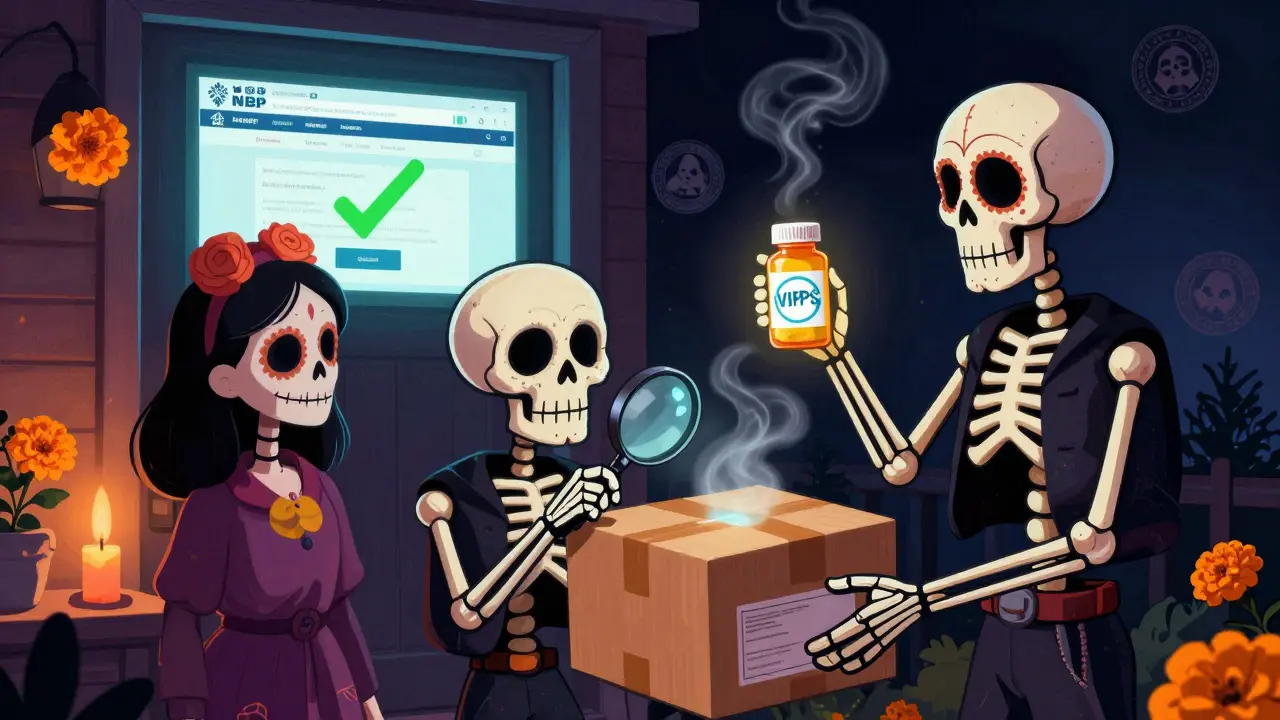
It takes five to ten minutes - but it could save your life. Here’s how:- Check the VIPPS seal. Go to nabp.pharmacy and use their database to search for the pharmacy by name. If it’s not there, it’s not safe.
- Look for the physical address. Click on the “Contact Us” page. Does it show a real street address? Call them. Ask if you can visit. Legitimate pharmacies will welcome the question.
- See if you can speak to a pharmacist. A real pharmacy will have a live chat, phone line, or email option to talk to a licensed pharmacist - not just a bot.
- Check for state licensure. Each state has its own pharmacy board. If the pharmacy ships to your state, it must be licensed there. Massachusetts, for example, started enforcing this in May 2025. If the site doesn’t mention state licensing, it’s a red flag.
- Don’t trust fake seals. Some scam sites use fake “NABP Verified” logos. Always go to the NABP site yourself to verify. Don’t click links from the pharmacy’s page.
Who’s Running the Legitimate Ones?
You’re not stuck with obscure websites. Major pharmacy chains run their own verified online services. CVS Caremark, Optum Rx, and Express Scripts together control over 55% of the legal online pharmacy market in the U.S. These are the same companies that run your local pharmacy - they just offer online ordering and home delivery. Many offer price matching, free shipping, and direct insurance billing. HealthWarehouse.com, a VIPPS-accredited site since 2004, has over 12,000 reviews on Trustpilot with a 4.6-star rating. Customers consistently mention “consistent medication quality” and “pharmacists who actually answer questions.” Compare that to unverified sites, which average just 1.8 stars, with complaints like “received empty bottles” or “no response after paying.”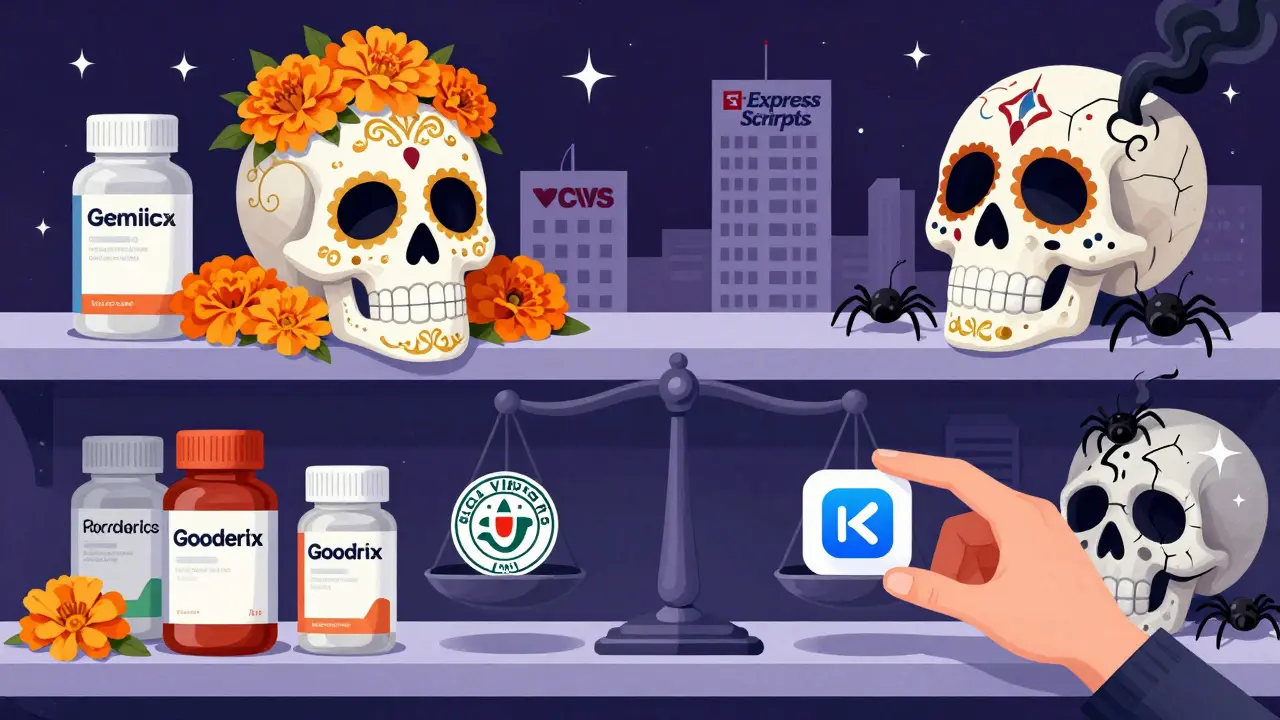
What’s Changing in 2025?
Regulation is tightening. The DEA now requires all telemedicine platforms that connect patients to pharmacies to register under one of three new categories: Special, Limited, or Advanced Telemedicine Prescribing. This means doctors can’t just email a prescription anymore - they have to use a verified system that checks patient identity and links to state drug monitoring programs. Missouri’s new rules, effective December 30, 2024, require pharmacies to notify customers if a package was exposed to extreme heat or cold during shipping. Maryland is following suit. And by 2027, 78% of legitimate pharmacies are expected to use blockchain to track every pill from manufacturer to your door - making counterfeits nearly impossible to slip through. The FDA is also deploying AI to scan websites and flag suspicious ones. In 2025, they issued 217 warning letters - up from 165 in 2024. Sites like MediSaveOnline.com and QuickPharmaRX were shut down after hundreds of customers reported receiving empty bottles or mislabeled drugs.What You Can Do Right Now
If you need to buy generics online:- Use GoodRx. It filters results to show only VIPPS-accredited pharmacies. Over 48 million Americans use it monthly.
- Check your insurance. Many plans cover mail-order prescriptions with low copays - sometimes cheaper than buying in-store.
- Report suspicious sites. The FDA’s online reporting system processed nearly 15,000 tips in Q1 2025. Your report helps protect others.
- Don’t assume “cheap” means “good.” If a price seems too good to be true, it probably is.
Final Thought: Safety Isn’t Optional
Online pharmacies aren’t inherently bad. They’re a necessary tool for millions of people. But safety has to come first. You wouldn’t buy medicine from a stranger on the street. Don’t buy it from a website that won’t tell you where it’s from, who’s behind it, or how to reach a real pharmacist. The tools to protect yourself exist. The information is public. The risks are real - and growing. You don’t need to be a tech expert to stay safe. Just take five minutes. Verify the site. Ask the questions. Choose the pharmacy that proves it’s legitimate - not the one that just looks like it is.Are online pharmacies legal in the U.S.?
Yes - but only if they’re licensed and verified. Legitimate online pharmacies must be accredited by the NABP’s VIPPS program, hold state pharmacy licenses, require valid prescriptions, and employ licensed pharmacists. Many major pharmacy chains like CVS and Walgreens operate verified online services. However, most websites claiming to sell prescription drugs are illegal and unregulated.
How can I tell if a generic drug from an online pharmacy is safe?
Only buy generics from VIPPS-accredited pharmacies. These sites source medications from FDA-approved manufacturers and maintain a 99.7% authenticity rate. Unverified sites often sell counterfeit or substandard generics - some with no active ingredient, others with dangerous overdoses. Check the NABP website to verify the pharmacy before purchasing.
Why are generic drugs cheaper online?
Legitimate online pharmacies reduce costs by cutting out middlemen, buying in bulk, and operating with lower overhead than brick-and-mortar stores. They pass these savings to customers - typically offering generics at 40% to 60% below retail prices. Illegitimate sites advertise even bigger discounts (70%-90%), but those savings come from selling fake, expired, or contaminated drugs.
What should I do if I received fake medication from an online pharmacy?
Stop taking the medication immediately. Contact your doctor to report any symptoms. Then report the pharmacy to the FDA using their online reporting system at fda.gov/safety/reporting-problems. You can also file a complaint with the NABP and your state’s pharmacy board. Keep all packaging, receipts, and pills - they may be needed for investigation.
Can I use GoodRx to find safe online pharmacies?
Yes. GoodRx filters results to show only VIPPS-accredited pharmacies. It’s used by over 48 million Americans monthly and is one of the easiest ways to compare prices from verified sources. Always double-check the pharmacy’s VIPPS status on the NABP website before ordering, even if GoodRx lists it.
Do I need a prescription to buy from an online pharmacy?
Yes - legally, you always need a valid prescription for prescription medications. Legitimate online pharmacies require a prescription from a licensed provider and verify it before dispensing. Any site that sells prescription drugs without one is breaking federal law. The Ryan Haight Act of 2008 made this mandatory, and enforcement has increased significantly since 2024.
Are international online pharmacies safe?
Generally, no. The FDA does not regulate foreign pharmacies, and many operate outside U.S. safety standards. Even if a site claims to be “based in Canada” or “UK-approved,” it may still be selling counterfeit drugs. Only pharmacies verified through VIPPS and based in the U.S. are guaranteed to meet federal safety requirements.
Sandeep Mishra
December 30, 2025 AT 20:17It's wild how we trust our lives to a website with a fancy logo and a discount banner. I've seen friends buy insulin from 'Canadian' sites only to get sugar pills. The real tragedy? They didn't even know until their blood sugar crashed. We need more community-led verification networks - not just government seals. Sometimes, the people who've been burned are the ones who know best.
And yeah, generics aren't the problem. The lack of transparency is. 💭
Joseph Corry
December 31, 2025 AT 20:53Let’s be honest - the entire ‘online pharmacy’ industry is a regulatory arbitrage play. You’re not ‘saving money’ - you’re externalizing risk onto the consumer. The FDA’s 99.7% authenticity rate applies to *regulated* channels. When you opt out of that system, you’re not a savvy shopper - you’re a lab rat in a poorly designed experiment. The fact that people still fall for this speaks to the collapse of pharmaceutical literacy in the post-truth era.
Also, ‘GoodRx’ is just a glorified affiliate marketing platform. Don’t mistake convenience for safety.
Colin L
January 1, 2026 AT 06:22Look, I get it - I’ve been there. My mom was on blood pressure meds, couldn’t drive, and the local pharmacy charged $200 a month. We found a site that offered it for $30. We thought we were heroes. Then she started having dizziness, confusion - we thought it was aging. Turns out, the pills were laced with fentanyl analogs. She ended up in the ICU for three weeks. I didn’t even know what a ‘fentanyl analog’ was until then.
Now I spend hours every week verifying every pharmacy. I call them. I ask for their state license number. I check the NABP database. I print out the verification page and keep it with her meds. It’s exhausting. But I’d rather be paranoid than bury another family member.
And yes, I cried reading your post. Because I know how many people still don’t get it. And they’re going to die because they thought a discount was worth the risk.
kelly tracy
January 1, 2026 AT 16:32srishti Jain
January 2, 2026 AT 04:22Cheyenne Sims
January 2, 2026 AT 22:42The integrity of the U.S. pharmaceutical supply chain is a matter of national security. The proliferation of unregulated online pharmacies constitutes a systemic threat to public health infrastructure. The FDA’s recent deployment of AI-driven monitoring is not merely a regulatory update - it is a necessary corrective to a decades-long erosion of enforcement standards. Any citizen who chooses to circumvent verified channels is not exercising autonomy - they are enabling criminal enterprise.
Furthermore, the normalization of ‘discount’ pharmaceuticals undermines the economic viability of legitimate manufacturers and pharmacists who operate under stringent compliance regimes. This is not a consumer choice. It is a moral failure.
Shae Chapman
January 4, 2026 AT 03:00THIS. THIS RIGHT HERE. 😭 I’ve been buying my anxiety meds online for years because I live in the middle of nowhere and my insurance won’t cover the local pharmacy’s prices. I always check VIPPS, I call the pharmacists, I ask questions. I even saved the email where one pharmacist told me my dose might interact with my thyroid med - saved my life.
But I swear, every time I see someone say ‘it’s just a pill, how bad can it be?’ I want to scream. It’s not just a pill. It’s your heartbeat. Your brain. Your future.
Thank you for writing this. I’m sharing it with my entire family. ❤️
Nadia Spira
January 4, 2026 AT 16:57The entire premise is flawed. You’re treating ‘legitimacy’ as if it’s a binary - verified or not. But the regulatory framework itself is a corporate capture mechanism. The VIPPS seal? It’s a membership club for pharmacies that can afford the compliance overhead. Meanwhile, small, ethical foreign suppliers - often producing identical generics under WHO-GMP standards - are demonized because they don’t pay the U.S. bureaucratic tax.
Also, ‘FDA-approved’ doesn’t mean ‘safe.’ It means ‘approved after a 12-month review process that’s been gamed by pharma lobbyists.’
Stop conflating compliance with ethics. The real danger isn’t the unverified site - it’s the system that makes you feel like you have no other choice.
henry mateo
January 6, 2026 AT 11:59i read this whole thing and i just want to say… thank you. i’ve been buying my diabetes meds from a vipps site for 3 years now. my insurance sucks and the cash price at the store was killing me. i was scared at first but i checked the address, called the pharmacist, and they even mailed me a free sample vial to test before shipping my full prescription. i didn’t know what to look for until i found this post. now i tell everyone i know. just… please, check the site. don’t just click ‘buy now’. you’re worth more than that.
Kunal Karakoti
January 7, 2026 AT 09:47There’s a deeper question here: Why do we treat medicine as a commodity? In a world where access to health is determined by income and geography, online pharmacies are not a flaw - they’re a symptom. We’re not just buying pills. We’re buying dignity, autonomy, survival. The real villain isn’t the scam site. It’s a system that forces people to gamble with their lives just to afford treatment.
Let’s fix the system. Not just the websites.
Kelly Gerrard
January 8, 2026 AT 23:16Glendon Cone
January 9, 2026 AT 04:22Big shoutout to the folks who take the time to verify pharmacies - you’re the unsung heroes of this whole mess. I used to be the guy who clicked ‘$5 for 90 pills’ without a second thought. Then I lost a friend to a fake blood thinner. Never again.
Now I use GoodRx + NABP check + call the pharmacist. Takes 10 minutes. Feels like a ritual. Like saying a prayer before you drive. It’s not paranoia - it’s responsibility.
Also, if you’re on insulin? Don’t even think about shipping unless they say it’s temperature-controlled. I’ve seen the melt charts. It’s terrifying. 🥶
Henry Ward
January 9, 2026 AT 05:07You’re all just naive. This whole ‘verify the pharmacy’ nonsense is a distraction. The real problem? The pharmaceutical industry is a cartel. They inflate prices so high that people are forced into the shadows. Then they cry ‘fraud!’ when people try to survive. The ‘VIPPS’ seal? A marketing tactic to keep you loyal to the same overpriced system.
I’ve bought from international sites for 8 years. Never had a problem. The FDA doesn’t care about you - they care about profits. Stop being their puppet.