Anticoagulant Reversal Agent Decision Tool
Step 1: Patient Profile & Constraints
Step 2: Compare Agents
Select to highlightIdarucizumab
Specific for Dabigatran
Andexanet Alfa
Specific for Factor Xa
4F-PCC + Vit K
Versatile / Warfarin/DOAC
Select a patient profile above and click the button to see a tailored recommendation.
Imagine a patient in the emergency room with a severe brain bleed, but their blood is too thin to clot. For doctors, this is a race against time. The solution lies in anticoagulant reversal agents, specialized drugs that stop the effects of blood thinners instantly. While some patients are on older medications like warfarin, others take newer direct oral anticoagulants (DOACs) such as apixaban or rivaroxaban. Each type of blood thinner requires a specific antidote or strategy to manage life-threatening bleeding effectively.
The medical landscape for reversing these drugs has changed dramatically in the last decade. We now have targeted antibodies and decoy proteins designed for modern drugs, alongside older, proven methods using concentrates and vitamins. Understanding which agent to use when is critical for saving lives and preventing complications like stroke or heart attack after treatment.
Key Takeaways
- Idarucizumab is the specific antidote for dabigatran, working within minutes and showing lower mortality rates in major studies.
- Andexanet alfa reverses factor Xa inhibitors like apixaban and rivaroxaban but carries a higher risk of thromboembolic events compared to other options.
- Prothrombin Complex Concentrate (PCC) serves as a versatile backup for both warfarin and DOACs, offering rapid correction at a significantly lower cost.
- Vitamin K is essential for long-term warfarin reversal but takes up to 24 hours to work, so it must be paired with PCC for emergencies.
- Cost and hospital availability heavily influence clinical decisions, with PCC being more widely stocked than expensive specific reversal agents.
Understanding the Specific Reversal Agents
Modern medicine has developed precise tools for modern drugs. When a patient taking dabigatran bleeds severely, clinicians reach for idarucizumab. This humanized monoclonal antibody fragment binds directly to dabigatran, neutralizing its effect. In the RE-VERSE AD trial, published in the New England Journal of Medicine, idarucizumab reversed anticoagulation within five minutes. It is administered as two 2.5g intravenous infusions, totaling 5g. Its speed and safety profile make it the preferred choice in many emergency departments, with a mortality rate of just 11% in meta-analyses of intracranial hemorrhage cases.
For patients on factor Xa inhibitors like apixaban, rivaroxaban, or edoxaban, andexanet alfa is the designated specific agent. Developed by Portola Pharmaceuticals, this modified factor Xa decoy protein works by trapping the drug molecules. However, it requires a more complex administration protocol: a 400mg IV bolus followed by a 4mg/min infusion for 120 minutes. While effective, the ANNEXA-4 trial noted a half-life of about one hour, meaning redosing might be necessary. More importantly, data from JAMA Network Open indicates a higher rate of thromboembolic events (14%) compared to other agents, leading some clinicians to hesitate before using it unless absolutely necessary.

The Role of Prothrombin Complex Concentrates and Vitamin K
Not every hospital stocks the expensive, brand-name specific agents. This is where Prothrombin Complex Concentrate (PCC) becomes a lifeline. PCC contains coagulation factors II, VII, IX, and X. It was originally designed for warfarin reversal but is increasingly used off-label for DOACs. Four-factor PCC (4F-PCC) corrects INR levels rapidly, often within 30 minutes. Dosing depends on the patient's weight and current INR, typically ranging from 25 to 50 units per kilogram. Because PCC provides immediate factors but has a short half-life, it is almost always paired with Vitamin K.
Vitamin K is the oldest reversal agent, dating back to the 1940s. It helps the liver produce new clotting factors, but this process is slow. Intravenous vitamin K takes 4 to 6 hours for initial effect and up to 24 hours for full reversal. Therefore, you never use vitamin K alone for an emergency bleed; it is the maintenance therapy that prevents rebound anticoagulation after the PCC wears off. This combination offers a robust, cost-effective strategy that remains a cornerstone of hematology practice, especially in resource-limited settings.
Comparing Efficacy, Safety, and Cost
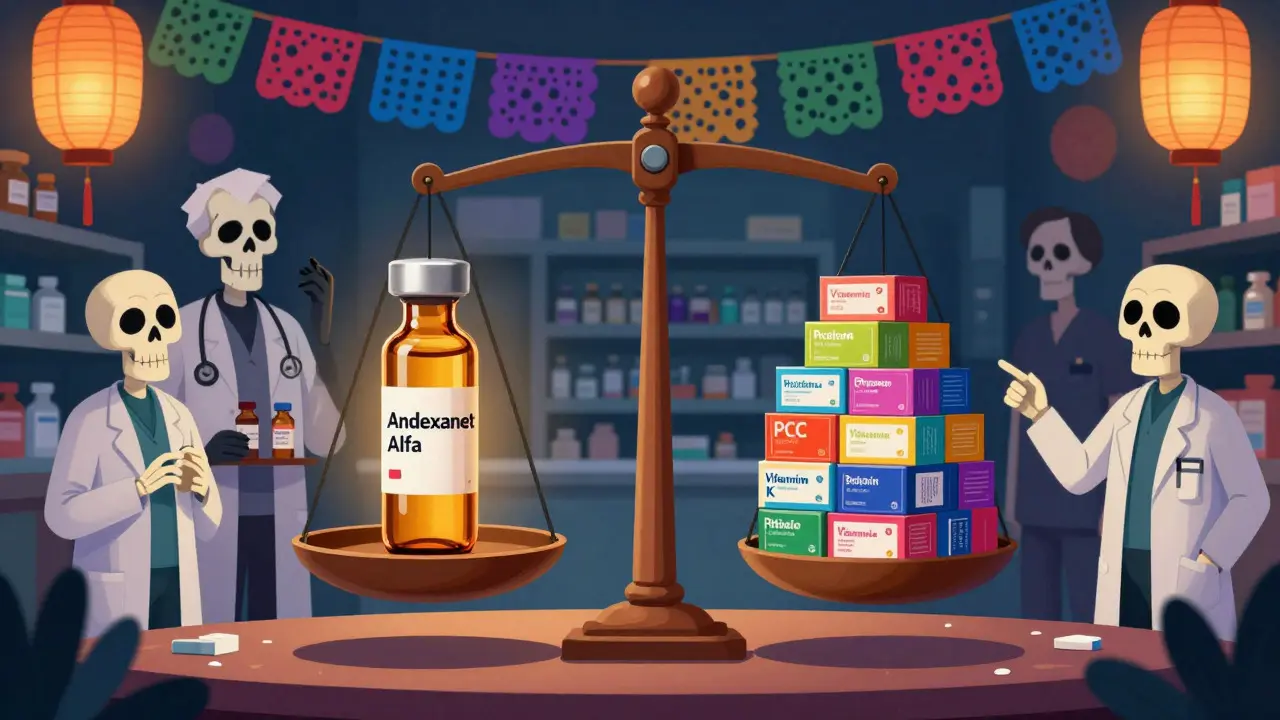
Choosing the right agent isn't just about pharmacology; it's about balancing outcomes, risks, and resources. A 2022 meta-analysis in JAMA Network Open compared these agents in over 1,800 patients with intracranial hemorrhage. The results showed that while all agents successfully reversed anticoagulation, the outcomes varied. Idarucizumab had the lowest mortality rate at 11%, followed by andexanet alfa at 24% and 4F-PCC at 26%. However, the safety profile tells a different story. Andexanet alfa was associated with a 14% rate of thromboembolic events, whereas 4F-PCC saw only 8%, and idarucizumab just 5%. This trade-off between mortality reduction and clotting risk is a major point of debate among experts.
| Agent | Target Drug | Onset of Action | Mortality Rate (ICH) | Thromboembolic Risk | Approximate Cost |
|---|---|---|---|---|---|
| Idarucizumab | Dabigatran | 5 minutes | 11% | 5% | $3,500 |
| Andexanet Alfa | Apixaban/Rivaroxaban | 2-5 minutes | 24% | 14% | $13,500 |
| 4F-PCC + Vit K | Warfarin/DOACs | 15-30 minutes | 26% | 8% | $1,200-$2,500 |
Cost plays a massive role in real-world application. Andexanet alfa is the most expensive option, costing around $13,500 per treatment course. According to 2023 American Hospital Association data, only 65% of US hospitals keep it in stock. In contrast, PCC is cheaper and universally available. This financial reality means that many emergency physicians rely on 4F-PCC as a first-line alternative for DOAC-related bleeds, despite it being off-label, simply because it is accessible and affordable.
Clinical Decision-Making and Practical Challenges
In the chaos of an emergency department, decision-making must be fast. Guidelines from the American College of Chest Physicians suggest preferring specific reversal agents when they are immediately available. If not, 4F-PCC is a viable and recommended alternative. For warfarin users, the protocol is clear: give 4F-PCC for immediate effect and vitamin K for sustained reversal. For DOAC users, if idarucizumab or andexanet alfa are on the shelf, use them. If not, PCC becomes the standard of care.
Training and documentation also vary. Administering idarucizumab is straightforward, requiring minimal training. Andexanet alfa, however, involves a complex infusion protocol that demands specialized knowledge and careful monitoring. This complexity can delay treatment if staff are not well-trained. Furthermore, the lack of head-to-head trials comparing these agents directly means clinicians must rely on observational data and expert consensus. As Dr. Joshua N. Goldstein noted, the goal is lowering the risk of hemorrhage expansion, but interpreting the data requires caution due to the absence of direct comparisons.
Future Directions and Emerging Therapies
The field is evolving. Researchers are looking at universal reversal agents that could work for multiple types of blood thinners. Ciraparantag, a synthetic small molecule, is currently in Phase III trials. Unlike current agents, it may reverse heparin, low molecular weight heparin, and various DOACs. If approved, it could simplify hospital formulary management and reduce costs. Additionally, extended infusion protocols for andexanet alfa are being studied to potentially lower the thromboembolic risk without sacrificing efficacy.
As DOAC prescriptions continue to rise, reaching 15 million annually in the US, the demand for effective reversal strategies will grow. The market for these agents is projected to expand, driven by the need to manage bleeding in an aging population on chronic anticoagulation. Balancing innovation with accessibility will remain the central challenge for healthcare systems worldwide.
What is the fastest acting anticoagulant reversal agent?
Idarucizumab is generally considered the fastest, reversing the effects of dabigatran within five minutes of administration. Andexanet alfa also acts quickly, typically within 2 to 5 minutes, but requires a longer infusion process.
Can PCC be used to reverse DOACs?
Yes, four-factor PCC (4F-PCC) is frequently used off-label to reverse direct oral anticoagulants (DOACs) like apixaban and rivaroxaban, especially when specific reversal agents like andexanet alfa are unavailable or too costly.
Why is Vitamin K given with PCC?
PCC provides immediate clotting factors but has a short half-life. Vitamin K helps the liver produce new factors over the next 24 hours, preventing the anticoagulant effect from returning once the PCC wears off.
Which reversal agent has the highest risk of causing clots?
Andexanet alfa is associated with a higher rate of thromboembolic events (around 14%) compared to idarucizumab (5%) and 4F-PCC (8%). This risk is a significant consideration in clinical decision-making.
Is andexanet alfa available in all hospitals?
No, availability varies. According to recent data, only about 65% of US hospitals stock andexanet alfa due to its high cost ($13,500 per course). PCC and vitamin K are much more widely available.