Warfarin & NSAID Bleeding Risk Calculator
Calculate Your Bleeding Risk
This tool estimates your increased bleeding risk when taking warfarin with NSAIDs based on your specific factors.
Every year, millions of people take warfarin to prevent dangerous blood clots-especially if they have atrial fibrillation, a mechanical heart valve, or a history of deep vein thrombosis. At the same time, countless others reach for over-the-counter NSAIDs like ibuprofen or naproxen for a headache, sore knee, or back pain. What most don’t realize is that combining these two can turn a simple pain reliever into a silent threat. The risk isn’t just theoretical. It’s real, measurable, and often deadly.
Why This Combination Is So Dangerous
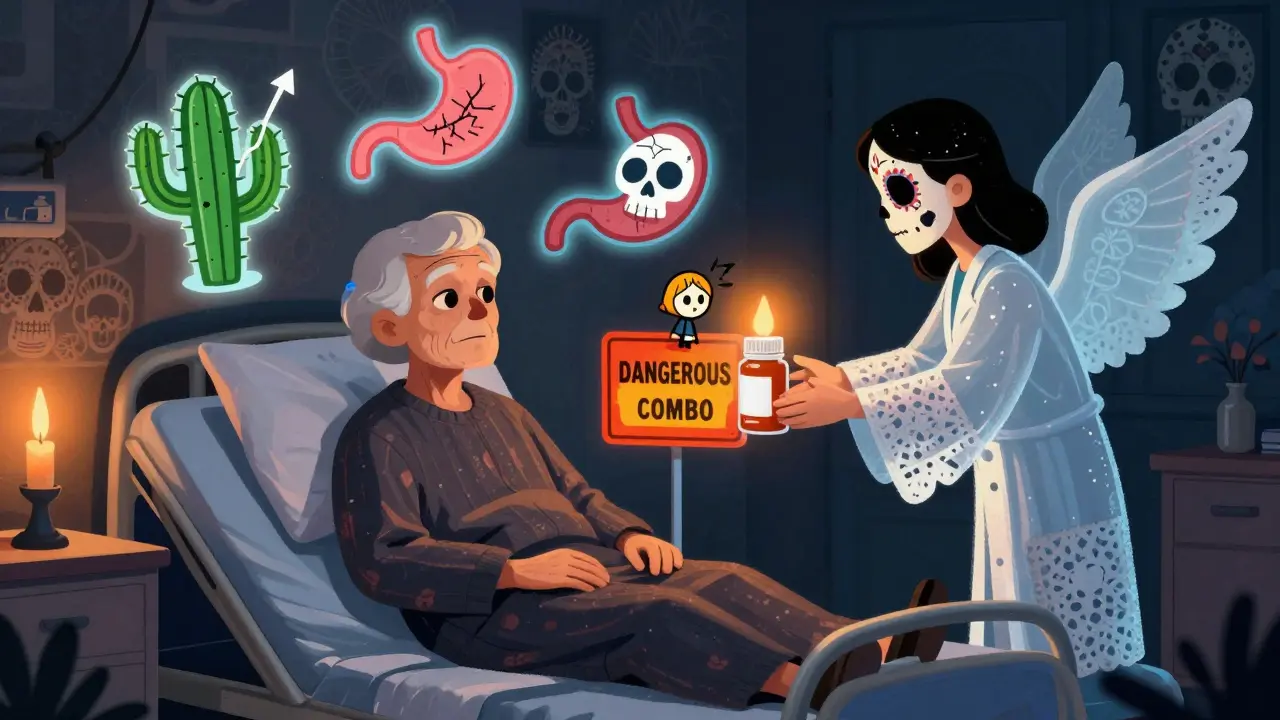
Warfarin works by blocking vitamin K, which your body needs to make clotting factors. Without those factors, blood takes longer to clot. That’s the whole point-you’re preventing clots that could cause strokes or pulmonary embolisms. But NSAIDs? They do something completely different. They shut down an enzyme called COX, which doesn’t just cause inflammation-it’s also needed for platelets to stick together and form clots. So now you’ve got two systems working against clotting: one from warfarin, one from the NSAID. It’s like turning off two brakes on a car at once. The result? A much higher chance of bleeding.Studies show that people taking both warfarin and NSAIDs have more than double the risk of bleeding compared to those on warfarin alone. That’s not a small increase. That’s a 2.09-fold jump in risk, according to a 2023 study from Aarhus University Hospital. And it’s not just about stomach bleeds. Intracranial bleeding-the kind that causes strokes-rises by 3.22 times. Gastrointestinal bleeding? Up 2.24 times. Even bleeding in the lungs or urinary tract goes up.
Not All NSAIDs Are Created Equal
You might think all painkillers are the same when it comes to bleeding risk. They’re not. Some are far worse than others. Naproxen is the most dangerous, increasing bleeding risk by 4.1 times compared to warfarin alone. Diclofenac isn’t far behind at 3.3 times. Even ibuprofen, which many assume is “safe,” still raises the risk by nearly 80%. Meloxicam, often prescribed for arthritis, is another high-risk offender.And here’s the twist: the so-called “safer” NSAIDs-COX-2 inhibitors like celecoxib-are just as dangerous. Early hopes that they wouldn’t affect platelets turned out to be wrong. A 2020 meta-analysis confirmed that celecoxib and rofecoxib (now pulled from the market) still double the risk of GI bleeding when taken with warfarin. The idea that “selective” means “safe” is a myth.
Who’s at Highest Risk?
It’s not just about taking both drugs. Certain factors make bleeding far more likely. If you’re on more than 40 mg of warfarin per week, your risk spikes. If you’re already on other medications-like antibiotics or antifungals-that interact with warfarin, you’re in even more danger. And if your INR (the test that measures how long your blood takes to clot) is already low when you start an NSAID, your body has less room to handle the added stress. One study found that 39.8% of warfarin users saw their INR jump by 15% or more after adding an NSAID.Age matters too. People over 75 face a 3.7 times higher risk of bleeding when combining these drugs. That’s why the 2024 American College of Chest Physicians guidelines now specifically warn older adults. And don’t assume that because you feel fine, you’re safe. Many bleeding events happen without warning. A patient might wake up with bruising they don’t remember, or notice dark, tarry stools-signs of internal bleeding-only after it’s too late.
What About the Newer Blood Thinners?
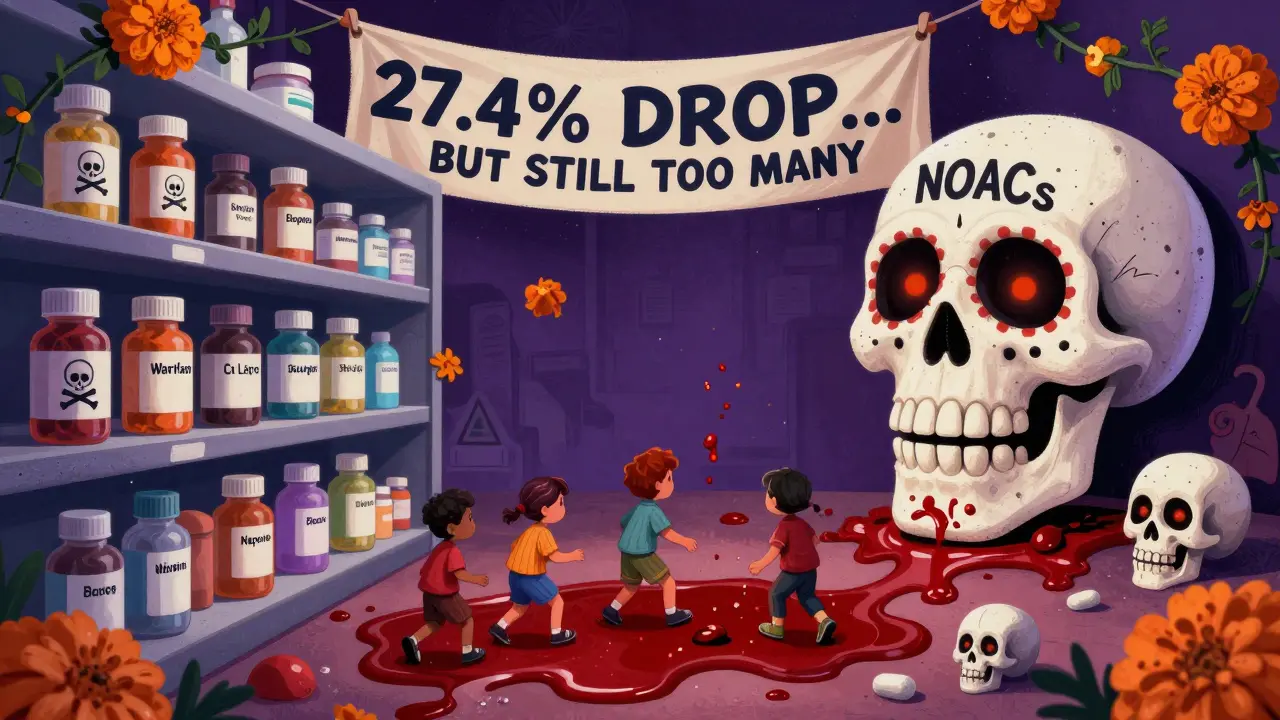
A lot of people switch from warfarin to newer drugs like apixaban, dabigatran, or rivaroxaban because they don’t need regular blood tests. But that doesn’t mean they’re safer with NSAIDs. Research from the ARISTOTLE trial showed that even with apixaban, NSAID use still increased bleeding risk. A 2020 study found that dabigatran had slightly lower bleeding risk than warfarin when combined with NSAIDs, but rivaroxaban was just as risky. The bottom line? No oral anticoagulant is safe with NSAIDs. The belief that “NOACs are safer with painkillers” is dangerously wrong-and it’s getting worse. Between 2015 and 2022, NSAID use with NOACs increased by 34.8%, even as use with warfarin dropped.Real Stories, Real Consequences
Behind the statistics are people who ended up in emergency rooms. One Reddit user wrote: “I took ibuprofen for a headache while on warfarin. My hemoglobin dropped from 14 to 8 in 24 hours. I was hospitalized for three days.” That’s not rare. A 2021 analysis of over 5,000 warfarin users found that 78.4% of those who bled after taking NSAIDs needed hospitalization. On average, they stayed in the hospital 5.2 days-longer than most other bleeding causes.The FDA’s adverse event database recorded over 1,800 bleeding events linked to warfarin-NSAID combinations between 2015 and 2020. Sixty-two percent of those were gastrointestinal. And on Drugs.com, 87% of 1,452 reviews about this combo warn others not to take it. The average safety rating? 2.1 out of 10.
What Should You Do Instead?
The safest pain reliever for people on warfarin is acetaminophen (Tylenol). It doesn’t affect platelets or the stomach lining. About 23.5% of warfarin users already use it as their go-to alternative. Topical pain creams-like those with diclofenac or menthol-are another good option. They deliver pain relief without systemic effects. And for chronic pain, physical therapy, heat/cold therapy, or even acupuncture can be effective without the risk.If you absolutely must take an NSAID-for example, after surgery or for severe arthritis-do it under strict supervision. The Anticoagulation Forum recommends:
- Use the lowest possible dose for the shortest time-no more than a few days.
- Avoid naproxen, meloxicam, and diclofenac. If you must use one, choose ibuprofen.
- Get your INR checked before starting the NSAID.
- Check it again 3 to 5 days after starting, then weekly while taking it.
- Take a proton pump inhibitor (like omeprazole) to protect your stomach.
- Know the signs of bleeding: unusual bruising, blood in urine or stool, severe headaches, dizziness, vomiting blood.
Why Doctors Still Prescribe This Combo
You’d think with all this evidence, doctors would stop prescribing NSAIDs to warfarin patients. But they don’t. A 2023 analysis found that 42.6% of warfarin users still get NSAID prescriptions each year. Why? Because patients don’t tell their doctors they’re taking over-the-counter painkillers. A University of Michigan study found that in 68.2% of warfarin-related bleeding cases, the patient hadn’t mentioned the NSAID use. And even when they do, many electronic health records don’t flag the interaction. Only 58.3% of U.S. hospitals have systems that warn doctors about this specific combo.Also, many patients think NSAIDs are harmless because they’re available without a prescription. They don’t realize that “over-the-counter” doesn’t mean “safe with everything.” A 2022 study showed that nearly half of patients on warfarin didn’t know NSAIDs could be dangerous.
The Economic Cost of Ignoring the Warning
This isn’t just a health issue-it’s a financial one. In 2022, warfarin-NSAID bleeding events cost the U.S. healthcare system $1.87 billion. That’s hospital stays, emergency visits, blood transfusions, and follow-up care. For every bleeding event, the average cost exceeds $15,000. Preventing just one case saves more than the cost of a year’s worth of physical therapy or a topical pain patch.What’s Changing?
There’s some progress. Between 2015 and 2022, co-prescribing of warfarin and NSAIDs dropped by 27.4%. That’s thanks to more people switching to NOACs and better education. But the rise in NSAID use with NOACs shows the problem is shifting, not disappearing. The 2024 American College of Chest Physicians guidelines will now say clearly: avoid all NSAIDs with all oral anticoagulants. No exceptions. No gray areas.Future solutions are coming too. Researchers are working on new painkillers that don’t affect platelets. Others are developing genetic tests to find people who metabolize warfarin unusually slowly-making them even more vulnerable. And AI tools are being built to scan prescriptions and alert doctors before they write a dangerous combo.
For now, the message is simple: if you’re on warfarin-or any blood thinner-don’t take NSAIDs unless your doctor tells you to, and even then, only under strict monitoring. Your life isn’t worth the risk of a headache.
Can I take ibuprofen with warfarin if I only use it once in a while?
Even occasional use of ibuprofen with warfarin increases your bleeding risk by nearly 80%. There’s no safe “occasional” dose. The interaction happens quickly-sometimes within 24 to 48 hours. If you need pain relief, use acetaminophen instead. If you must use ibuprofen, get your INR checked before and 3-5 days after taking it, and only do so under direct medical supervision.
Are topical NSAIDs safe with warfarin?
Topical NSAIDs like diclofenac gel or patches are generally safer because very little of the drug enters your bloodstream. Studies show they don’t significantly affect INR or platelet function. They’re a good alternative for joint or muscle pain. But even these should be used cautiously-don’t apply them over large areas or for long periods without checking with your doctor.
What should I do if I accidentally took an NSAID while on warfarin?
Stop taking the NSAID immediately. Contact your anticoagulation clinic or doctor right away. They’ll likely want to check your INR within 24-48 hours. Watch closely for signs of bleeding: unusual bruising, nosebleeds, dark or bloody stools, pink or red urine, severe headaches, or dizziness. If you notice any of these, go to the ER. Don’t wait.
Why does my doctor keep prescribing NSAIDs if they’re so risky?
Some doctors aren’t fully aware of the latest guidelines, or they assume the patient is using NSAIDs only occasionally. Others may not realize the patient is on warfarin if it’s not clearly documented. It’s also common for patients to not mention OTC meds. If your doctor prescribes an NSAID, ask: “Is this safe with my blood thinner?” and suggest acetaminophen or a topical option as an alternative.
Can I use aspirin instead of other NSAIDs?
No. Aspirin is also an NSAID and a powerful antiplatelet drug. It increases bleeding risk just like ibuprofen or naproxen. In fact, it’s often used to prevent clots in low doses-but never combine it with warfarin unless your doctor specifically tells you to. Even then, it’s done with extreme caution and close monitoring.
How often should I get my INR checked if I’m on warfarin and need pain relief?
If you’re on warfarin and must take an NSAID, check your INR before starting, then again 3-5 days after. After that, check weekly until you stop the NSAID. Once you’re off it, continue monitoring for another week or two, as the effects can linger. Never assume your INR is stable just because you feel fine. Bleeding can happen without symptoms until it’s severe.
phara don
February 2, 2026 AT 03:22Ellie Norris
February 3, 2026 AT 22:18Marc Durocher
February 5, 2026 AT 19:30larry keenan
February 6, 2026 AT 00:56Nick Flake
February 6, 2026 AT 07:15Akhona Myeki
February 7, 2026 AT 20:03Chinmoy Kumar
February 9, 2026 AT 05:28Vatsal Srivastava
February 10, 2026 AT 07:37Brittany Marioni
February 11, 2026 AT 23:55Ansley Mayson
February 13, 2026 AT 00:25Eli Kiseop
February 13, 2026 AT 13:56Becky M.
February 15, 2026 AT 04:09clarissa sulio
February 17, 2026 AT 01:22Monica Slypig
February 17, 2026 AT 07:23jay patel
February 17, 2026 AT 09:58