What Exactly Are Basal and Squamous Cell Carcinomas?
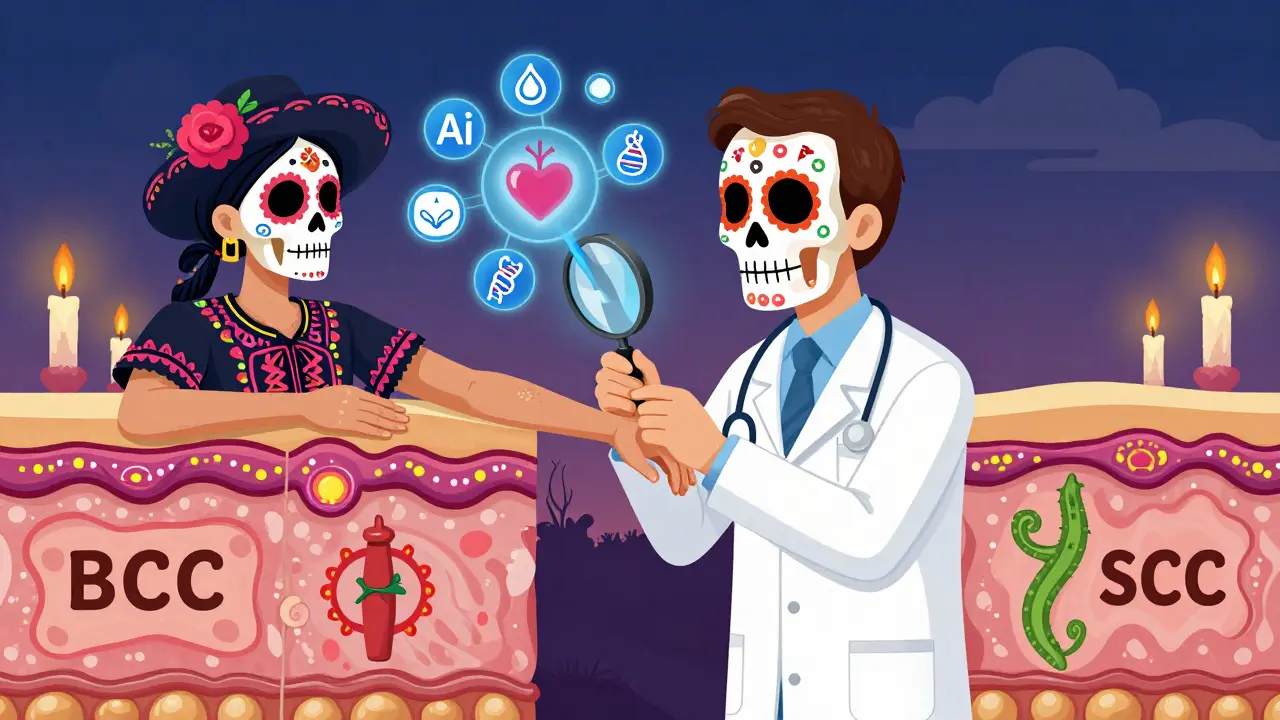
Basal cell carcinoma (BCC) and squamous cell carcinoma (SCC) are the two most common types of skin cancer you’ve never heard of-until you or someone you know gets diagnosed. Together, they make up about 95% of all nonmelanoma skin cancers. That’s more than 5 million cases diagnosed each year in the U.S. alone. You might think, "It’s just skin cancer," but these two aren’t the same. One grows slowly and rarely spreads. The other can turn dangerous fast if ignored.
BCC starts in the deepest layer of your epidermis-the basal cells. These are the cells that keep making new skin. As they rise to the surface, they flatten out and become squamous cells. SCC begins in those flattened cells near the top. So, even though they’re neighbors in your skin, they behave very differently.
How Do They Look Different?
Spotting them early saves your skin-and sometimes your life. BCC usually shows up as a shiny, pearly bump, often mistaken for a harmless mole or pimple. It might look like a sore that won’t heal, or a scar-like patch that’s slightly waxy. These are common on the nose, ears, and forehead-places you’ve probably sunburned over the years.
SCC looks different. It’s often a firm, red bump that feels rough or scaly. Sometimes it looks like a wart, or a flat, reddish patch that cracks and bleeds. Unlike BCC, SCC can grow quickly. People report noticing a bump change size in just weeks. If it’s on your lip, ear, or genitals, that’s a red flag. Those spots have a higher chance of spreading.
Which One Is More Dangerous?
BCC is more common-about 8 out of 10 nonmelanoma skin cancers. But SCC is more serious. Here’s why: BCC spreads to other parts of the body in fewer than 0.1% of cases. That’s practically unheard of. SCC? It spreads in 2% to 5% of cases. On high-risk areas like the lips, that number jumps to 14%.
When SCC spreads, survival rates drop sharply. If caught early, the 5-year survival rate is over 95%. But once it spreads, that number falls to 25-45%. BCC doesn’t usually threaten life, but it can destroy tissue. Left untreated for two years, 70% of advanced BCCs invade deep into skin, cartilage, or even bone.
Doctors treat SCC more aggressively because of this. If it’s larger than 2 cm, deeper than 2 mm, or on your ear or lip, they’ll use wider surgical margins and sometimes combine treatments. BCC? A simple shave or local excision often does the trick.

Who Gets These Cancers-and Why?
Most cases happen after age 50. About 85% of patients are over 50, with the average diagnosis age at 67 for both. But men are more likely to get SCC-65% of cases are in men. Why? More time spent outdoors in jobs like construction, farming, or fishing. BCC affects men and women almost equally.
The main cause? UV radiation. Not just sunburns-cumulative exposure matters more for SCC. Daily sun exposure over decades adds up. BCC is more linked to intense, occasional burns-like a bad beach day in your 20s. People with fair skin, blue eyes, or red hair are at higher risk. But darker skin isn’t immune. SCC can show up on palms, soles, or scars in people of color.
Immunosuppressed people face the biggest risk. Organ transplant recipients are 250 times more likely to develop SCC than the average person. Their bodies can’t fight off the DNA damage from UV light. BCC risk goes up too-but only 10 times.
Treatment: What to Expect
Both cancers are highly curable when caught early. For small, low-risk BCC, topical creams like imiquimod or 5-fluorouracil work in 60-70% of cases. SCC? Those creams only clear 40-50% of lesions. Surgery is the gold standard.
Mohs surgery-where layers of skin are removed and checked under a microscope-is the most effective. It cures 99% of new BCCs and 97% of new SCCs. But SCC often needs more tissue removed because it grows deeper. That means bigger scars and more reconstructive surgery. One study found 45% of SCC patients needed skin grafts or flaps, compared to 28% of BCC patients.
Follow-up is also different. SCC patients have 2.3 times more check-ups. Why? Recurrence is more common. 73% of SCCs come back within a year. BCCs? Only 18% recur within 18 months. If you’ve had one SCC, your risk of another is high. Regular skin checks every 3-6 months are essential.
What’s New in Treatment?
There’s hope for advanced cases. In 2018, the FDA approved cemiplimab (Libtayo), the first immunotherapy for metastatic SCC. It works by helping your immune system attack cancer cells. In trials, it shrank tumors in nearly half of patients who had no other options. That’s a big jump from old chemo, which only worked in 20%.
For BCC, drugs like vismodegib block the hedgehog pathway-a key driver of these tumors. They work well for advanced cases, but aren’t used for early ones. For SCC? No equivalent yet. Researchers are working on it.
AI tools are getting better at spotting the difference. In early tests, AI algorithms analyzed skin images and correctly identified BCC vs. SCC 94% of the time. That’s better than many dermatologists. Soon, your phone camera might help flag suspicious spots before you even see a doctor.
Can You Prevent These Cancers?
Yes. And it’s simpler than you think. Daily sunscreen use cuts BCC risk by 40% and SCC risk by 50%. Why the difference? SCC is tied to long-term sun exposure. Sunscreen helps block that slow damage. BCC is more about sudden burns, so sunscreen helps, but wearing hats and avoiding midday sun matters more.
Wear UPF 50+ clothing. Seek shade. Don’t tan. Avoid tanning beds-they’re a major cause of both cancers. If you’ve had one skin cancer, your chance of getting another within five years is 50%. Prevention isn’t optional-it’s survival.
What Do Patients Really Experience?
Real stories tell you what no medical textbook can. On patient forums, BCC patients often say, "I thought it was just a pimple." Many didn’t see a doctor for months. SCC patients? They’re more anxious. They notice rapid changes. One Reddit user wrote, "It doubled in size in three weeks. I was terrified it was going to spread."
Recovery is different too. BCC patients usually have one treatment and move on. SCC patients often need multiple procedures, more follow-ups, and longer healing times. Cosmetic outcomes matter-especially on the face. But the emotional toll is heavier with SCC. Fear of recurrence, fear of metastasis, fear of disfigurement-it’s real.
Final Takeaway: Know the Difference
BCC is common. SCC is serious. One is a slow creep. The other is a sprint. Both are preventable. Both are treatable-if you catch them early.
Check your skin monthly. Look for new bumps, sores that don’t heal, or spots that change color or size. Don’t wait for a doctor to find it. You’re your first line of defense. If you’re over 50, have fair skin, or spend time outdoors, get a full-body skin exam every year. If you’ve had one skin cancer, get checked every 6 months.
It’s not about fear. It’s about awareness. Your skin changes every day. Learn what’s normal for you. And if something looks off? See a dermatologist. Don’t Google it. Don’t wait. A small spot today could be a big problem tomorrow.
Can basal cell carcinoma turn into squamous cell carcinoma?
No. Basal cell carcinoma and squamous cell carcinoma are two separate types of skin cancer that start from different cells in the skin. One doesn’t transform into the other. However, a person can develop both types at different times, especially if they have a history of sun damage or previous skin cancers. Having one increases your overall risk of developing another type, but they remain distinct diseases.
Is squamous cell carcinoma more dangerous than basal cell carcinoma?
Yes, in terms of potential to spread. While BCC rarely metastasizes (less than 0.1% of cases), SCC can spread to lymph nodes or other organs in 2-5% of cases. When it does, survival rates drop sharply. SCC is also more likely to invade deeper tissues, requiring more aggressive treatment. However, both are highly curable when caught early-so timing matters more than the type.
How fast does squamous cell carcinoma grow compared to basal cell carcinoma?
SCC grows about 3 times faster than BCC on average. BCC typically expands at 0.5-1.0 cm per year. SCC can grow 1.5-2.0 cm per year, and aggressive forms may double in size within 4-6 weeks. This rapid growth is why SCC often causes more concern and requires quicker intervention.
Can sunscreen prevent both types of skin cancer?
Yes, but it works better against SCC. Daily sunscreen use reduces SCC risk by about 50%, because SCC is strongly linked to long-term, cumulative UV exposure. BCC risk drops by about 40%, since it’s more tied to intense, intermittent sunburns. For best protection, combine sunscreen with hats, sunglasses, and shade during peak sun hours (10 a.m. to 4 p.m.).
Do I need to see a dermatologist if I’ve had one skin cancer?
Absolutely. People who’ve had one nonmelanoma skin cancer have a 50% chance of developing another within five years. After BCC, checkups every 12-18 months are recommended. After SCC, every 6 months is standard-because recurrence is more common and happens faster. Early detection saves lives, and dermatologists can spot changes you might miss.
Anu radha
December 16, 2025 AT 20:07Sachin Bhorde
December 16, 2025 AT 22:27Evelyn Vélez Mejía
December 18, 2025 AT 05:32Nishant Desae
December 19, 2025 AT 02:05Anna Giakoumakatou
December 19, 2025 AT 18:57Sam Clark
December 21, 2025 AT 12:35Jessica Salgado
December 22, 2025 AT 00:36Virginia Seitz
December 23, 2025 AT 00:42Peter Ronai
December 24, 2025 AT 06:26