When you pick up a generic pill at the pharmacy, you’re not getting a cheaper version of a drug-you’re getting the same drug, made to the same exacting standards as the brand-name version. The FDA doesn’t allow generics to be "close enough." They must be identical in safety, strength, quality, and how they work in your body. This isn’t marketing. It’s science. And it’s enforced with precision.
What Makes a Generic Drug Approved?
The FDA doesn’t require generic manufacturers to repeat the massive clinical trials that brand-name drug companies run. Instead, they use a shortcut called the Abbreviated New Drug Application (ANDA). But don’t let the word "abbreviated" fool you. This process is one of the most technically demanding in pharmaceuticals. The goal? Prove that the generic drug behaves in your body exactly like the brand-name drug-down to the last milligram and microsecond.
Every generic must contain the same active ingredient, in the same strength, and in the same form-tablet, capsule, injection-as the original. It must be taken the same way: by mouth, through the skin, or by injection. The inactive ingredients can differ, but they can’t affect how the drug is absorbed or how safe it is.
How Do You Prove It Works the Same?
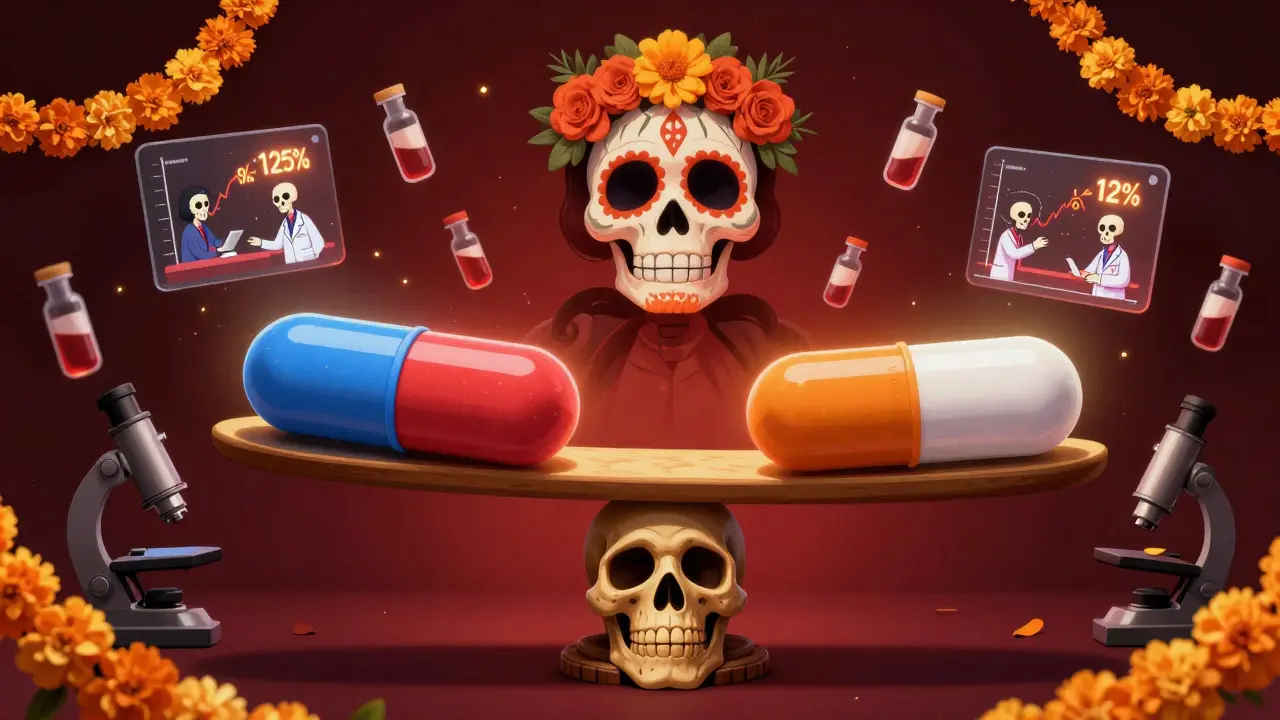
The core of approval is bioequivalence. That means the generic drug must deliver the active ingredient into your bloodstream at the same rate and to the same extent as the brand-name drug. The FDA requires that the amount of drug absorbed-measured by blood concentration over time-falls between 80% and 125% of the brand-name drug’s levels. This range isn’t arbitrary. It’s based on decades of data showing that within this window, there’s no clinically meaningful difference in how the drug works or how safe it is.
For most pills, this is tested in 24 to 36 healthy volunteers. They take the brand-name drug one day, the generic the next, and blood samples are taken every 15 to 30 minutes for hours. Two key numbers are checked: Cmax (the highest concentration reached) and AUC (how much drug is absorbed over time). Both must stay inside the 80%-125% range. For complex drugs-like extended-release tablets or inhalers-the testing gets even tighter. Some require multiple AUC measurements across different time windows to ensure the drug releases slowly and steadily, just like the original.
For drugs with a narrow therapeutic index-like warfarin, levothyroxine, or lithium-the rules are stricter. The FDA now requires a tighter range of 90% to 111% for these. One small change in blood levels can mean a blood clot or a seizure. So the FDA doesn’t take chances. In 2020, they updated the guidance for generic levothyroxine to require a 95%-105% range. That’s tighter than most people realize.
Manufacturing Isn’t Just About the Formula
It’s not enough to have the right ingredients in the right amounts. The drug must be made the same way every single time. That’s why the FDA inspects manufacturing plants-about 1,200 pre-approval inspections a year. These aren’t walk-throughs. They’re deep dives into every step: how raw materials are stored, how machines are calibrated, how tablets are pressed, how batches are tested.
Manufacturers must follow Current Good Manufacturing Practices (cGMP). This means every batch of a generic drug must be consistent. If one tablet is too hard, another too soft, the whole batch is rejected. In 2021, the FDA rejected a generic version of Jardiance because tablet hardness varied too much between production runs. That’s not a minor issue-it affects how quickly the drug dissolves in your stomach, which affects how well it works.
Successful applicants don’t guess. They validate. Teva Pharmaceuticals’ regulatory team says they need data from at least three full-scale production batches showing consistent quality before even submitting an application. That’s not optional. It’s the baseline.
Why Do So Many Generics Get Rejected?
Here’s the truth: 90% of new brand-name drugs get approved on the first try. Only 10% of generic applications do. Why? Because the bar is higher in different ways.
Brand-name companies are proving a drug works for the first time. Generic companies are proving they can copy it perfectly. And that’s harder than it sounds. Complex drugs-like inhalers, topical creams, or injectable suspensions-are especially tough. Between 2015 and 2020, only 3 out of 27 applications for a generic EpiPen were approved. Why? The device-the auto-injector-is part of the drug. The needle, the spring, the pressure-all must match. A tiny difference in how the drug is delivered can mean the difference between life and death.
Even simple pills can fail. A missing specification in the chemistry report. A typo in the labeling. An unexplained variation in dissolution rate. These aren’t big mistakes. But the FDA doesn’t accept "close enough." It’s all or nothing.
How Long Does It Take? How Much Does It Cost?
Developing a brand-name drug costs $2.6 billion. Developing a generic? Around $1.3 million. That’s not a typo. The savings come from not running new clinical trials. But that doesn’t mean it’s cheap or easy.
The average time from submission to approval is 32.7 months. For complex generics, it’s nearly 47 months. That’s over three and a half years. Why? Because the FDA reviews every page of the application-often 5,000 to 10,000 pages of chemistry data, bioequivalence studies, manufacturing details, and proposed labeling. A single missing test result can delay approval for months.
Companies that succeed early use the FDA’s Pre-ANDA program. In 2022, 78% of applicants who met with the FDA before submitting got approved on the first try. Those who didn’t? Only 41% did. Talking to the FDA early isn’t a favor-it’s a requirement for success.

Are Generics Really Safe?
Yes. And the data proves it. The American Medical Association reviewed 15 years of post-market data and found that 98.7% of generic drugs performed identically to brand-name drugs in real-world use. That’s not anecdotal. That’s statistical certainty.
Patients who switch from brand to generic for conditions like high blood pressure, diabetes, or depression don’t have worse outcomes. In fact, studies show they’re more likely to stick with their medication because generics cost a fraction of the price. In 2022, generics made up 90.3% of all prescriptions in the U.S. but only 22.8% of total drug spending. That’s $373 billion saved in one year.
Even drugs with narrow therapeutic windows-like levothyroxine or digoxin-show no increase in hospitalizations or adverse events after switching to generic. The FDA’s additional requirements for these drugs make the difference.
What’s Changing Now?
The FDA is pushing to approve more complex generics faster. In 2023, they approved the first generic of Humira, a biologic drug with a complex structure and delivery system. That was a milestone. But there are still 127 complex drugs with no generic alternatives-worth $52 billion in annual sales.
The agency’s 2023 plan aims to get half of complex generic applications approved within two review cycles by 2027. Right now, it’s only 28%. That’s the new frontier.
Meanwhile, the industry is shifting. More companies are investing in quality systems, not just cost-cutting. The ones that survive are the ones who treat approval like a science, not a race to the bottom.
Why This Matters
Generic drugs aren’t a compromise. They’re the backbone of affordable healthcare. They let people take their blood pressure pills, their insulin, their antidepressants-without choosing between medicine and rent. The system isn’t perfect. It’s slow. It’s expensive to navigate. But the standards? They’re rock solid.
If you’re taking a generic, you’re not getting less. You’re getting the same drug, made to the same rules, tested with the same rigor. The only difference? The price tag.
Are generic drugs as safe as brand-name drugs?
Yes. The FDA requires generic drugs to meet the same safety, strength, quality, and performance standards as brand-name drugs. They contain the same active ingredient, work the same way in the body, and are held to the same manufacturing standards. Post-market studies show no meaningful difference in safety or effectiveness between generics and brand-name drugs for over 98% of prescriptions.
What does bioequivalence mean for generic drugs?
Bioequivalence means the generic drug delivers the same amount of active ingredient into your bloodstream at the same rate as the brand-name drug. For most pills, this is measured by blood tests showing that the maximum concentration (Cmax) and total absorption (AUC) fall between 80% and 125% of the brand-name drug’s levels. For sensitive drugs like thyroid medication or blood thinners, the range is tighter-often 90% to 111%-to prevent any risk of under- or overdosing.
Why do some generic drugs get rejected by the FDA?
Most rejections happen because of manufacturing inconsistencies or incomplete data. Even small issues-like tablet hardness varying between batches, a typo in labeling, or missing dissolution test results-can trigger a Complete Response Letter. Complex drugs like inhalers or injectables are especially prone to rejection because their delivery systems must match the original exactly. The FDA doesn’t approve "close enough." It requires perfect replication.
How long does it take to get a generic drug approved?
On average, it takes about 32.7 months from submission to approval. For simple pills, it’s around 28.5 months. For complex products like inhalers, topical creams, or extended-release formulations, it can take 47 months or more. The FDA aims to review standard applications within 10 months after submission, but delays often occur due to incomplete applications or manufacturing issues.
Can I trust a generic drug if it’s much cheaper?
Absolutely. The lower price comes from skipping expensive clinical trials, not cutting corners on quality. Generic manufacturers must prove bioequivalence and meet the same cGMP standards as brand-name companies. The FDA inspects their facilities just as rigorously. A $5 generic isn’t a bargain-it’s the result of a well-designed regulatory system that promotes competition without sacrificing safety.
Frank Drewery
December 20, 2025 AT 00:48Really glad to see this breakdown. I’ve been on generic levothyroxine for years and never had an issue. My doctor even said the FDA’s standards are stricter than most people realize. It’s not a compromise-it’s science done right.
mary lizardo
December 20, 2025 AT 18:07The notion that generics are 'identical' is a regulatory fiction. The FDA permits excipient variation, which can-and does-alter pharmacokinetics in sensitive populations. To claim equivalence without acknowledging this is disingenuous at best.
jessica .
December 21, 2025 AT 15:22you think the fda is really checking every batch? lol. big pharma owns them. the real generics are made in china and shipped here with no inspection. my cousin works at a warehouse-he saw pallets labeled 'FDA approved' with no paperwork. they're just printing stamps.
Sajith Shams
December 23, 2025 AT 07:59Let me tell you something. In India, we make 40% of the world’s generics. We don’t cut corners. We have labs that test every batch with HPLC, dissolution profiles, stability studies-same as the U.S. The FDA sends inspectors to our plants every year. If you think Indian generics are cheap because they’re bad, you’re the one who doesn’t know science.
Erica Vest
December 24, 2025 AT 12:51One thing people overlook: the ANDA process requires not just bioequivalence, but also comparative dissolution testing across multiple pH levels. That’s because stomach acidity varies between patients. A generic that works at pH 1.2 but fails at pH 4.5 gets rejected. This isn’t just about blood levels-it’s about real-world physiology.
Chris Davidson
December 24, 2025 AT 20:42Generics are fine I guess. The system works. People take them. No one dies. End of story. Why are we even talking about this
Glen Arreglo
December 25, 2025 AT 13:11As someone who’s worked with drug manufacturers in Southeast Asia and the U.S., I can say this: the real difference isn’t in the pills-it’s in the culture. American companies treat compliance like a sacred duty. Some overseas plants treat it like a checklist. The FDA’s inspections catch that. That’s why the approval rate is so low. It’s not bureaucracy-it’s integrity.
Jedidiah Massey
December 26, 2025 AT 23:40bioequivalence? more like bio-approximation 🤡 80-125%? that’s a 45% swing! if your insulin varies that much, you’re either hypoglycemic or in a coma. the FDA’s 'safe' range is a corporate loophole dressed up as science. #GenericMyth
Janelle Moore
December 27, 2025 AT 02:25wait so you’re telling me my $3 generic blood pressure pill is exactly the same as the $150 brand? but my cousin took it and got dizzy and had to go to the ER? so it’s not the same? who’s lying? the pharma companies? the fda? or just me?
Matt Davies
December 27, 2025 AT 23:23Generics are the unsung heroes of healthcare. They’re the quiet warriors keeping millions on their meds without bankrupting them. I’ve seen elderly folks in rural towns choose between groceries and prescriptions-until generics came along. This isn’t just chemistry. It’s dignity.
mark shortus
December 28, 2025 AT 22:47I WAS ON A GENERIC FOR DEPRESSION AND I FELT LIKE A ZOMBIE FOR THREE WEEKS. I SWITCHED BACK TO THE BRAND AND SUDDENLY I COULD SMELL THE RAIN AGAIN. THE FDA CAN SAY WHAT THEY WANT BUT MY BRAIN KNEW THE DIFFERENCE. THIS ISN’T JUST STATS-IT’S MY LIFE.
Vicki Belcher
December 30, 2025 AT 21:05soooo… if generics are so perfect why do we still have brand names? 🤔 maybe because some people just… need the brand? like comfort? and that’s okay? ❤️
Mark Able
January 1, 2026 AT 18:17yo i work at a pharmacy and we get 200 boxes of generics a week. half the time the bottles are mislabeled. last week we had lisinopril labeled as metoprolol. we caught it but how many slipped through? the system is broken.
Dorine Anthony
January 2, 2026 AT 07:52My grandma’s on generic warfarin. She’s 84. Her INR’s stable. She’s been on it for five years. She doesn’t know what an ANDA is. She just knows she can afford to live. That’s all that matters.