Licorice Risk Calculator
How Much Licorice Is Safe?
This tool helps you understand your risk based on the type of licorice you consume and your medications. The safe daily limit is 100mg of glycyrrhizin.
Most people think of licorice as a sweet, chewy candy-something you grab for a quick treat or maybe to freshen your breath. But if you’re taking any kind of medication, especially for blood pressure, heart conditions, or kidney issues, that little black stick could be doing more than just satisfying a craving. It might be quietly messing with your drugs, raising your blood pressure, or dropping your potassium to dangerous levels-without you even realizing it.
What’s Actually in Licorice?
Not all licorice is the same. The real deal comes from the root of the licorice plant (Glycyrrhiza glabra), which contains a compound called glycyrrhizin. This is what gives licorice its distinct flavor-and its powerful, sometimes dangerous, effects on your body. Glycyrrhizin acts like a hormone that mimics aldosterone, a chemical your kidneys use to control salt and water balance. Too much of it, and your body starts holding onto sodium, flushing out potassium, and retaining fluid. That’s why people who eat a lot of real licorice end up with swollen ankles, high blood pressure, and muscle weakness.Here’s the catch: many candies labeled "licorice" don’t contain any licorice root at all. Instead, they use anise oil, which tastes similar but has none of the active compounds. So if you’re worried about interactions, you need to know what you’re actually eating. Look for ingredients like "licorice extract," "glycyrrhizin," or "Glycyrrhiza glabra." If it’s not listed, it’s probably just flavoring.
Traditional black licorice candy usually has 0.5% to 2% glycyrrhizin. That means eating just 50 grams a day-about the size of a small bar-could put you over the safe daily limit of 100 mg established by the European Food Safety Authority. Herbal supplements? Those can pack 4% to 24% glycyrrhizin. One 500 mg capsule could contain more glycyrrhizin than a whole bag of candy.
How Licorice Interacts With Common Medications
Licorice doesn’t just cause side effects on its own. It actively interferes with how your body handles medications. There are two main ways this happens: pharmacodynamic (how the drug works in your body) and pharmacokinetic (how your body breaks down the drug).1. Blood Pressure Medications
If you’re on ACE inhibitors like lisinopril, ARBs like losartan, or even diuretics like hydrochlorothiazide, licorice can undo their benefits. It makes your body hold onto salt and water, which directly opposes what these drugs are trying to do. One patient in a 2023 Reddit thread reported his blood pressure jumped from 120/80 to 165/95 after eating 30 grams of licorice daily for just three days. Another case from Medsafe involved a man on fludrocortisone-a steroid that already raises blood pressure-who developed a terrifying 205/110 reading after eating licorice. His doctor had no idea the candy was the trigger.
2. Potassium-Lowering Drugs
Thiazide diuretics, loop diuretics, and even some asthma inhalers can lower potassium. Licorice does the same. Together, they can crash your potassium levels below 3.0 mmol/L, which is dangerous. At 2.4 mmol/L, you risk irregular heart rhythms, muscle paralysis, or even sudden cardiac arrest. A 2012 study documented a man whose potassium dropped to 2.6 mmol/L after eating 200 grams of licorice daily for three weeks. He needed hospitalization.
3. Blood Thinners
Warfarin and phenprocoumon are tricky. Some studies suggest licorice can make them stronger, increasing bleeding risk. Others show it can weaken them, causing dangerous clots. A 92-year-old woman on phenprocoumon had her INR (a measure of blood thinning) suddenly drop after eating licorice. Her doctors didn’t connect the dots until she had a minor stroke. The mechanism isn’t fully understood, but it’s clear: if you’re on blood thinners, avoid licorice.
4. Heart Medications
Digoxin, used for heart failure and irregular heartbeat, is especially risky. Low potassium makes your heart more sensitive to digoxin. Even normal doses can become toxic. A 2002 case report described a patient who developed digoxin toxicity after eating licorice, with potassium levels at 2.8 mmol/L. His heart started skipping beats. He had to be hospitalized.
5. Immunosuppressants and Cancer Drugs
Drugs like cyclosporine and tacrolimus are broken down by liver enzymes that licorice can either boost or block, depending on the product. This means your drug levels could spike (risking toxicity) or crash (risking organ rejection). Memorial Sloan Kettering warns that licorice may reduce the effectiveness of metformin in animal studies, though human data is still limited.
What About DGL? Is It Safe?
Deglycyrrhizinated licorice (DGL) is marketed as a "safe" alternative for digestive issues like heartburn or ulcers. It’s been stripped of most glycyrrhizin-usually to less than 1%. For most people, DGL doesn’t cause the same blood pressure or potassium problems. But here’s the thing: not all DGL products are created equal. Some still contain trace amounts, and others are poorly regulated. Always check the label. If it doesn’t say "deglycyrrhizinated" and list glycyrrhizin content, assume it’s not safe.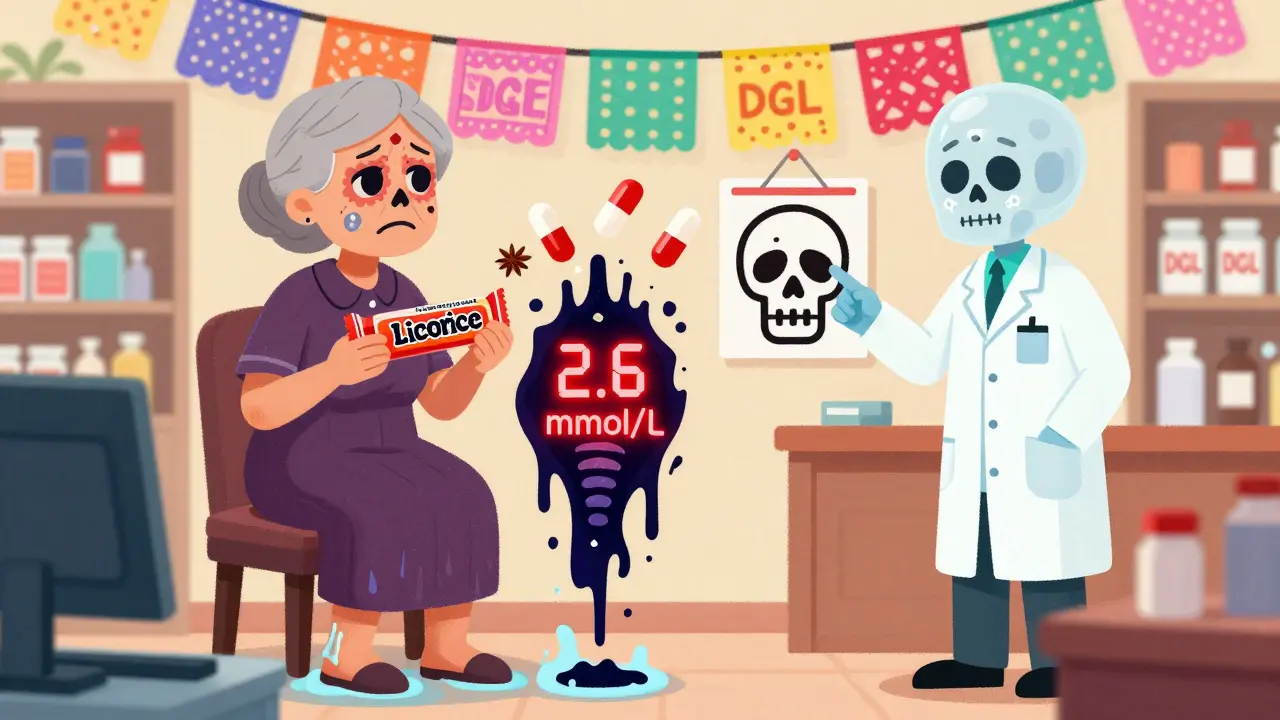
Who’s at Risk?
You don’t have to be eating pounds of licorice to be in danger. The problem is cumulative. For most healthy adults, occasional candy won’t hurt. But if you’re over 60, have high blood pressure, kidney disease, heart failure, or take any of the medications listed above, even small amounts can add up.Women, especially those on birth control or hormone therapy, may be more sensitive. Older adults are at higher risk because their kidneys don’t clear glycyrrhizin as efficiently. People with liver disease may also process it slower. And if you’ve been eating licorice daily for more than two weeks, you’re already in the danger zone.
How Much Is Too Much?
There’s no official FDA limit, but experts agree on this: 100 mg of glycyrrhizin per day is the safe upper limit for healthy adults. That’s about:- 50 grams of traditional black licorice candy (about two small bars)
- 10 grams of herbal licorice extract
- 1 teaspoon of licorice root powder
But here’s the kicker: most products don’t tell you how much glycyrrhizin they contain. A 2023 Consumer Reports survey found that 78% of black licorice products didn’t list glycyrrhizin content. 92% didn’t warn about drug interactions. You’re flying blind.
What Should You Do?
If you’re on medication:- Check your candy. Read the label. If it says "licorice extract," "Glycyrrhiza glabra," or "glycyrrhizin," avoid it.
- Ask your pharmacist. Only 37% of community pharmacists can correctly identify all licorice-drug interactions. But they’re still your best bet for a quick check.
- Monitor your body. If you’ve eaten licorice and suddenly feel bloated, weak, dizzy, or notice your ankles swelling, stop immediately. Get your blood pressure and potassium checked.
- Don’t assume DGL is safe. Even DGL products vary. Stick to trusted brands that list glycyrrhizin content.
- Keep a food log. If you’re on multiple medications, track everything you eat for a week. You might be surprised what’s triggering symptoms.
If you’re not on meds but love licorice, enjoy it in moderation-once in a while, not every day. And if you’re pregnant, have liver or kidney disease, or are over 60, skip it entirely.
The Bigger Picture
The global licorice market is worth over $1.3 billion, with supplements making up a third of sales. Yet, most people have no idea what they’re consuming. Regulatory agencies are catching on. The UK requires warning labels on high-glycyrrhizin products. Japan limits supplements to 100 mg per day. The FDA now lists licorice as a "high-priority" interaction risk. By 2026, the American Herbal Pharmacopoeia wants all licorice products to clearly label glycyrrhizin content.Until then, you’re the only one watching out for you. That candy bar might seem harmless. But if you’re taking medication, it’s not just a treat-it’s a potential health risk.
Can licorice raise my blood pressure even if I’m not on medication?
Yes. Even if you’re not taking any drugs, eating more than 100 mg of glycyrrhizin daily for more than two weeks can cause high blood pressure, fluid retention, and low potassium. This condition, called pseudoaldosteronism, can happen to anyone-but it’s more common in older adults and people with existing kidney or heart issues.
Is red licorice safe?
Most red licorice doesn’t contain licorice root at all-it’s flavored with artificial or anise oil. These are generally safe from a pharmacological standpoint. But always check the ingredients. If it says "licorice extract," avoid it. If it just says "artificial flavor," you’re likely fine.
How long does it take for licorice to affect my medications?
It varies. Some people see blood pressure spikes within days. Potassium levels can drop in as little as one to two weeks with daily consumption. The effects are cumulative, so even small amounts over time can build up to dangerous levels.
Can I take licorice tea or supplements while on blood pressure meds?
No. Licorice tea, capsules, and extracts are often concentrated sources of glycyrrhizin. Even one cup of strong licorice tea daily can push you over the safe limit. If you’re on blood pressure medication, avoid all forms of real licorice-including teas, tinctures, and herbal remedies.
What should I do if I’ve been eating licorice and now feel unwell?
Stop eating licorice immediately. If you have symptoms like muscle weakness, cramps, irregular heartbeat, swelling in your legs, or headaches, get your blood pressure and potassium levels checked right away. Don’t wait. These effects can be serious-and reversible if caught early.
Are there any safe alternatives to licorice for flavoring?
Yes. Anise, fennel, star anise, and even cinnamon can mimic licorice’s sweetness without the risks. Look for products labeled "anise-flavored" instead of "licorice-flavored." Always read the ingredients list. If it doesn’t mention licorice root or glycyrrhizin, it’s likely safe.
Pooja Kumari
January 8, 2026 AT 00:18I’ve been eating black licorice every day for years because it calms my anxiety, and honestly? I didn’t even know it had chemicals that could mess with my meds. My BP spiked last month and my doctor was like ‘did you eat anything weird?’ I said ‘uhhh… candy?’ He nearly passed out. Now I’m terrified to even look at a black jelly bean. 😭
Jacob Paterson
January 8, 2026 AT 03:32Oh wow. So now we’re treating candy like a Schedule II drug? Next you’ll tell me sugar is a controlled substance because it makes people fat. Chill out. If you’re eating 50 grams of licorice daily and then acting surprised your BP’s up, maybe the problem isn’t the candy-it’s your inability to do basic math. Stop blaming the snack. Start blaming your choices.
Angela Stanton
January 9, 2026 AT 16:11Let’s break this down pharmacodynamically: glycyrrhizin inhibits 11β-HSD2 → mineralocorticoid receptor overactivation → sodium retention + potassium wasting → hypertension + hypokalemia. The real issue? No FDA labeling requirements. 78% of products don’t disclose glycyrrhizin content? That’s not negligence-that’s systemic regulatory failure. And don’t even get me started on DGL. ‘Deglycyrrhizinated’ sounds like a corporate lie wrapped in a lab coat. Always check the HPLC-MS data if you care about safety. 🧪
Johanna Baxter
January 10, 2026 AT 11:38I ate licorice every day for 3 months and didn’t feel a thing. Then my heart started doing the cha-cha and I ended up in the ER. Turns out I was on lisinopril. My doctor said I was lucky I didn’t have a stroke. Now I’m that girl who stares at candy labels like they’re CIA documents. 🤡
Jerian Lewis
January 12, 2026 AT 01:16I don’t eat candy. I don’t trust anything that’s marketed as ‘fun.’ If it’s sweet, it’s probably trying to kill you slowly. This post just confirmed what I’ve always suspected: modern life is one big poison pill with a wrapper.
Kiruthiga Udayakumar
January 12, 2026 AT 05:10My aunt in Delhi used to chew licorice root for her stomach pain. She’s 82, on blood pressure meds, and still alive. Maybe it’s not as bad as you think? Also, why are Americans so scared of everything? We’ve been eating this for centuries. Maybe your body knows what to do with it.
Patty Walters
January 12, 2026 AT 05:50Just wanted to say THANK YOU for this post. I’m on metformin and had no clue licorice could mess with it. I’ve been eating those ‘licorice’ gummies from the gas station for years. I just threw them all out. Also, I misspelled ‘glycyrrhizin’ like 7 times trying to type it. Sorry. But I’m learning. 🙏
Phil Kemling
January 12, 2026 AT 06:06It’s fascinating how we’ve turned food into a moral dilemma. Licorice isn’t evil. Medications aren’t magic. The real issue is that we’ve outsourced our health to corporations and pharmacists and forgotten how to listen to our own bodies. Maybe the answer isn’t more warnings-it’s more awareness. More curiosity. Less fear. And less labeling things as ‘dangerous’ just because they’re complex.
tali murah
January 13, 2026 AT 09:54Let me get this straight: a 92-year-old woman had a stroke because she ate licorice, and now we’re supposed to panic about candy? Meanwhile, Big Pharma is selling $12,000 pills for conditions caused by processed food. But sure, blame the licorice. It’s easier than holding the FDA accountable for letting 92% of products hide their active ingredients. #CorporateCriminality
Diana Stoyanova
January 14, 2026 AT 01:55Okay but imagine if we treated ALL food like this. ‘Don’t eat tomatoes if you’re on beta-blockers!’ ‘Avoid bananas if you’re on diuretics!’ ‘STOP EATING BREAD OR YOUR INSULIN WILL REBEL!’ We’d all starve. Or go insane. Or both. Licorice is a warning sign-not a death sentence. Enjoy it. In moderation. Like everything else in life. And maybe stop treating your body like a lab rat. 🌈✨
Jenci Spradlin
January 14, 2026 AT 12:26just read this and checked my licorice tea bag-yep, says ‘licorice root extract.’ i’ve been drinking 2 cups a day for 6 months. i’m gonna go check my bp right now. thanks for the scare. 😅
Elisha Muwanga
January 14, 2026 AT 13:24Why is this even a thing? In America, you can’t have a snack without a 12-page warning label. We used to eat things without needing a PhD in pharmacology to enjoy them. This post reads like a government pamphlet written by someone who’s never tasted candy. Grow up. Life is risky. Licorice isn’t the enemy.
Maggie Noe
January 15, 2026 AT 01:00My grandma used to say, ‘If it’s been around for 3,000 years, it’s probably not trying to kill you.’ She ate licorice root with her tea every morning and lived to 98. Maybe the real danger is over-medicalizing everything. We’re scared of food because we’ve forgotten how to trust our bodies. 🌿
Gregory Clayton
January 15, 2026 AT 11:01Y’all are losing it. I’m a 50-year-old guy who eats licorice like it’s M&Ms and I’ve got the biceps of a Greek god and a BP of 110/70. This isn’t science-it’s fear porn. Someone’s making money off your anxiety. Go outside. Lift something. Stop reading doom posts about candy.
Catherine Scutt
January 16, 2026 AT 22:18I read this and immediately checked my licorice stash. Turned out I had two bags from a ‘health food’ store. I felt so stupid. Now I’m embarrassed to tell my friends I was eating ‘natural remedies’ that were basically slow poison. Lesson learned: if it’s labeled ‘herbal,’ read the fine print. Always.