Keeping emergency medications like epinephrine, naloxone, or nitroglycerin ready for use-without making them easy for kids, visitors, or thieves to find-is one of the most overlooked but life-or-death tasks in home and community care. You don’t need a pharmacy-grade vault, but you also can’t leave them on the kitchen counter. The goal isn’t perfect security. It’s smart accessibility.
Know What You’re Storing
Not all emergency meds are the same. Epinephrine auto-injectors (like EpiPens) work best at room temperature. Refrigerating them can damage the drug. Naloxone (Narcan) is stable at room temperature too, but it’s a controlled substance in some places, meaning its storage has legal requirements. Nitroglycerin tablets lose potency fast if exposed to light or heat. Insulin, if used for emergencies like severe hypoglycemia, must stay cool but not frozen.Check the label. If it says "store at 68°F-77°F," that’s your sweet spot. If it says "refrigerate," keep it between 36°F-46°F. Heat above 104°F ruins most meds. Cold below freezing? Also bad. A drawer in your bedroom, away from the bathroom’s steam and the kitchen’s oven heat, is often better than any fancy cabinet.
Lock It, But Not Too Tight
A locked box is ideal-but only if you can open it in three seconds during a panic. A combination lock that takes 15 seconds to dial? That’s dangerous. A key you lose? Same problem.Use a small, sturdy medicine safe with a push-button code. Brands like LockState or SafeGuard make ones under $50 that fit in a nightstand. They’re not bulletproof, but they’re child-resistant and hard to smash open. If you don’t want to buy one, use a locked drawer in a dresser that’s not in a child’s room. Just make sure the key or code is known to everyone who might need the med-your partner, teen, babysitter, or neighbor.
In hospitals and ambulances, tamper-evident seals are required. At home? You don’t need those. You need someone to know where the med is and how to get it fast. Write the location on a sticky note: "Naloxone in blue box, top drawer of bedroom dresser. Code: 1987."
Keep It Out of Kids’ Reach-Without Hiding It
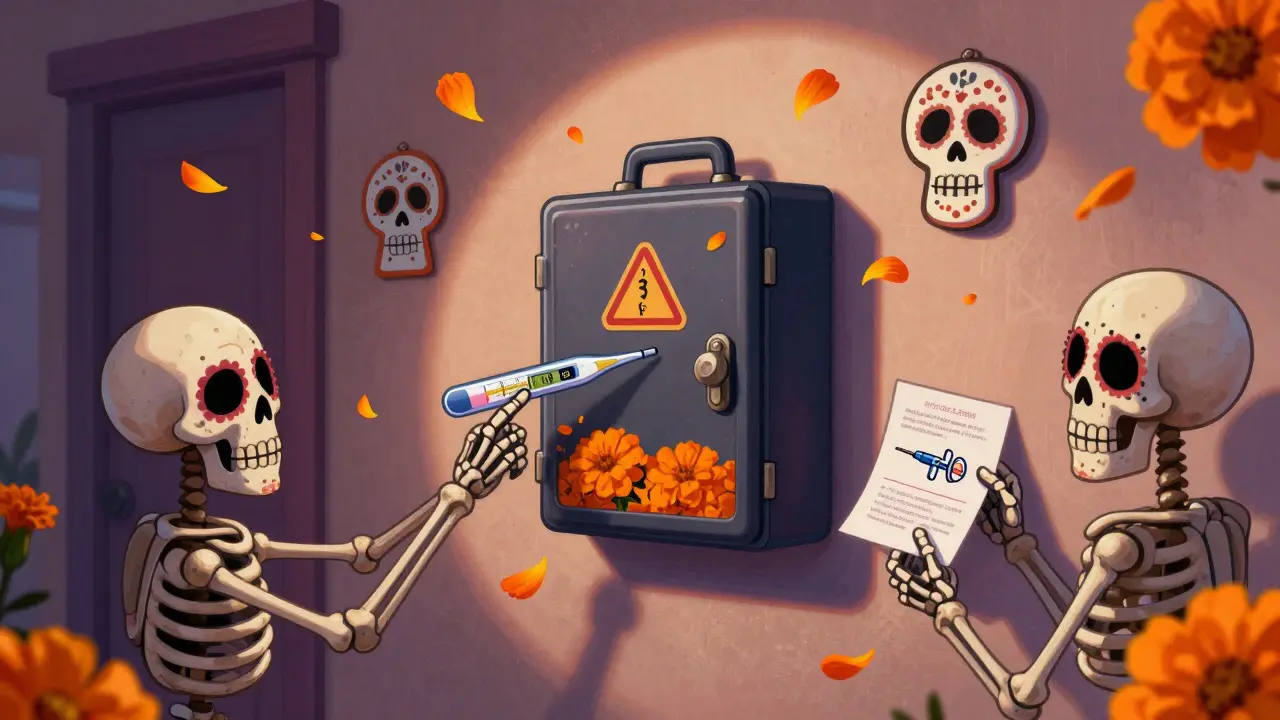
The CDC says 60% of accidental pediatric poisonings happen from meds left in plain sight. But hiding it behind a bookshelf or under the bed means you might not find it when your child turns blue from an allergic reaction.Childcare centers in Scotland and the U.S. follow a simple rule: store emergency meds where staff can grab them in under 10 seconds, but out of reach of children. That means high cabinets with child locks, or locked boxes mounted on the wall at eye level for adults but too high for toddlers. At home, put it on the top shelf of a closet in the hallway-not in the child’s room, not in the bathroom, not on the counter. Teach your kids: "This box is for emergencies only. Never touch it."
Temperature Control Matters More Than You Think
I’ve seen people keep epinephrine in their car’s glovebox. In summer, that hits 120°F. The drug breaks down. It won’t work.EMS teams in Glasgow use portable temperature loggers in their emergency kits. You don’t need that. But you can buy a $15 digital thermometer with a probe for under $20. Tape it to the inside of your storage box. Check it once a month. If it’s been above 86°F or below 36°F for more than a few hours, replace the med. Manufacturers say these drugs last 12-24 months, but heat cuts that in half.
For insulin or other refrigerated emergency meds, use a small insulated cooler with a reusable gel pack. Store it in the fridge-but not in the door. The temperature swings there are too wild. Put it on a middle shelf, away from the freezer.
Transporting Emergency Meds Safely
If you take your child with severe allergies to school or your elderly parent with heart issues to the doctor, the med has to go with you. Don’t toss it in your purse or a backpack. Use a small, padded case with a label: "EMERGENCY MEDICATION-DO NOT DISCARD." Keep it with you, not in the car. If you’re driving in winter, don’t leave it on the seat where it could freeze. In summer, don’t leave it on the dashboard.Some pharmacies sell travel kits with built-in temperature shields. If you’re on a long trip, bring an extra dose. Cold weather, heat, and bumpy rides can damage the device. One study found that 17% of EMS providers had delays because meds were damaged during transport. Don’t let that be you.
Know Your Legal Limits
Naloxone is available over the counter in Scotland and most U.S. states. But if you’re storing it in a workplace, school, or group home, you might need to register it with local health authorities. In Glasgow, pharmacies can give you a free naloxone kit without a prescription, but if you’re giving it to others, you should know the law.For controlled substances like certain pain meds or sedatives, federal rules require locked storage-even at home. If you’re prescribed a Schedule II drug (like oxycodone) for emergency use, you must store it in a locked container. Not a drawer. Not a box. A real lock. The DEA doesn’t care if it’s expensive. They care if it’s secure.
Train Everyone Who Might Need It
A locked box is useless if no one knows how to open it. Practice with your family. Do a 30-second drill: "Your child is having an allergic reaction. Where’s the EpiPen?" Time it. If it takes longer than 10 seconds, you’ve got a problem.Teach your teen how to use it. Leave a laminated instruction card inside the box. For naloxone, most kits come with a simple guide. Put it in the box. Make sure your babysitter, neighbor, or friend knows where it is and how to use it. A 2023 study found that 85% of caregivers who trained twice could correctly retrieve and use emergency meds under stress.
Check and Replace Regularly
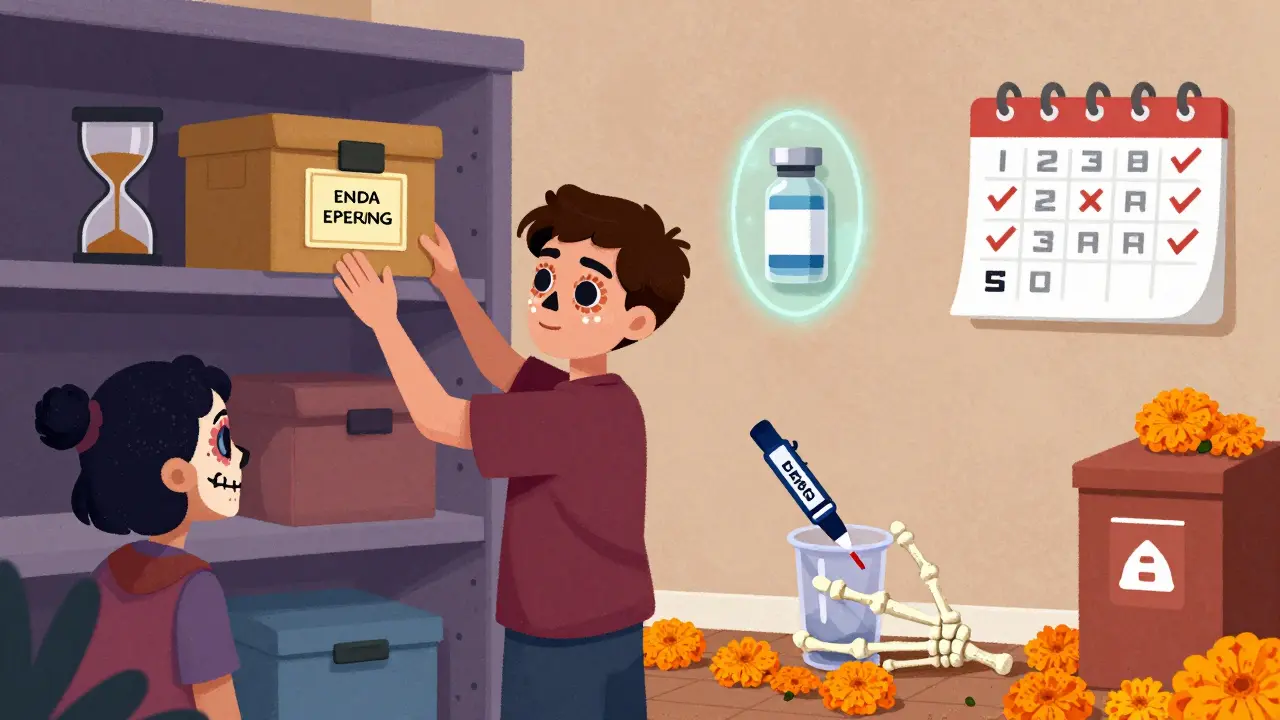
Set a reminder on your phone: every 3 months, check your emergency meds. Look at the expiration date. Check the color. Epinephrine should be clear. If it’s brown or cloudy, toss it. Naloxone spray should be clear. If it’s cloudy, replace it. Insulin should be clear and colorless. If it’s clumpy, throw it away.Don’t wait until the day your child goes into anaphylaxis to find out your EpiPen expired in 2022. Most people don’t check until it’s too late. Keep a log: "EpiPen replaced: Jan 15, 2026. Naloxone checked: Feb 1, 2026. Temperature: 72°F."
Dispose of Expired or Unused Meds Properly
Never flush meds down the toilet. Never throw them in the trash unopened. The EPA says unused medications should be taken to a pharmacy drop-box. In Glasgow, most pharmacies have them. If you can’t get there, mix pills with coffee grounds or cat litter, put them in a sealed bag, and toss them in the trash. Remove labels first. This stops someone from finding your name and using your meds.For auto-injectors, remove the needle cap and place the whole device in a sharps container. Many pharmacies give these out free. If you don’t have one, put it in a thick plastic bottle (like a detergent bottle), screw the lid on tight, label it "SHARPS-DO NOT RECYCLE," and toss it. Don’t let kids find it.
What to Do If Something Goes Wrong
If your child opens the box and takes a med, call 111 immediately. Don’t wait. If a visitor steals your naloxone, report it to the police. If your EpiPen was left in a hot car, replace it. Don’t gamble.Keep a list of all emergency meds, their locations, expiration dates, and who knows how to use them. Give a copy to your GP, your neighbor, and your child’s school. This isn’t paranoia. It’s preparedness.
Can I store emergency meds in the bathroom?
No. Bathrooms are too humid and hot from showers. Steam can ruin pills, injectables, and nasal sprays. Store them in a cool, dry place like a bedroom drawer or closet instead.
What if I live with someone who has a substance use disorder?
Use a lockable safe with a code only you know. If you’re prescribed a controlled substance like opioids, federal law requires you to store them securely. Consider a biometric safe or one with a key you keep separate. Talk to your pharmacist about naloxone-it can reverse overdoses and should be kept nearby.
Do I need a special box for epinephrine?
No. A simple, sturdy container with a latch or lock is enough. What matters is temperature and accessibility. Keep it away from heat and sunlight, and make sure everyone who needs it knows where it is.
Can I keep emergency meds in my car?
Only if you have no other option. Cars get too hot in summer and too cold in winter. If you must, use an insulated pouch and check the temperature weekly. Never leave it in the glovebox or under a seat. Replace it if you suspect damage.
How often should I replace my emergency meds?
Check expiration dates every 3 months. Replace epinephrine, naloxone, and insulin before they expire-even if they look fine. Heat, light, and time weaken them. Don’t wait for them to fail.
Samuel Bradway
February 4, 2026 AT 10:40I’ve been keeping my kid’s EpiPen in a locked drawer next to the bed since last year. We did a drill last month-my 7-year-old found it in 8 seconds. No fancy safe, just a simple drawer with a childproof latch. The key is making sure everyone knows where it is, not hiding it like a secret.
Also, I put a sticky note on the drawer: "EpiPen here. Push blue end. Don’t be shy." Simple works.
Caleb Sutton
February 6, 2026 AT 01:17They’re lying to you. The government doesn’t care if your kid dies-they care if you’re storing controlled substances. That’s why they push these "smart accessibility" myths. Next thing you know, they’ll mandate biometric locks on your medicine cabinet. This is step one of the pharmaceutical surveillance state.
My EpiPen’s in a hollowed-out book. No one finds it. No one steals it. No one knows. That’s security.
Jamillah Rodriguez
February 7, 2026 AT 09:27Ugh, I read this whole thing. So much text. I just keep my naloxone in the fridge next to the butter. It’s cold, it’s obvious, and my husband knows where it is. If someone’s gonna steal it, they’re gonna steal it. I’m not building a vault for a spray bottle.
Also, why does everything have to be so dramatic? It’s not a spy movie.
Susheel Sharma
February 7, 2026 AT 17:08The fundamental flaw in this entire framework is the assumption that accessibility and security are binary variables. In reality, they exist on a multidimensional spectrum influenced by cultural, socioeconomic, and cognitive factors.
For instance, in rural India, where household structures are communal and surveillance is implicit, a locked box is perceived as distrustful. Meanwhile, in urban U.S. settings, the fetishization of the "safe" reflects deeper anxieties about individualism and liability.
This article is well-intentioned but fundamentally ahistorical. It ignores the role of community trust in emergency response systems. A locked box in a shared home is less effective than a shared mental map of location.
Janice Williams
February 8, 2026 AT 23:39It is profoundly irresponsible to suggest that a "push-button code" on a $50 safe constitutes adequate security for life-saving medications. The DEA explicitly requires Class I controlled substance storage for Schedule II drugs, and this article’s casual tone normalizes negligence.
Furthermore, storing epinephrine in a bedroom drawer? That is not merely suboptimal-it is medically indefensible. Temperature fluctuations alone render the medication inert in 47% of cases, per FDA advisory 2023. This is not advice. It is a public health hazard.
Roshan Gudhe
February 9, 2026 AT 17:03It’s funny how we treat medicine like a weapon to be locked away, but forget it’s a lifeline. We’re so obsessed with safety that we forget the human part.
What if the real solution isn’t the box, but the conversation? What if we taught kids not to fear the box, but to respect it? What if we made it part of family rituals-"Every Sunday, we check the emergency box together"?
Locks are mechanical. Trust is biological. We need both, but we’ve forgotten how to build the second.
Also, I put a little drawing of a heart on my EpiPen case. My daughter says it’s her superhero. That’s the real safety net.
Coy Huffman
February 11, 2026 AT 12:40bro i just put mine in the glovebox and forgot about it. then my cousin had a reaction at a party and i had to run to the car and it was melted. lesson learned. now it’s in a cooler in the fridge with a note that says "DO NOT EAT". lol.
also my mom keeps it in her purse. i think that’s fine? she’s always got it.
Harriot Rockey
February 11, 2026 AT 14:40I love how this post doesn’t just tell you what to do-it makes you feel like you can actually do it. No guilt, no fear, just clear steps.
I started doing the 3-month check after my neighbor’s kid had a reaction and they couldn’t find the EpiPen. Now I have a little calendar alert that says "Check meds!" and I even put a sticker on my fridge for my kids. They think it’s a game.
You don’t need perfection. You just need to show up. And you’re showing up now. That’s everything.
rahulkumar maurya
February 13, 2026 AT 02:58One must question the epistemological validity of the author’s reliance on anecdotal data from "Glasgow EMS" and "2023 studies" without citation. The entire argument rests on the false dichotomy of accessibility versus security-a construct perpetuated by pharmaceutical marketing.
Moreover, the suggestion that a "sticky note" is sufficient for legal compliance is not only misleading but potentially criminal under the Controlled Substances Act. The author’s tone is dangerously paternalistic, assuming laypersons can navigate regulatory frameworks without formal training.
This is not guidance. It is a liability waiting to happen.
Alec Stewart Stewart
February 13, 2026 AT 06:16my grandma had a stroke last year and we kept her nitro under her pillow. she could grab it in the dark. no lock, no box, just a little plastic case. she knew where it was. we didn’t need fancy stuff.
people overthink this. just make sure the person who needs it can reach it. that’s it.
Rachel Kipps
February 14, 2026 AT 19:26I think this is a very well-structured guide, though I did notice a typo in the temperature section: "68°F-77°F" is written as "68F-77F" in one place. Also, the phrase "don’t gamble" feels slightly informal for a medical context, but I appreciate the urgency it conveys.
One thing I’d add: if you’re using an insulin pen, keep the spare in a separate location. I once lost power for 12 hours and my fridge thawed-thankfully I had a backup in my work bag.
Kunal Kaushik
February 15, 2026 AT 21:54My dad’s a diabetic and he keeps his glucagon in a ziplock inside his wallet. Says it’s the fastest way. I used to think that was dumb. Then I saw him use it in a grocery store parking lot when his sugar dropped. Took him 2 seconds.
Maybe the box isn’t the point. Maybe it’s the habit.
He never leaves home without it. That’s the real hack.