When you pick up a generic pill at the pharmacy in Berlin, Madrid, or Warsaw, you’re not just getting a cheaper version of the brand-name drug. You’re stepping into one of the most complex regulatory systems in the world. The European Union’s approach to generic medicines isn’t a single rulebook-it’s a patchwork of four different approval paths, each with its own timeline, costs, and hidden traps. And as of 2025, everything is changing.
How Generic Drugs Get Approved in the EU
There are four ways a generic drug can win approval across the EU. Each one is designed for different situations, but none of them are simple.
The Centralized Procedure is the fastest route to pan-European access. You submit one application to the European Medicines Agency (EMA), and if approved, your drug can be sold in all 27 EU countries plus Iceland, Liechtenstein, and Norway. It takes about 180 days under the new 2025 rules, down from 210. But here’s the catch: the fees alone start at €425,000. Add in consulting, studies, and documentation, and you’re looking at €1.5 million or more. Only companies with a drug expected to generate over €250 million in annual EU sales bother with this. Sandoz used it to launch its version of Cosentyx across the entire EU in Q2 2025-11 months faster than any other route would have allowed.
The Mutual Recognition Procedure (MRP) is where most companies start. You get approval in one country-say, Germany-then ask others to recognize it. Sounds efficient, right? In theory, yes. In practice, it takes an average of 132.7 days, far longer than the 90-day legal window. Why? Because countries keep adding their own demands. Teva’s generic rosuvastatin got approved in Germany in January 2023, but didn’t hit Dutch and Belgian shelves until September. Why? Pricing negotiations dragged on. The approval was valid, but the market wasn’t ready.
The Decentralized Procedure (DCP) lets you apply to multiple countries at once. No prior approval needed. But coordination is a nightmare. One country raises a concern about impurity levels. Another wants extra stability data. The clock resets. EMA’s own data shows 37% of DCP applications get delayed more than six months. Eastern European regulators, in particular, interpret quality standards differently than Western ones. That’s not a bug-it’s a feature of the system.
The National Procedure is the slowest and most limited. You apply to just one country. It takes 180 to 240 days. You get access to one market. It’s only worth it if that country has high reimbursement rates and you don’t care about the rest. Accord Healthcare found it took 197 days to get a national approval in France, but only 142 days to get the same drug approved in five countries using MRP.
What the 2025 Pharma Package Changes
The biggest shift since the early 2000s arrived on June 4, 2025. The EU Pharma Package didn’t tweak the system-it rewrote it.
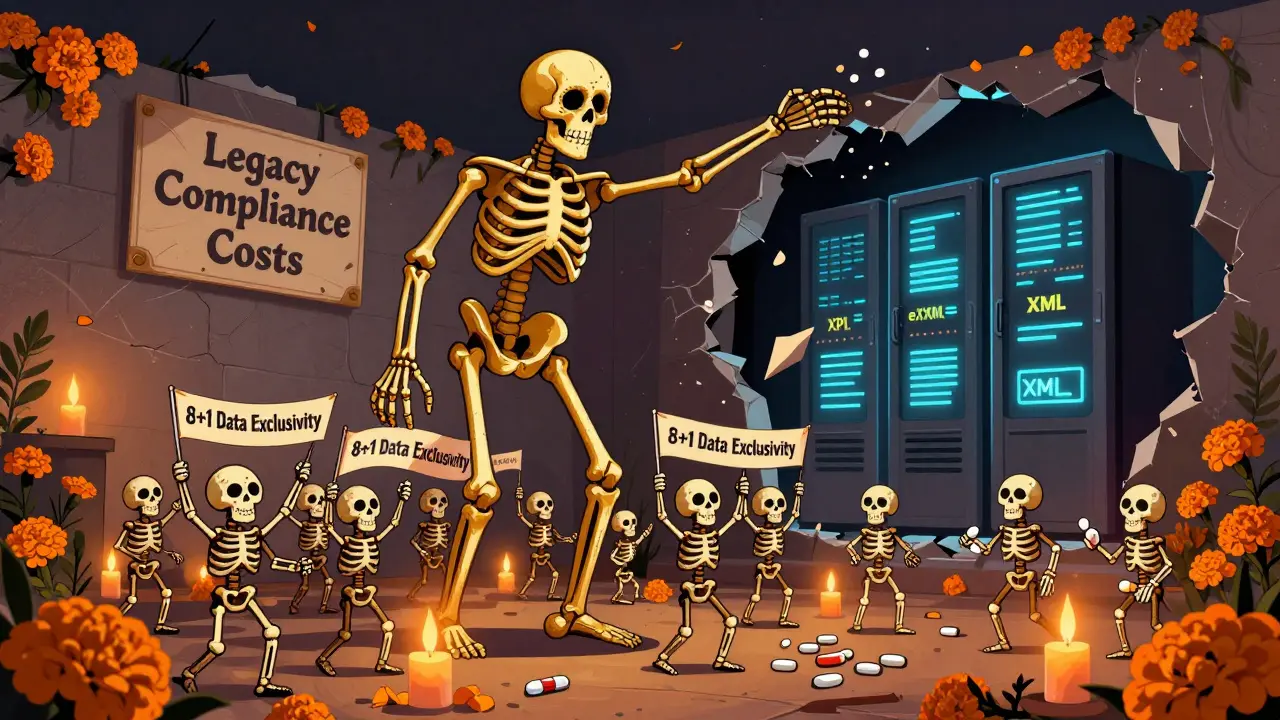
First, data protection is shrinking. Before, a brand-name drug’s data was protected for 10 years. Now, it’s 8 years of data exclusivity, plus 1 year of market exclusivity. That’s 9 years total. But if the drug meets certain public health goals-like treating rare diseases or improving pediatric use-it can get extended to 10 years. This means generic makers can enter the market sooner. For 78 high-value biologics in development, this could cut generic entry time by up to 18 months.
Second, the Bolar exemption got a major boost. Before, generic companies could start negotiating prices and reimbursement with health authorities just two months before the patent expired. Now, they can start six months early. That’s huge. REMAP Consulting estimates this alone will speed up market entry by 4.3 months on average. But there’s a trade-off: payers get more leverage. With earlier access to pricing data, they can push for deeper discounts. Evaluate Pharma predicts this will lower generic launch prices by 12-18% in the first year.
Third, the obligation to supply rule is now enforceable. If a company has a generic drug approved and there’s a shortage, authorities can force them to produce more. Sounds fair. But here’s the problem: each country defines “sufficient quantities” differently. Professor Panos Kanavos of LSE Health warns this could lead to artificial shortages in smaller markets where regulators lack the power to enforce supply.
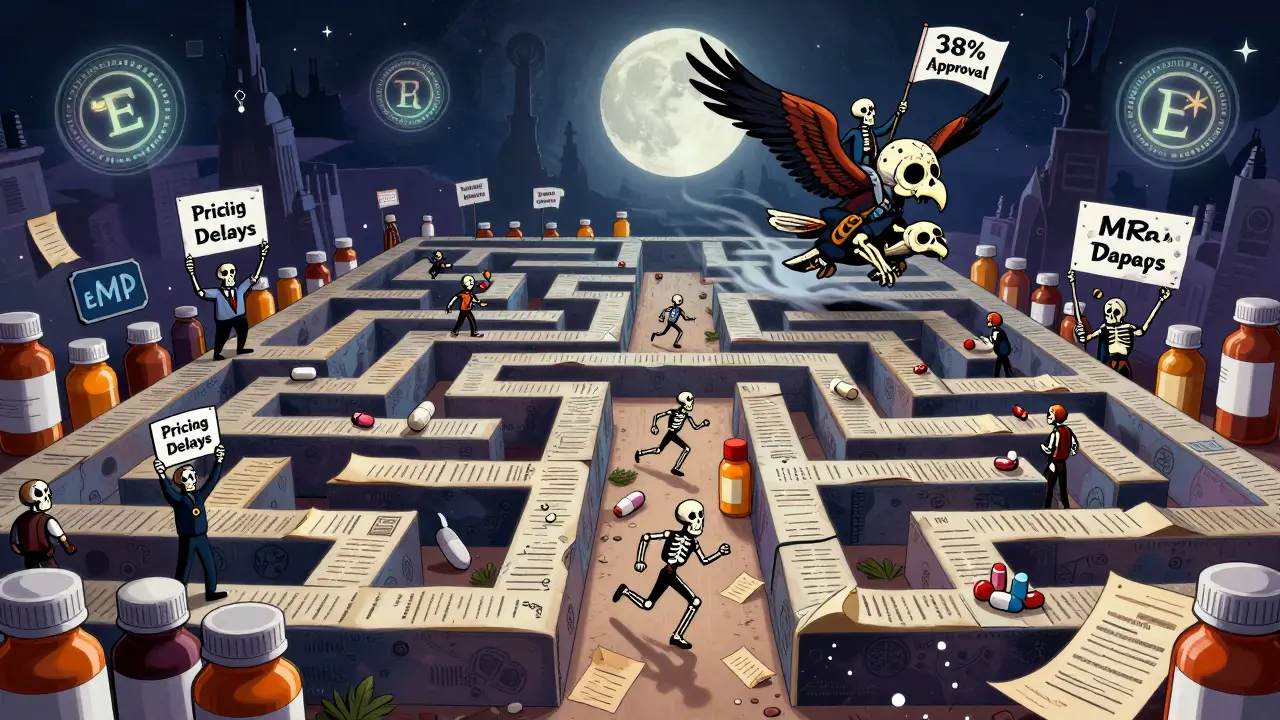
Why Generic Prices Stay Low-Even When Approval Takes Forever
Generics make up 65% of all prescriptions in the EU by volume, but only 18% by value. That’s because they’re cheap. How? Competition. The system is designed to let multiple generic makers enter after patent expiry. In 2024, Indian companies won 38% of all EU generic approvals-up from 29% in 2020. European firms like Sandoz and Viatris still hold 52%, but they’re playing a different game. They use the Centralized Procedure to launch fast and dominate the market before cheaper competitors arrive.
But here’s what most people don’t realize: approval speed doesn’t always equal market speed. Even when a generic is approved, it can sit on a warehouse shelf for months because reimbursement hasn’t been set. In France, it can take 10 months after approval to get listed for public reimbursement. In Germany, it’s 6. In Poland, it’s 14. The regulatory approval is just the first step. The real race is with payers.
What Generic Manufacturers Actually Deal With
Companies don’t just submit paperwork. They fight bureaucracy.
Germany’s BfArM requires extra pharmacodynamic studies for inhalers. France’s ANSM demands pediatric formulation details. Italy wants additional stability data for polymorphic compounds. The EMA sets the baseline, but national agencies layer on their own rules. A 2025 ABPI survey found 68% of generic companies say inconsistent bioequivalence requirements are their biggest headache.
And then there’s the paperwork. By 2026, every product’s information must be submitted in XML format as electronic product information (ePI). That means companies need new IT systems. White & Case estimates this will cost €180,000-€250,000 per firm. Smaller generics can’t afford it. Big ones can. The system is becoming more efficient, but also more expensive.
Mylan (now Viatris) reported in its 2024 annual report that MRP delays added €3.2 million in carrying costs per high-value generic launch. That’s not a one-off. It’s the norm.
Who Benefits-and Who Gets Left Behind
The 2025 reforms were meant to make generics faster, cheaper, and more reliable. And in many ways, they are.
Patients benefit from quicker access. The EU expects generic prescription rates to rise from 65% to 69.2% by 2028. That’s billions in savings.
But the system still favors big players. The €490 million sales threshold for Transferable Exclusivity Vouchers-new in 2025-means only the top 5% of generic companies can trade their market protection rights. Mid-sized firms get squeezed. And while the obligation to supply rule sounds good, it’s only as strong as the weakest regulator. In countries with thin healthcare budgets, enforcement is weak. That’s where shortages still happen.
Indian manufacturers are winning because they’re agile. They don’t waste time chasing national approvals. They go straight for the Centralized Procedure or pick one strong market and use MRP. They’re also cheaper to operate. European firms are stuck with legacy systems, unionized workforces, and higher compliance costs.
What’s Next for Generic Drugs in Europe
The next big deadline is July 1, 2026. That’s when the new 8+1 data protection rule fully kicks in. That’s when we’ll see the first wave of generics hitting the market for high-value biologics that were previously locked down.
The EU is also rolling out Joint Health Technology Assessment (HTA) starting January 1, 2025. That means multiple countries will review a drug’s clinical value together. It’s supposed to cut down on duplication. But it’s also adding a new layer of bureaucracy. Will it speed things up? Or just make approvals slower and more political?
And then there’s the US-EU Framework Agreement, effective September 1, 2025. It adjusts tariffs on key pharmaceutical ingredients. We don’t know yet if it will make generic production cheaper or more expensive. But it’s another variable in an already complicated equation.
The bottom line? The EU’s generic system is no longer broken-it’s evolving. It’s faster than it was five years ago. It’s more transparent. But it’s also more expensive and more complex. The companies that win aren’t the ones with the best lawyers. They’re the ones with the best data, the best IT, and the best strategy for picking the right approval path.
If you’re a patient, you’ll get cheaper drugs sooner. If you’re a manufacturer? You’d better know your way around the maze.
How long does it take to get a generic drug approved in the EU?
Approval times vary by pathway. The Centralized Procedure takes about 180 days under 2025 rules. The Mutual Recognition Procedure averages 132.7 days but often takes longer due to national delays. The Decentralized Procedure averages 247 days, with 37% of applications delayed over six months. National approvals take 180-240 days. These are just approval times-reimbursement can add another 6-14 months.
What’s the difference between the Centralized and Mutual Recognition Procedures?
The Centralized Procedure gives you approval across all EU countries with one application to the EMA. It’s faster for wide launches but costs over €1.5 million. The Mutual Recognition Procedure starts with approval in one country, then asks others to accept it. It’s cheaper (€180,000-€220,000) but slower and riskier because countries can block or delay acceptance, even after technical approval.
Why do generic drugs cost so little in the EU even after approval?
Multiple generic manufacturers enter the market after patent expiry, creating intense price competition. Once three or four generics are on the shelf, prices drop by 70-90% from the brand-name level. The EU’s reimbursement systems also pressure manufacturers to lower prices to stay listed. This is why generics make up 65% of prescriptions but only 18% of spending.
How has the 2025 Pharma Package changed data protection for generics?
Before 2025, brand-name drug data was protected for 10 years. Now, it’s 8 years of data exclusivity plus 1 year of market exclusivity-9 years total. If the drug meets public health goals (like treating rare diseases), it can be extended to 10 years. This means generics can enter sooner, especially for biologics, cutting launch delays by up to 18 months for some drugs.
Are Indian generic manufacturers dominating the EU market?
Yes. In 2024, Indian companies secured 38% of all EU generic approvals, up from 29% in 2020. They’re winning because they’re low-cost, agile, and focused on the Centralized Procedure or high-reimbursement markets. European firms still hold 52% of the market share, but they’re mostly large players like Sandoz and Viatris using expensive, strategic approvals to dominate early.
What’s the biggest challenge for generic companies today?
The biggest challenge is inconsistent national requirements. Even though the EMA sets EU-wide standards, countries like Germany, France, and Italy add their own rules-extra studies, different impurity limits, unique documentation. A 2025 survey found 68% of generic companies cite this as their top regulatory hurdle. It makes scaling across Europe unpredictable and expensive.
Layla Anna
December 31, 2025 AT 15:51Kristen Russell
January 1, 2026 AT 03:09jaspreet sandhu
January 2, 2026 AT 10:59Alex Warden
January 2, 2026 AT 17:40Olukayode Oguntulu
January 2, 2026 AT 20:15LIZETH DE PACHECO
January 4, 2026 AT 10:46Lee M
January 5, 2026 AT 18:59Todd Nickel
January 6, 2026 AT 22:16Bryan Anderson
January 8, 2026 AT 14:28Heather Josey
January 9, 2026 AT 00:07Matthew Hekmatniaz
January 10, 2026 AT 15:02Stephen Gikuma
January 11, 2026 AT 20:26