Constipation isn’t just about going to the bathroom less often. It’s when your stools become hard, dry, and painful to pass - or when you feel like you haven’t fully emptied your bowels, even after trying. If you’re having fewer than three bowel movements a week, and it’s been going on for weeks or months, you’re not alone. About one in three people who visit a doctor for gut issues are dealing with constipation. In the U.S. alone, over 2.5 million people seek medical help for it every year. It’s not a joke. It’s not just "being regular." It’s a real, often misunderstood problem that can drag on for years if you don’t know how to tackle it properly.
Why Your Body Isn’t Moving Things Along
Constipation happens when your colon absorbs too much water from your stool. That makes it hard, dry, and stubborn. But why does this happen? It’s rarely just one thing. There are two main categories: primary (functional) and secondary causes.Primary causes are lifestyle-based. Most people don’t get enough fiber - the average American eats only 15 grams a day, but experts recommend 25 to 30 grams. Not enough water? That makes it worse. If you’re adding fiber but not drinking enough, you might end up even more backed up. Physical inactivity plays a role too. Sitting all day slows down your gut. And then there’s ignoring the urge. If you keep putting off going to the bathroom, your body eventually stops sending the signal.
Secondary causes are medical. Medications are a huge factor. Opioids? Up to 95% of people on long-term painkillers get constipated. Calcium channel blockers for blood pressure, tricyclic antidepressants, iron supplements - all of them can slow things down. Medical conditions like diabetes (affects nearly 60% of patients), hypothyroidism, Parkinson’s, and multiple sclerosis also directly interfere with nerve signals to the gut. Even after a stroke or spinal injury, bowel function can go haywire. And yes, it’s more common in women and older adults. After age 60, your risk goes up by about 1.5% every year.
The Four Main Types of Constipation
Not all constipation is the same. Doctors classify it into four types, and knowing which one you have changes everything.Normal transit constipation is the most common - about 60% of cases. Your stool moves through your colon at a normal speed, but you still feel like you’re straining, passing hard stools, or not emptying fully. This is often tied to pelvic floor dysfunction or poor toilet habits.
Slow transit constipation means your colon is sluggish. Stool takes more than 72 hours to move through. This type doesn’t respond well to fiber alone. It’s more common in younger women and can run in families.
Defecatory disorders affect 20-50% of chronic cases. It’s not that stool isn’t moving - it’s that your pelvic floor muscles aren’t working right. You might be pushing, but the muscles tighten instead of relaxing. This is why some people feel like they’re “pushing into a wall.” A balloon expulsion test or anorectal manometry can confirm this.
Refractory constipation is when nothing works. You’ve tried fiber, water, laxatives - and you’re still stuck. This affects 15-20% of people with chronic constipation. Often, there’s an underlying nerve issue, visceral hypersensitivity, or a combination of factors that make standard treatments useless.
Laxatives: What Actually Works (and What Doesn’t)
Laxatives aren’t all created equal. Some are helpful. Others are overhyped - or even risky if used wrong.Bulk-forming laxatives (like psyllium or methylcellulose) are great for normal transit constipation. They soak up water and swell up, making stool softer and easier to pass. But here’s the catch: you must drink at least 8 ounces of water with each dose. If you don’t, they can turn into a blockage. They’re safe for long-term use, but they take a few days to kick in.
Osmotic laxatives like polyethylene glycol (PEG 3350) are the gold standard. They pull water into the colon without irritating it. Studies show 65-75% of people get relief with 17g daily. It’s gentle, doesn’t cause dependency, and is safe for months or even years. Lactulose and magnesium hydroxide work too, but they can cause gas or cramps.
Stimulant laxatives (senna, bisacodyl) get things moving fast. They’re good for short-term use - think a few days after surgery or a medication change. But if you use them longer than 12 weeks, you risk something called cathartic colon: your colon loses its natural ability to contract. The American Gastroenterological Association says to avoid stimulants beyond 3 months.
Stool softeners like docusate sodium? Don’t bother. Studies show they’re barely better than a placebo. They’re often prescribed out of habit, not science.
For stubborn cases, doctors turn to prescription options: lubiprostone, linaclotide, and plecanatide. These don’t just stimulate - they actually increase fluid secretion in the gut. They work for 40-60% of people with refractory constipation, especially if it’s linked to IBS. But they’re expensive. Linaclotide alone costs over $1,200 a year.

Long-Term Management: It’s Not Just About Pills
If you’re dealing with constipation for more than a few weeks, pills alone won’t fix it. You need a system.Start with fiber - but go slow. Jumping from 15g to 30g overnight? You’ll bloat, gurgle, and feel worse. Add 5g every 3-4 days. Focus on soluble fiber: oats, beans, apples, chia seeds. It holds water better than wheat bran. And pair it with water - add 250-500ml for every extra 5g of fiber.
Hydration matters more than you think. Aim for 1.5 to 2 liters of water daily. Coffee? Yes - it triggers the gastrocolic reflex. A morning cup can nudge your bowels along. Alcohol and sugary drinks? Skip them. They dehydrate you.
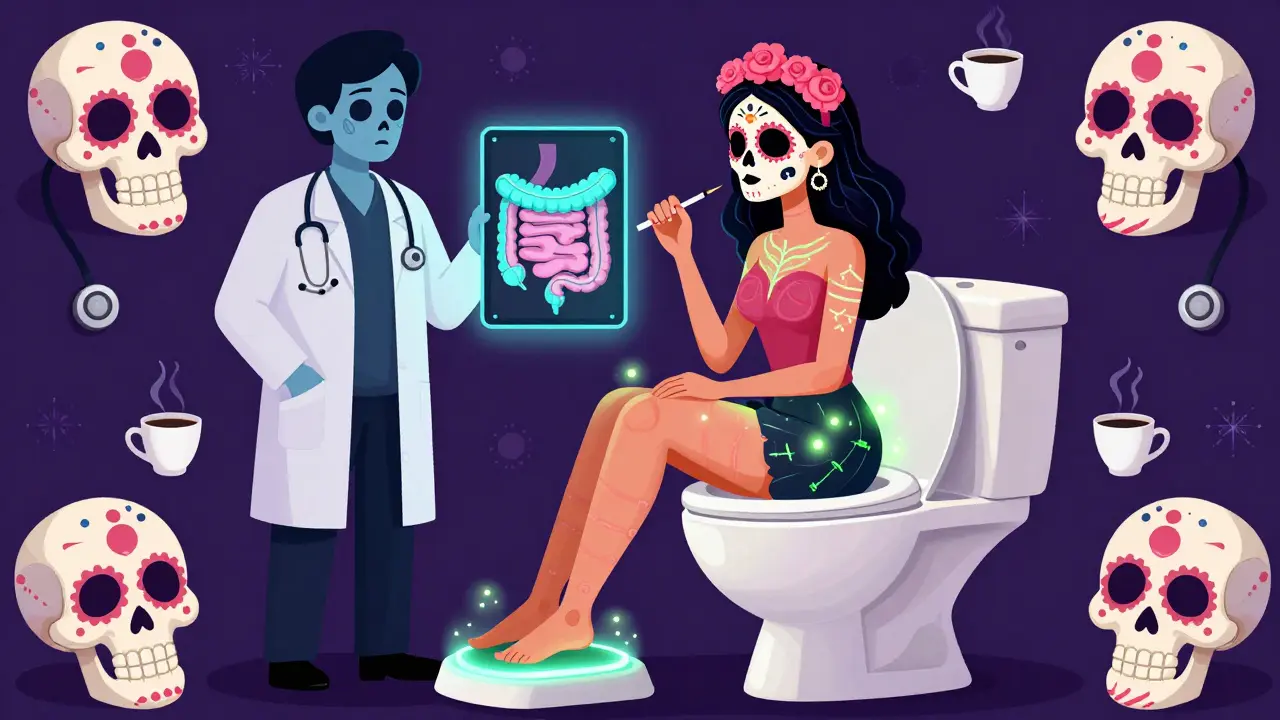
Train your body to go. Sit on the toilet for 10-15 minutes after breakfast. That’s when your gut is most active. Don’t rush. Don’t strain. Use a footstool to elevate your feet. That 35-degree hip angle mimics squatting - and studies show it cuts straining by 60%. It’s that simple.
Biofeedback therapy works for pelvic floor dysfunction. It’s like physical therapy for your butt. You work with a specialist for 6-8 weekly sessions. Sensors show you when your muscles are tightening instead of relaxing. Over time, you learn to control them. Success rates? 70-80%.
For those who’ve tried everything and still struggle: sacral nerve stimulation (a tiny device implanted near the tailbone) helps 60-70% of people. Surgery? Only for less than 1% of cases - when the colon is completely paralyzed.
What You Should Never Do
There are red flags you can’t ignore. If you’ve lost weight without trying, noticed blood in your stool, or your bowel habits changed suddenly and lasted more than 6 weeks - get checked. These could be signs of something serious like colorectal cancer. The American College of Gastroenterology says: don’t wait.Also, don’t fall for the myth of "laxative dependency." It’s not that your body gets addicted. It’s that if you rely on stimulants for years, your colon forgets how to work on its own. That’s why osmotic laxatives like PEG are the safer long-term choice.
And please - don’t blame yourself. Constipation isn’t caused by being lazy or eating "bad" food. It’s a complex mix of nerves, muscles, hormones, and meds. Many people suffer for years because their doctor didn’t take it seriously. You deserve better care.
Real Stories, Real Results
One 52-year-old woman in Glasgow - who’d been constipated for 12 years - finally got relief after combining three things: 25g of psyllium husk daily, 2 liters of water, and a footstool during morning toilet time. She also drank coffee every day. Within 8 weeks, she was going regularly. No pills. No pain.Another man, on long-term opioids for back pain, tried everything - until his doctor switched him from senna to PEG 3350 and added daily walks. His bowel movements went from once every 5 days to daily. He stopped needing emergency visits.
These aren’t miracles. They’re science. And they’re repeatable.
The Bigger Picture
Constipation costs the U.S. over $1.7 billion a year. The global laxative market hit $2.3 billion in 2022. But most of that money is spent on temporary fixes, not long-term solutions. The future is in better diagnostics - like AI apps that analyze your pelvic floor movement using your smartphone camera. And new drugs like tenapanor are helping people with IBS-related constipation. Research is also looking at gut bacteria. One study found that 68% of constipated people are missing a specific microbe: Bacteroides uniformis. Probiotics targeting this could be the next breakthrough.But right now, the best tools are simple: fiber, water, posture, and patience. No magic pills. No quick fixes. Just consistent, smart habits.
Byron Duvall
February 27, 2026 AT 19:34Katherine Farmer
March 1, 2026 AT 14:50Sophia Rafiq
March 2, 2026 AT 15:58Noah Cline
March 3, 2026 AT 02:17Lisa Fremder
March 3, 2026 AT 22:10Miranda Anderson
March 4, 2026 AT 12:52Gigi Valdez
March 6, 2026 AT 12:16Sneha Mahapatra
March 6, 2026 AT 16:49bill cook
March 6, 2026 AT 20:31Full Scale Webmaster
March 7, 2026 AT 18:49Brandie Bradshaw
March 9, 2026 AT 17:19Angel Wolfe
March 10, 2026 AT 14:53Ajay Krishna
March 11, 2026 AT 09:11Charity Hanson
March 12, 2026 AT 10:23