When a patient picks up a generic pill at the pharmacy, they expect it to work just like the brand-name version. That expectation is built on a strict scientific standard: bioequivalence. But for simple pills and capsules, proving this is straightforward. For complex generics-like inhalers, topical creams, injectable gels, or nasal sprays-it’s a whole different battle. These aren’t just copies. They’re intricate systems designed to deliver drugs to specific spots in the body, and proving they behave the same way as the original is one of the toughest challenges in modern pharmacy.
What Makes a Generic "Complex"?
Not all generic drugs are created equal. The term "complex generic" refers to products that go beyond the classic small-molecule tablet. These include drugs delivered through the skin (like corticosteroid creams), lungs (inhaled asthma medications), eyes (eye drops), or ears (otic suspensions). They also cover advanced delivery systems like liposomes, nanoparticles, extended-release injectables, and drug-device combos like auto-injectors or metered-dose inhalers. The active ingredient might be a peptide, a polymer, or a naturally derived compound that’s hard to replicate. The formulation isn’t just a mix of chemicals-it’s a carefully engineered structure where particle size, viscosity, pH, and even the order of mixing matter.The FDA defines these as products where the approval path isn’t clear-cut. They’re not simple copies. They’re scientific puzzles. And that’s why, despite generics making up 90% of U.S. prescriptions, less than 15% of complex generic applications get approved-compared to over 80% for simple ones.
Why Bioequivalence Is Harder Than It Looks
Bioequivalence means the generic drug releases the same amount of medicine into the body at the same rate as the brand-name version. For a regular pill, you measure blood levels over time. You check two numbers: AUC (total exposure) and Cmax (peak concentration). If both fall within 80-125% of the original, you’re good to go.But that doesn’t work for a cream applied to eczema-prone skin. The drug isn’t meant to enter the bloodstream-it’s meant to sit on the skin and reduce inflammation. Measuring blood levels tells you nothing about whether the cream works. Same for an inhaler: the drug needs to land in the lungs, not show up in the blood. You can’t stick a needle into someone’s lung to measure concentration. So how do you prove it works the same?
This is the core problem. Traditional bioequivalence studies are useless for locally acting drugs. The tools we’ve used for decades just don’t apply. And that’s why regulators and manufacturers are stuck.
The Reverse-Engineering Nightmare
Generic makers don’t get the original formula. They don’t get the manufacturing blueprint. They get a product on the shelf and have to figure out how it works-like a chef trying to recreate a secret recipe by tasting it and feeling its texture.They have to de-formulate the brand-name drug. That means breaking it down chemically, testing how each ingredient behaves, reverse-engineering the particle size distribution, analyzing the emulsion structure, figuring out the spray pattern of an inhaler. One tiny change-a different stabilizer, a slightly higher pH, a different mixing speed-can alter how the drug penetrates skin or deposits in the lungs. And if it changes, the drug might not work the same way.
Some complex products have over 10 ingredients. Each one can interact. Each one can degrade. Each one can shift the product’s behavior under heat, humidity, or light. Stability testing becomes a months-long marathon. And even then, you might not know if you’ve nailed it.
Regulatory Chaos Across Borders
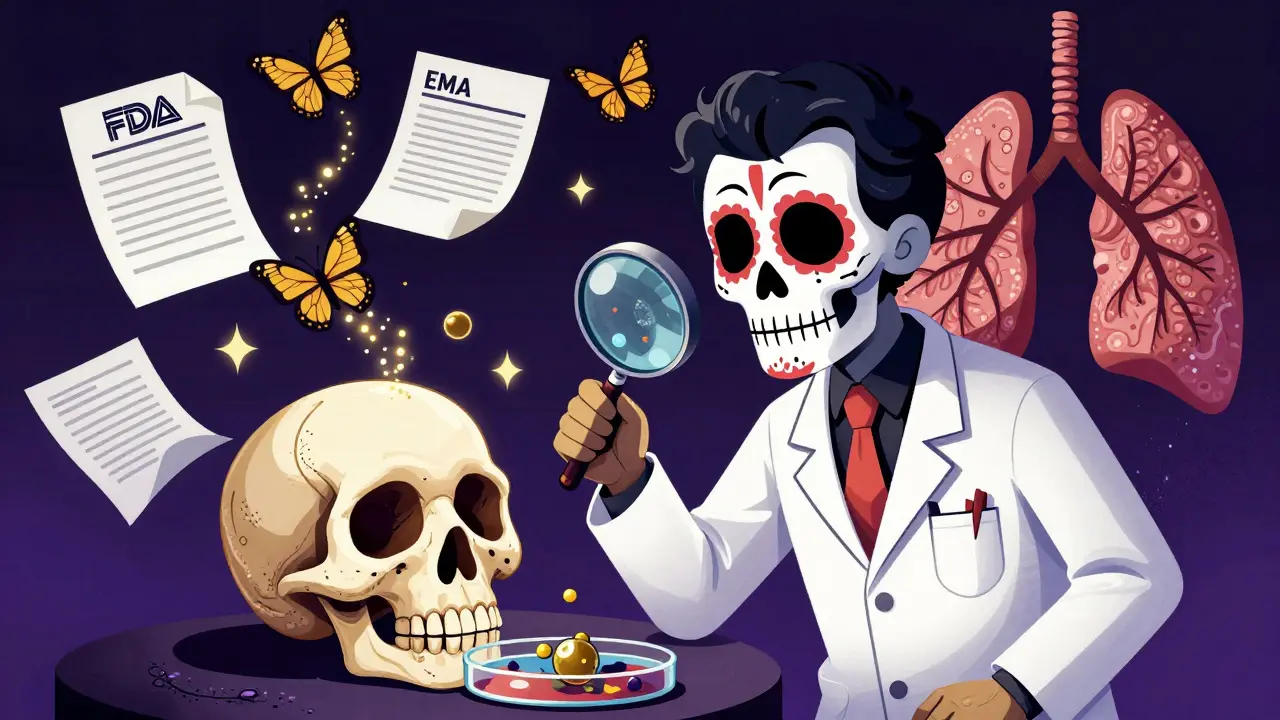
The FDA has one set of expectations. The European Medicines Agency (EMA) has another. For a topical gel, the FDA might accept in vitro permeation studies. The EMA might demand clinical endpoint data. For an inhaler, one agency might require aerosol particle size distribution data, while another insists on lung deposition imaging. That means companies have to run duplicate studies, pay for multiple batches, and delay approvals by years.One survey found that 89% of generic manufacturers said bioequivalence testing methods were their biggest challenge. Another 76% said stability testing was a nightmare. And 68% struggled just to characterize what they were making. These aren’t small problems. They’re systemic.
Costs and Failure Rates That Deter Innovation
Developing a simple generic takes about 18-24 months. A complex one? 36-48 months. The cost? Two to three times higher. And failure rates? Over 70% at the bioequivalence stage.That’s why so few companies try. The risk is too high. The science is too uncertain. The regulatory path is too unpredictable. The market for complex generics is worth $120 billion in the U.S. alone. Yet only a handful of products have made it through. That’s not because there’s no demand. It’s because the path to approval is a minefield.
How the FDA Is Trying to Fix It
The FDA knows this is a problem. They’ve created the Complex Generic Drug Products Committee. They’ve held workshops. They’ve published 15 new guidance documents between 2022 and 2023 covering topical corticosteroids, inhaled budesonide, and testosterone gels.They’re pushing Quality by Design (QbD). That means manufacturers need to think about stability and bioequivalence from day one-not as an afterthought. Choose excipients that won’t degrade. Test compatibility with the active ingredient early. Account for environmental stress. Build in controls.
They’re also investing in new tools. Physiologically-based pharmacokinetic (PBPK) modeling is one. Instead of measuring blood levels, you simulate how the drug moves through the body based on its physical properties. Early studies suggest this could cut bioequivalence testing needs by 40-60% for certain products.
They’re funding better in vitro models for lung deposition. New imaging techniques to track how creams penetrate skin. Standardized methods for measuring particle size in nanosuspensions. These aren’t science fiction-they’re happening now.
What’s Next for Complex Generics?
The future hinges on three things: better science, better tools, and better alignment.Industry and academia are teaming up. The Center for Research on Complex Generics (CRCG) has published 12 new analytical protocols in the last two years for liposomes, nanoparticles, and other tricky formulations. That’s progress.
Regulatory harmonization is coming. The International Council for Harmonisation (ICH) is finalizing guidelines on elemental impurities in complex products by late 2024. If global agencies start speaking the same language, approvals could speed up by 25-30% in the next five years.
Market projections show complex generic sales will jump from $15 billion in 2023 to $45 billion by 2028. That’s a 24.6% annual growth rate. The demand is there. The patients need it. The cost savings are massive.
But it won’t happen without better science. Without regulators being willing to accept new methods. Without manufacturers having the resources to tackle the technical hurdles.
Why This Matters to Patients
Think about someone with asthma. Their inhaler costs $300 a month. A generic version could cost $50. But if that generic doesn’t deliver the drug properly to the lungs, it won’t work. The patient suffers. The system still pays for emergency visits.Or someone with chronic eczema. Topical steroids are essential. But if the generic cream doesn’t penetrate the same way, the rash doesn’t clear. The patient tries another one. And another. And another. The cycle continues.
Complex generics aren’t just about saving money. They’re about access. They’re about fairness. They’re about making sure everyone-no matter their income-can get the medicine they need.
Right now, too many patients are stuck with expensive brand-name drugs because the science hasn’t caught up. But the tools are being built. The path is being cleared. It’s slow. It’s hard. But it’s happening.
Why can’t we just use blood tests to prove bioequivalence for all generic drugs?
Blood tests only work when the drug is meant to enter the bloodstream. For inhalers, creams, eye drops, or nasal sprays, the drug is designed to act locally-on the skin, in the lungs, or in the eye. Measuring blood levels tells you nothing about whether the drug reached the right spot or worked as intended. That’s why new methods like skin penetration models and lung deposition simulations are needed.
How long does it take to develop a complex generic compared to a regular one?
A regular generic takes 18-24 months. A complex generic takes 36-48 months-sometimes longer. That’s because developers must reverse-engineer intricate formulations, run dozens of stability tests, and design new bioequivalence studies from scratch. Many fail at the final stage, making the process even longer.
Why do some complex generics never make it to market?
Over 70% of complex generic applications fail at the bioequivalence stage. Reasons include: inability to match the original’s performance, lack of standardized testing methods, regulatory differences between countries, and instability of the formulation under real-world conditions. Without a clear path to approval, many companies simply don’t invest.
What role does the FDA play in helping complex generics get approved?
The FDA provides guidance documents, hosts scientific workshops, and offers early feedback through its Complex Generic Drug Product program. Companies that engage early with the FDA have a 35% higher chance of approval. The agency is also funding research into new tools like PBPK modeling and advanced imaging to replace outdated testing methods.
Are complex generics safe and effective?
Yes-once approved. The FDA requires that complex generics meet the same safety and effectiveness standards as brand-name drugs. The difference isn’t in quality-it’s in how hard it is to prove equivalence. Approved complex generics are just as safe and effective as their brand-name counterparts.
rasna saha
January 25, 2026 AT 08:33This hit home for me. My mom’s asthma inhaler costs $400 a month, and the generic they tried didn’t work at all. She ended up in the ER. It’s not just about money-it’s about trust. I’m so glad someone’s finally talking about this.
Thank you for writing this.
James Nicoll
January 25, 2026 AT 20:33So let me get this straight-we’ve got a $120 billion market where 70% of attempts fail because we’re asking scientists to reverse-engineer a cake by smelling it and then judging it by how well it floats in water?
Yep. Capitalism.
John Wippler
January 26, 2026 AT 13:03Look, I’ve worked in pharma R&D for 18 years. This isn’t just hard-it’s *heroic*. Imagine trying to recreate a symphony by listening to a 3-second clip on your phone while wearing noise-canceling headphones in a subway. That’s what these teams do every day.
And yet? They still show up. They still tweak the pH, the particle size, the emulsifiers-sometimes for years-just so a kid in rural Ohio can breathe without going broke.
We need to celebrate these people. Not just tolerate them. Celebrate them.
Also-PBPK modeling? That’s the future. We’re not just catching up. We’re leapfrogging.
Kipper Pickens
January 28, 2026 AT 07:35From a regulatory science standpoint, the disconnect lies in the ontological mismatch between traditional pharmacokinetic paradigms and the physicochemical complexity of topically and locally administered drug delivery systems. The conventional AUC/Cmax framework is predicated on systemic absorption, which is an inappropriate surrogate endpoint for mucoadhesive, transdermal, or aerosolized formulations where bioavailability is spatially constrained and mechanistically heterogeneous.
Furthermore, the lack of harmonized in vitro-in vivo correlation (IVIVC) models across jurisdictions introduces unacceptable variability in equivalence thresholds, especially when dealing with non-Newtonian rheological profiles or multilamellar vesicle stability in liposomal systems.
Aurelie L.
January 29, 2026 AT 01:32My cousin’s eczema cream didn’t work. She cried. That’s it. I’m done.
Angie Thompson
January 29, 2026 AT 04:05Okay but imagine if your phone charger was $300 and the $50 one didn’t even turn the phone on 😭
That’s what’s happening with these inhalers. And it’s not fair. We need this. We NEED this. 🙏✨
Also-PBPK modeling sounds like sci-fi but I’m here for it. Let’s gooooo!
eric fert
January 29, 2026 AT 08:18Let’s be real. This whole thing is a scam. The brand-name companies are just hiding behind ‘complexity’ to keep prices high. They fund the FDA. They write the guidelines. They control the patents. And now they’re pretending they can’t copy their own damn products? Please.
There’s no ‘science’ here. There’s corporate greed dressed up in lab coats. If they can make the original, they can copy it. They just don’t want to.
And don’t even get me started on ‘Quality by Design.’ That’s just a fancy way of saying ‘we’re not going to tell you how we made it.’
Curtis Younker
January 30, 2026 AT 01:56Man, I’ve seen this firsthand. My brother’s on a nasal spray for chronic sinusitis. Brand name? $600/month. Generic? Tried three. One made his nose bleed. One didn’t touch the congestion. One? Worked-but took 8 months to get approved.
And here’s the kicker: the *same* company that makes the brand also makes one of the generics. They’re literally the same people. But the FDA makes them do *different* tests. Why?
We need a system that trusts science, not bureaucracy. We need to cut the red tape and let the engineers do their jobs. This isn’t rocket science-it’s pharmacy. And it’s broken.
Simran Kaur
January 30, 2026 AT 05:31I come from a small town in India where asthma inhalers are a luxury. We have to choose between food and medicine. This article made me cry-not because it’s sad, but because it’s true.
When I was a kid, my aunt used to boil water and breathe in the steam because she couldn’t afford the inhaler. Now I work in a lab trying to make generics. I want to make sure no one else has to do that.
Thank you for seeing us. For seeing the science. For seeing the people.
Neil Thorogood
January 31, 2026 AT 05:27Oh wow. The FDA is ‘investing in new tools.’ 😂
Meanwhile, my cousin’s kid still can’t breathe because the ‘bioequivalent’ inhaler is just a fancy plastic tube with air.
Y’all are doing a TED Talk while the house is on fire.
Jessica Knuteson
February 1, 2026 AT 17:42They’re not trying to copy they’re trying to profit
Robin Van Emous
February 3, 2026 AT 15:03I really appreciate how thoughtful this post is. It’s easy to get frustrated, but this breaks it down with care. I think the key is collaboration-patients, scientists, regulators, and manufacturers all talking to each other, not past each other.
And yes-PBPK modeling is the future. We’ve got the tech. We just need the will. Let’s not let bureaucracy kill innovation. We can do better.
Skye Kooyman
February 4, 2026 AT 12:49Interesting. I wonder if AI could help simulate the particle interactions faster.