When your heart muscle weakens or stiffens, it doesn’t just feel like fatigue-it can be life-threatening. Cardiomyopathy isn’t one disease. It’s a group of conditions that attack the heart muscle directly, making it harder to pump blood. And while many people think of heart disease as clogged arteries, cardiomyopathy is different. It’s about the muscle itself. The three main types-dilated, hypertrophic, and restrictive-each behave in completely different ways, require different treatments, and carry different risks. Knowing which one you’re dealing with isn’t just academic; it changes everything.
Dilated Cardiomyopathy: The Heart That Gets Too Big
Dilated cardiomyopathy (DCM) is the most common type, making up about half of all cases. Think of it as a heart that’s stretched thin. The left ventricle-the main pumping chamber-gets enlarged, often beyond 55 mm in men or 50 mm in women. The walls become paper-thin, sometimes less than 10 mm. The muscle loses its grip. Instead of squeezing hard, it just flops. Ejection fraction drops below 40%, meaning less than 40% of the blood is being pushed out with each beat. Normal is 55-70%.
This isn’t always obvious. People might feel tired, short of breath climbing stairs, or notice swelling in their legs. But DCM can sneak up. Some cases are silent until someone collapses from arrhythmia or heart failure. About one in every 2,500 adults has it. And it’s not just aging-it hits younger people too.
Why does this happen? In 30-35% of cases, it’s genetic. Mutations in genes like TTN or LMNA mess with how heart cells stick together and contract. In another 30%, it’s from long-term alcohol abuse-more than 80 grams a day for years (that’s about six standard drinks). Viral infections like coxsackievirus can trigger it. Chemo drugs like doxorubicin? They can burn out heart muscle if given in high doses. Autoimmune diseases like sarcoidosis can also attack the heart.
Diagnosis starts with an echocardiogram. If the chamber is too big and the pump’s weak, that’s DCM. Cardiac MRI adds detail-showing scar tissue or inflammation. Genetic testing is recommended if there’s a family history. Treatment? It’s not one drug. It’s a combo: ARNIs like sacubitril/valsartan, beta-blockers, SGLT2 inhibitors (originally for diabetes), and sometimes aldosterone blockers. These reduce death risk by 30% over three years. In severe cases, an ICD (implantable defibrillator) prevents sudden cardiac arrest. For the worst cases, a transplant is the only option.
Hypertrophic Cardiomyopathy: The Heart That Gets Too Thick
If DCM is a stretched heart, hypertrophic cardiomyopathy (HCM) is a squeezed one. The walls thicken-often without warning. A wall thickness of 15 mm or more, with no high blood pressure or valve problem, means HCM. In many cases, the septum (the wall between the left and right ventricles) bulges more than the back wall. That’s called asymmetric septal hypertrophy. The heart doesn’t relax properly. It’s stiff. Blood can’t fill in between beats. That’s diastolic dysfunction.
What’s scary about HCM is who it affects. One in every 500 people has it. In Japan, it’s even more common-1 in 200. And it’s the #1 cause of sudden death in young athletes under 35. Why? Because during intense exercise, the thickened muscle blocks blood flow out of the heart. The heart races, but nothing comes out. That’s when arrhythmias strike. About 70% of HCM cases have this obstruction. The rest don’t-but they still struggle with fatigue and chest pain.
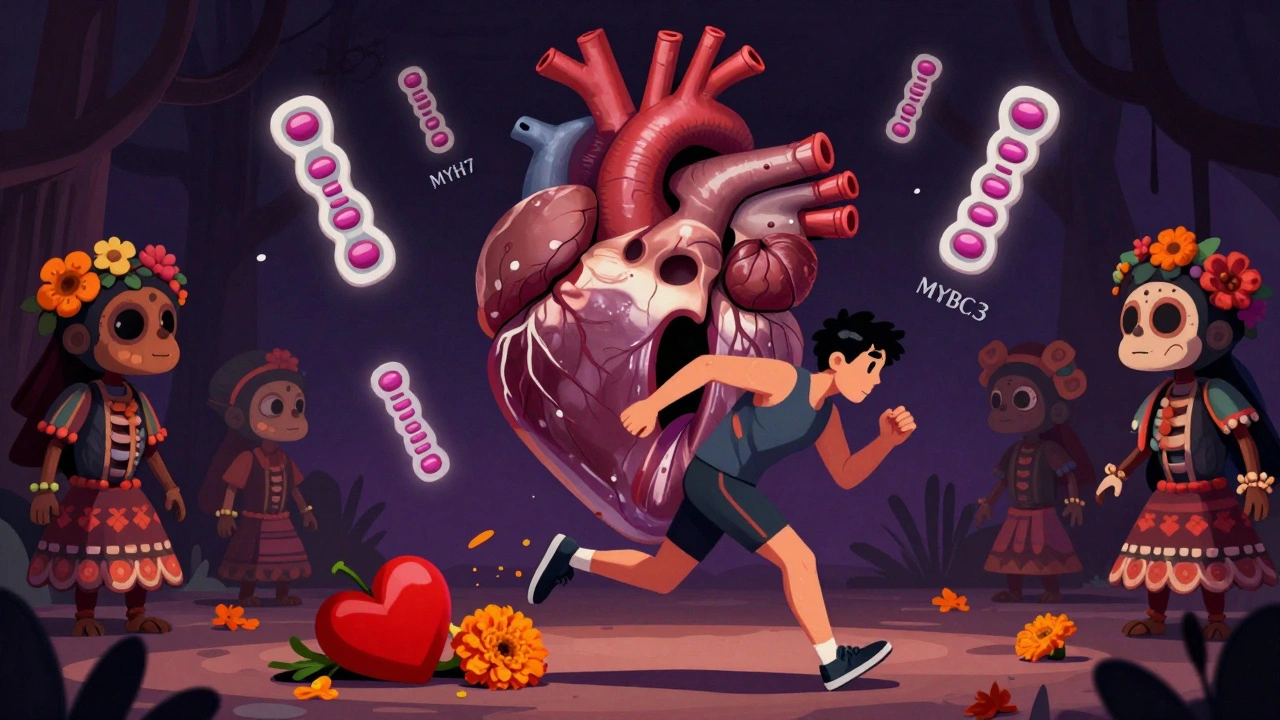
It’s mostly inherited. Around 60% of cases come from mutations in sarcomere genes: MYH7, MYBPC3, TNNT2. If a parent has it, each child has a 50% chance of inheriting it. Genetic testing panels (17 genes, $1,200-$2,500 in the U.S.) catch about 60% of cases. But not everyone with the gene gets sick. That’s why family screening is critical.
Diagnosis? Echocardiogram first. Then cardiac MRI to measure thickness and check for scarring. An exercise stress test can reveal hidden obstruction. Treatment isn’t one-size-fits-all. Beta-blockers help 70% of patients by slowing the heart and improving filling. Disopyramide reduces obstruction. For severe cases, two options: septal myectomy (surgical removal of excess muscle) or alcohol septal ablation (injecting alcohol to shrink the bulge). Both improve symptoms in 85% of patients. In 2022, the FDA approved mavacamten (Camzyos), a first-of-its-kind drug that directly targets the overactive heart muscle. It cuts the outflow gradient by 80% in trials.
But here’s the hard truth: even with treatment, 42% of HCM patients still have daily symptoms. And while non-obstructive HCM has a 95% five-year survival rate, obstructive cases drop to 70%. That’s why monitoring matters.
Restrictive Cardiomyopathy: The Heart That Won’t Fill
Restrictive cardiomyopathy (RCM) is rare-only 5% of cases-but it’s the hardest to diagnose. The heart doesn’t get big or thick. It looks normal on an echocardiogram. But it doesn’t expand. It’s like trying to fill a stiff balloon. The ventricles are small, the walls are thin, but the muscle is rigid. Blood can’t flow in properly. So the heart fills with pressure, not volume. That’s why the atria (upper chambers) swell-sometimes over 40 mm wide.
RCM doesn’t cause weak pumping. The ejection fraction stays above 50%. But the patient still feels breathless. Why? Because the lungs back up with fluid. The body retains salt and water. Fatigue sets in. Swelling follows. But because the pump isn’t failing, many doctors miss it. One study found 75% of RCM patients waited over a year for the right diagnosis.
RCM isn’t caused by the heart itself. It’s caused by what’s invading it. Sixty percent of cases are due to amyloidosis-when abnormal proteins (light chains) build up in the heart tissue. Sarcoidosis (15%) and hemochromatosis (10%) are next. In hemochromatosis, too much iron gets stored in the heart. In Fabry disease, fat builds up in cells. Cardiac MRI shows a telltale pattern: late gadolinium enhancement outside the coronary arteries, with extracellular volume over 35%. That’s fibrosis.
Diagnosis requires more than an echo. You need cardiac MRI, blood tests for biomarkers (like NT-proBNP), and often a biopsy. A biopsy confirms amyloidosis in 85% of cases. But it’s invasive. That’s why many wait until symptoms are severe.
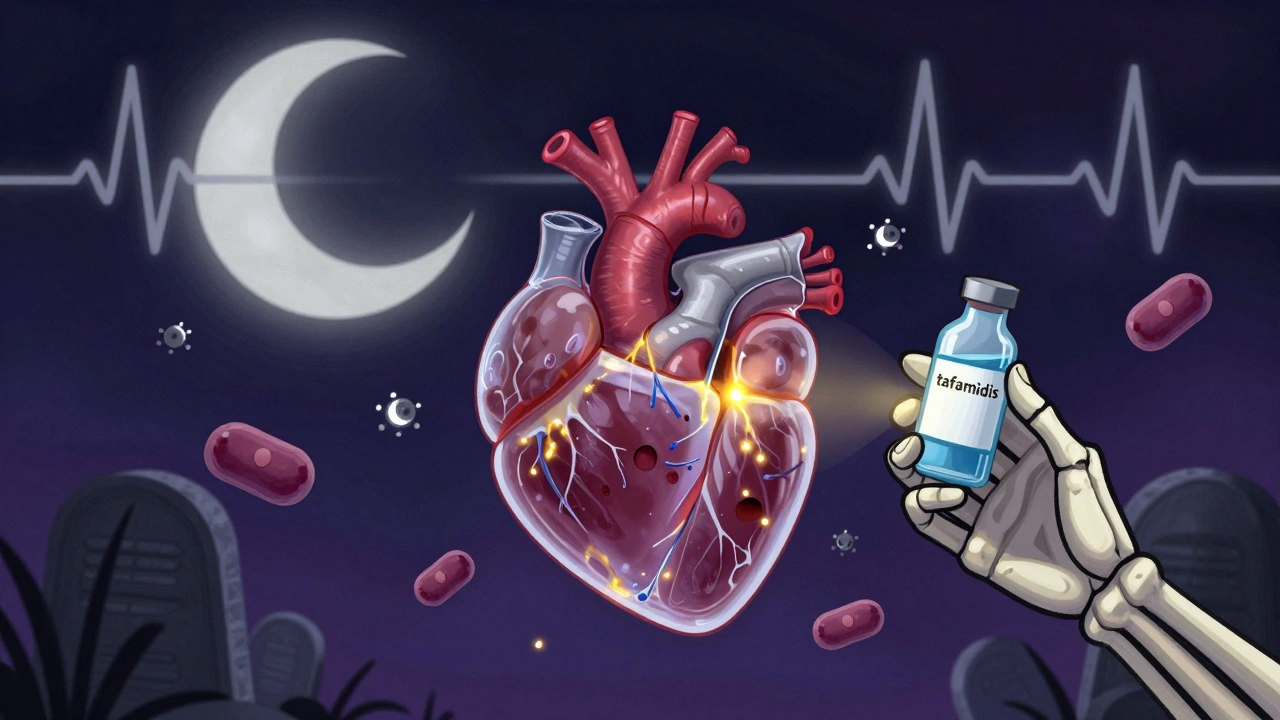
Treatment? You fix the root cause. For amyloidosis, drugs like tafamidis slow progression and improve walking distance by 25 meters in six months. Daratumumab targets the abnormal proteins. For hemochromatosis, regular blood removal (phlebotomy) can reverse damage if caught early. But here’s the catch: RCM has the worst prognosis. Five-year survival? Only 30-50%, depending on the cause. Amyloidosis patients face a grim reality-tafamidis costs $225,000 a year in the U.S. And not everyone has access.
Why Classification Matters
The American Heart Association and European Society of Cardiology updated their guidelines in 2020-2021 to stop calling heart failure from blocked arteries “ischemic cardiomyopathy.” That’s because it’s not a disease of the muscle-it’s a disease of the blood supply. The current system focuses on what’s wrong with the muscle itself. That shift changed everything. Now, doctors test for genes, look for infiltrates, and treat the root-not just the symptoms.
But misdiagnosis is still common. In community hospitals, only 35% correctly classify cardiomyopathy types. DCM gets mistaken for heart failure from high blood pressure. HCM gets written off as “just an athlete’s heart.” RCM? Often ignored until it’s too late.
And the future is changing fast. CRISPR-based gene editing for HCM is in early trials. Polygenic risk scores might predict who’ll develop HCM before symptoms appear. For DCM, gene therapies like AAV1/SERCA2a are being tested. But access remains unequal. Forty-five percent of U.S. counties don’t have a cardiomyopathy specialist.
What You Should Know
If you have a family history of sudden cardiac death before age 50, get screened-even if you feel fine. If you’ve had chemotherapy and now feel unusually tired, ask about heart function. If you’re an athlete and have unexplained shortness of breath, don’t brush it off.
Each type of cardiomyopathy has a different story. DCM is about weakness. HCM is about stiffness and blockage. RCM is about hidden invasion. But they all end up with the same risk: heart failure, arrhythmia, sudden death.
Early detection saves lives. And knowing which type you have? That’s the first step to the right treatment.
Can cardiomyopathy be cured?
There’s no universal cure, but some types can be managed effectively-or even reversed-if caught early. For example, hemochromatosis-related restrictive cardiomyopathy can improve with regular blood removal. Alcohol-induced dilated cardiomyopathy often gets better after quitting drinking. In rare cases, gene therapies or transplants may offer long-term solutions. But for most, treatment is lifelong and focuses on slowing progression, not reversing damage.
Is cardiomyopathy hereditary?
Yes, in many cases. About 30-40% of dilated cardiomyopathy cases, 60% of hypertrophic cases, and some restrictive forms (like Fabry disease) are inherited. If a close relative has cardiomyopathy, especially if they died suddenly under age 50, you should get screened. Genetic testing can identify mutations before symptoms appear, allowing early monitoring and prevention.
Can you exercise with cardiomyopathy?
It depends on the type. People with dilated cardiomyopathy can usually do light to moderate aerobic exercise with doctor approval. But those with hypertrophic cardiomyopathy, especially with obstruction, are often advised to avoid intense or competitive sports due to sudden death risk. Restrictive cardiomyopathy patients should avoid heavy lifting and extreme exertion. Always get a personalized exercise plan from a cardiologist.
What’s the difference between cardiomyopathy and heart failure?
Cardiomyopathy is a disease of the heart muscle itself. Heart failure is a syndrome-a result. You can have cardiomyopathy without heart failure (early stages). But most heart failure cases come from cardiomyopathy. Think of it like this: cardiomyopathy is the engine problem. Heart failure is the car not moving.
How do doctors tell apart restrictive cardiomyopathy and constrictive pericarditis?
They look similar on echo-both cause stiff hearts. But constrictive pericarditis is caused by a thickened sac around the heart, not the muscle itself. Cardiac MRI shows thickened pericardium in constriction, while RCM shows abnormal heart muscle. A key test: breathing changes. In constrictive pericarditis, heart pressures drop sharply during deep breathing. In RCM, they don’t. Biopsy or CT can confirm.
Are there new treatments on the horizon?
Yes. For hypertrophic cardiomyopathy, gene-editing therapies like VERVE-201 (targeting MYBPC3) are in early human trials. For amyloidosis, new drugs like vutrisiran are being tested to reduce protein buildup faster. In dilated cardiomyopathy, researchers are testing AAV gene therapy to restore calcium handling in heart cells. These aren’t available yet, but they represent a shift from symptom control to fixing the root cause.
Next Steps If You’re Concerned
If you have symptoms-fatigue, shortness of breath, palpitations, swelling-see a cardiologist. Don’t wait. Ask for an echocardiogram. If you have a family history, get screened even if you feel fine. Genetic counseling can help families understand risk. And if you’re diagnosed, don’t assume the worst. With modern care, many people live full, active lives. The key is knowing exactly what you’re dealing with-and getting the right treatment for your type.
Olivia Hand
December 6, 2025 AT 21:39Wow, this breakdown is insane. I never realized how much the muscle itself can go haywire without any plaque in sight. DCM’s genetic link to TTN mutations? That’s wild. My cousin was diagnosed at 29 with no history of drinking or chemo-turns out her dad had a silent mutation. Genetic testing saved her life. If you have unexplained fatigue and a family history, don’t wait. Get that echo.
And honestly? The fact that SGLT2 inhibitors-originally for diabetes-are now first-line for heart failure? That’s medical poetry. Pharma didn’t even see it coming.
Also, why is mavacamten only available in fancy hospitals? 225k/year for tafamidis? That’s not healthcare, that’s extortion.
Cardiomyopathy isn’t rare. It’s just ignored until someone drops dead on a treadmill.
Sangram Lavte
December 7, 2025 AT 09:51This is one of the clearest explanations I’ve ever read on cardiomyopathy. I’m from India and we rarely talk about this outside big cities. My uncle had HCM and they thought it was just high BP until he collapsed. Echocardiogram was the key. I shared this with my family. Thank you for writing this.
Stacy here
December 8, 2025 AT 17:50Let me tell you something they don’t want you to know. Cardiomyopathy isn’t just ‘genetic’ or ‘viral’-it’s a cover-up. Big Pharma doesn’t want you to know that heavy metals in vaccines and water supplies are triggering these mutations. Look at the rise in cases since 2010. Coincidence? Or is it the aluminum, the glyphosate, the 5G-induced cellular stress? They’re selling you drugs to manage symptoms while the real cause is hidden in your tap water and your child’s immunization record.
And don’t get me started on ‘gene therapy.’ They’re not fixing the gene-they’re locking you into a lifetime of dependency. The real cure? Detox your liver. Drink lemon water. Sleep in a Faraday cage. You think they’ll tell you that? No. Because the profit’s in the transplant.
Kyle Flores
December 8, 2025 AT 23:44Man, I read this whole thing and I’m just sitting here thinking about my buddy who passed last year. He was 34, played basketball every weekend, never smoked, ate clean. Got diagnosed with HCM two weeks before he collapsed. His mom had it too, but no one told him to get checked. I wish I’d pushed him harder.
For anyone reading this-especially if someone in your family died young and suddenly-get an echo. It takes 20 minutes. No radiation. No needles. Just a probe on your chest. You owe it to yourself and your family.
Also, if you’re an athlete and you get winded faster than usual? Don’t say ‘I’m just out of shape.’ Get checked. It could save your life.
Louis Llaine
December 10, 2025 AT 15:24So let me get this straight. We’ve got three types of heart diseases that all basically mean ‘your heart sucks,’ and we spend billions on drugs that don’t cure anything, while people in rural areas can’t even get a cardiologist?
And the solution is… more genetic testing? More expensive drugs? More transplants?
Meanwhile, my uncle quit drinking, started walking, and his DCM reversed. But nobody’s selling a $200k/year pill for ‘stop being an idiot.’
Jane Quitain
December 11, 2025 AT 12:38THIS IS SO IMPORTANT!!! I just found out my dad has DCM and I’m terrified but also so glad I read this!! I’m booking my echo right now!! You’re literally saving lives with this post!! ❤️🫀
Ernie Blevins
December 12, 2025 AT 07:24Everyone’s acting like this is some groundbreaking revelation. Nah. It’s just medicine being medicine. People get sick. Doctors try stuff. Some works. Some doesn’t. You think we’re gonna cure everything? Wake up. The heart’s a pump. It breaks. You fix it or you die. Stop romanticizing it.
Nancy Carlsen
December 13, 2025 AT 15:53Thank you for writing this with so much heart. 🫀 I’m a nurse in a rural ER and we see these cases all the time-misdiagnosed, ignored, dismissed. I’ve had patients cry because they thought they were ‘just old’ or ‘out of shape.’ This post? It’s the kind of thing I print and hand out. You’ve given people the words to fight for their lives. I’m so grateful.
And if you’re reading this and you’re scared? You’re not alone. We’ve got your back. You’re not a statistic. You’re a person. And your heart matters.
Ashley Farmer
December 15, 2025 AT 05:09Just wanted to say I read this after my mom got diagnosed with restrictive CM last month. We were lost. This explained everything in a way her cardiologist didn’t. The part about amyloidosis and the MRI patterns? That’s what finally made sense. I’m sharing this with our whole family. Thank you for making the complex feel human.