QT Prolongation Risk Calculator
Risk Assessment
This tool estimates your risk of QT prolongation based on medications and personal factors. It's not a medical diagnosis but a helpful guide for discussion with your doctor.
Risk Assessment Results
Estimated Risk Level
Key Risk Factors
Medical Recommendations
When you're taking an antipsychotic for schizophrenia, bipolar disorder, or severe depression, your doctor focuses on your mood, sleep, and thoughts. But there’s another silent conversation happening inside your heart-one that could turn dangerous if you're also taking another common medication. Many antipsychotics stretch out the heart’s electrical recovery time, called the QT interval. When you add another drug that does the same thing, the risk of a life-threatening heart rhythm goes up-not a little, but dramatically.
What Exactly Is QT Prolongation?
The QT interval is the time your heart takes to recharge between beats. You can see it on an ECG: it starts with the Q wave and ends with the T wave. If this interval gets too long-past 440 ms for men or 460 ms for women-it creates a dangerous window where the heart can misfire. The result? A chaotic, fast rhythm called torsades de pointes (TdP). It doesn’t always kill you, but when it does, it happens fast. And it’s not rare. Between 2010 and 2022, the FDA recorded 128 cases of TdP tied to people taking antipsychotics plus another QT-prolonging drug.
Why does this happen? Most antipsychotics block the hERG potassium channel, which is like a gatekeeper for heart cells to reset after firing. When that gate is jammed shut too long, the heart doesn’t recharge properly. Some drugs do this more than others. Thioridazine? It’s one of the worst-so bad it was pulled from the U.S. market in 2005. Ziprasidone and haloperidol? Also high risk. But not all antipsychotics are equal. Aripiprazole, brexpiprazole, and lurasidone? They barely touch the channel. That’s why your choice of medication matters more than you think.
Which Drugs Make the Risk Worse?
It’s not just other antipsychotics. You might be surprised what else is on the list. Antibiotics like moxifloxacin and ciprofloxacin? They prolong QT. Anti-nausea pills like ondansetron? Yes. Heart rhythm drugs like sotalol? Absolutely. Even some antidepressants-especially citalopram and escitalopram-add to the problem.
Here’s the math: when you take one high-risk antipsychotic alone, your QT interval might stretch by 20-30 ms. Add one more QT-prolonging drug? That jump goes to 40-60 ms. In some cases, it spikes over 100 ms. A 2021 study from the University of Pennsylvania showed that combining these drugs leads to 2.3 to 4.7 times more prolongation than either drug alone. That’s not a theory-it’s measured in real patients.
Take this real case: a 68-year-old woman on quetiapine 300 mg for psychosis was prescribed ciprofloxacin for a urinary infection. Her QTc jumped from 448 ms to 582 ms in just 72 hours. She went into TdP. She survived-but barely. This isn’t a one-off. Clinicians report these events regularly. And it’s avoidable.
Who’s at the Highest Risk?
It’s not just about the drugs. Your body matters too. Women naturally have longer QT intervals than men-add a drug, and the risk climbs faster. People over 65? Their hearts slow down. That adds another 15-18 ms of prolongation. Low potassium? That’s a big one. If your blood potassium drops below 3.5 mmol/L, your QT stretches by over 22 ms. Same with low magnesium. Bradycardia-heart rate under 50-adds another 18 ms. These aren’t small numbers. They stack up.
And here’s the kicker: 45% of people on antipsychotics are also taking at least one other QT-prolonging drug. That’s according to the 2024 National Ambulatory Medical Care Survey. It’s common. It’s dangerous. And too often, it’s missed.
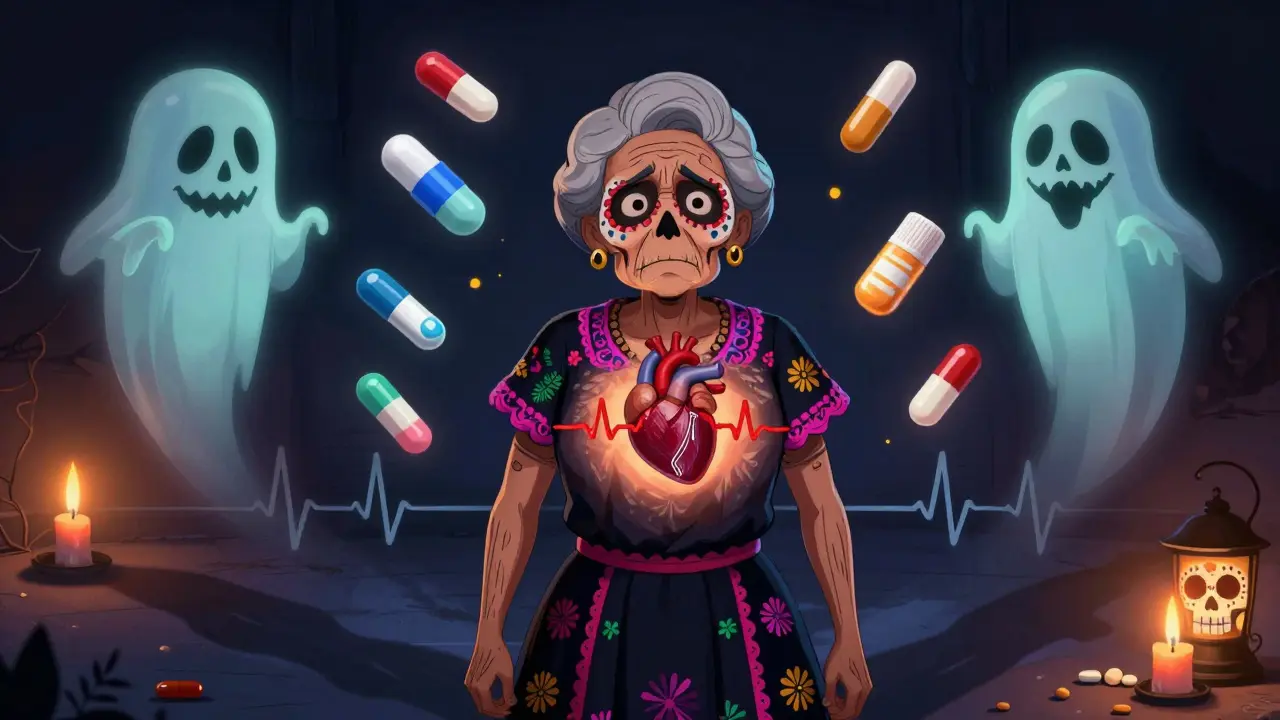
What’s the Real Risk? The Numbers Don’t Lie
Some doctors say the fear is overblown. They point out that TdP is still rare-about 1 in 25,000 patient-years. But that’s not the whole story. When you combine drugs, the risk jumps. One study in JAMA Internal Medicine found that pairing an antipsychotic with an antidepressant increased TdP risk by 4.3 times. Another showed that antipsychotic plus ondansetron pushed QTc up by 38.7 ms-way more than the antipsychotic alone.
And while the absolute risk may be low, the consequences are extreme. A single episode of TdP can lead to sudden cardiac death. And 78% of these events happen within 72 hours of starting the combo. That’s why timing matters. You don’t need to wait months to see danger. It can hit fast.
Even more telling: patients who stop their meds because they’re scared of heart problems? That’s 29% of people surveyed by NAMI. But here’s the irony-many of them don’t know how low the risk really is if monitored properly. Fear comes from silence. Not facts.
How to Stay Safe: The Practical Guide
Here’s what actually works, based on real clinical practice and guidelines:
- Get a baseline ECG before starting any antipsychotic with known QT risk. Do it within one week.
- Check your electrolytes. Potassium and magnesium levels should be in the normal range. If they’re low, fix them before or right after starting the drug.
- Avoid high-risk combos. Never mix thioridazine, ziprasidone, or haloperidol with moxifloxacin, ondansetron, or sotalol. Period.
- Monitor QTc. For high-risk combinations, get an ECG weekly for the first month, then monthly. For single moderate-risk drugs, check at 1 week, 4 weeks, then every 3 months.
- Choose low-risk antipsychotics. Aripiprazole, brexpiprazole, and lurasidone have minimal QT effect. If you’re on multiple meds, this is your safest bet.
One clinician in Massachusetts reduced arrhythmia risk by 67% in 12,000 patients just by sticking to this protocol. Another in Cleveland stopped a near-fatal event by spotting a 582 ms QTc and switching the antibiotic. These aren’t outliers-they’re best practices.
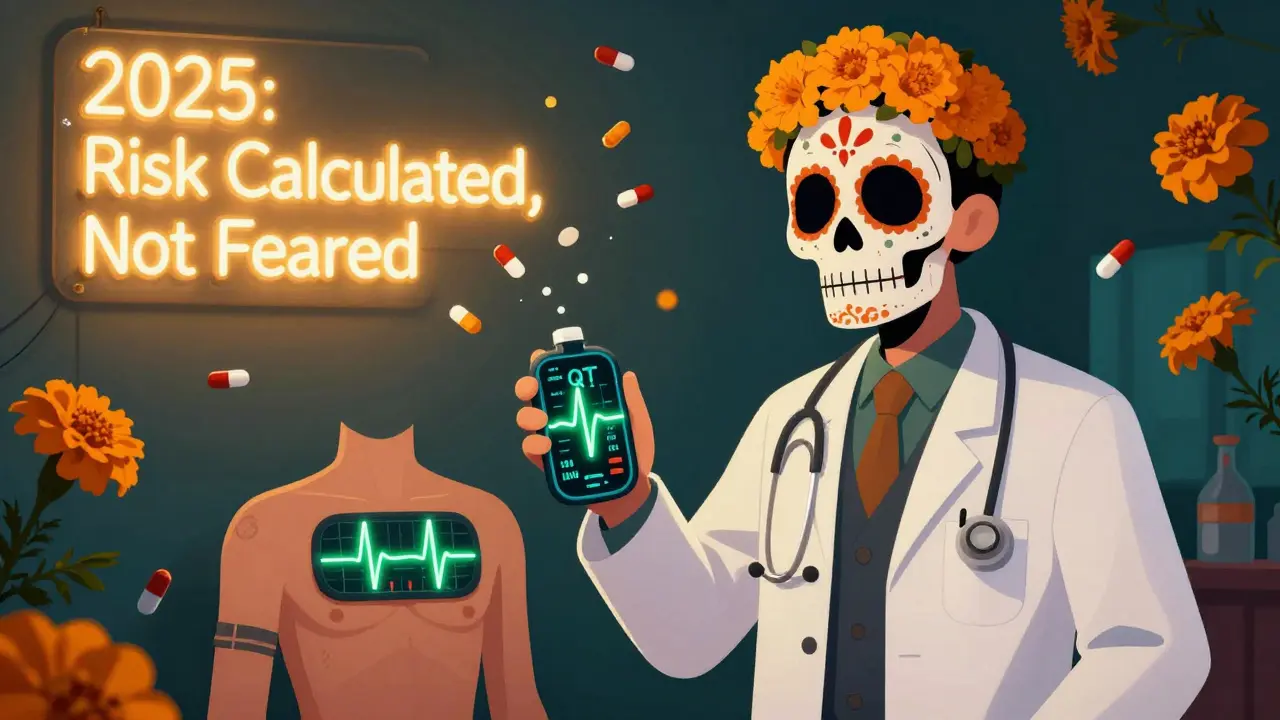
Why Isn’t This Done More Often?
Because it’s hard. Only 35% of community clinics routinely do ECGs for patients on these drugs. Why? Insurance denies them. Rural clinics don’t have the machines. Doctors don’t have time. A 2023 survey found that 68% of providers faced insurance denials for repeat ECGs. In some places, the only way to get one is to go to the ER.
And here’s the financial truth: unnecessary ECGs cost $1.2 billion a year. But so do cardiac emergencies. The smarter path isn’t doing fewer tests-it’s doing the right tests on the right people. A 2024 study showed that using EHR alerts to flag risky drug combos cut dangerous combinations by 53%. Yes, there were false alarms-but fixing one real case saves a life.
What’s Changing in 2025 and Beyond?
The landscape is shifting fast. The FDA just approved a digital ECG patch-Zio XT-that patients can wear for weeks. It’s been tested in psychiatric populations and catches QTc spikes with 98.7% accuracy. No more waiting for clinic appointments. Just wear it, and your doctor gets the data.
By January 2025, the American Psychiatric Association will release a new guideline with a risk calculator. It will weigh your age, sex, meds, potassium, and heart rate to give you a real-time risk score. And in 2026, a genetic test will launch to identify people with CYP2D6 poor metabolism-7-10% of Caucasians-who process antipsychotics too slowly, leading to toxic levels. That’s personalized medicine, finally arriving in psychiatry.
Medicare is catching on too. Starting in 2025, 2.3% of Part D payments will be tied to whether clinics monitor QT intervals properly. That’s not punishment-it’s incentive. It means hospitals will finally invest in ECG machines, training, and protocols.
Bottom Line: Don’t Panic. Do This.
You don’t need to stop your antipsychotic. You don’t need to fear every new prescription. But you do need to ask three questions:
- Is this antipsychotic high-risk for QT prolongation?
- Am I taking any other drugs that also stretch the QT interval?
- Have I had an ECG since I started this combo?
If the answer to the last one is no, ask for one. If you’re on multiple QT-prolonging drugs, insist on checking your potassium. If you’re over 65, female, or have heart rhythm issues, don’t assume it’s fine. It’s not. But with the right checks, the risk drops to less than 1 in 100,000 per year.
This isn’t about avoiding treatment. It’s about making treatment safer. And that’s possible-if you know what to look for.
John Smith
February 21, 2026 AT 22:11And don't get me started on the 2026 genetic test. Sure. Let's spend billions to find out who's slow at metabolizing drugs. We already know it's the poor ones. They're the ones with the 3 jobs and no insurance.
Meanwhile I'm over here wondering why the FDA didn't just ban all these drugs in 2005. Oh right. Pharma money. Always.
Shalini Gautam
February 22, 2026 AT 00:55Natanya Green
February 22, 2026 AT 19:34Wait no I’m not. I checked my potassium. It’s 4.1. I’m fine. I’m fine. I’m fine.
But like… why does this feel like a horror movie? Why is my heart suddenly a ticking time bomb? Why did no one tell me this before??
I need a hug. And maybe an ECG. And a therapist. And a new doctor.
Steven Pam
February 24, 2026 AT 08:42Also props to that Massachusetts clinic. 67% drop? That’s not luck. That’s smart systems. We need more of that. Not more fear. More action.
Timothy Haroutunian
February 24, 2026 AT 21:21And don’t get me started on the Zio XT patch. It’s not a breakthrough. It’s a $$$-driven gimmick. Who’s paying for these? Who’s getting reimbursed? Who’s getting paid to write this article? The answer is always the same: the same people who profit from the system being as complicated as possible.
Meanwhile, people are still dying because they can’t afford food, housing, or therapy. But hey, let’s spend $1.2 billion on ECGs. Priorities.
Erin Pinheiro
February 25, 2026 AT 20:28Brandice Valentino
February 26, 2026 AT 23:45So yeah. I’m not scared of my heart. I’m scared of my doctor.
Larry Zerpa
February 28, 2026 AT 08:30Also, the claim that "risk drops to less than 1 in 100,000" ignores that this is population-level math. For an individual on three QT-prolonging drugs with low potassium? The risk isn’t 0.001%. It’s 100%. You’re not a statistic. You’re a person. And the system treats you like data.
And yes, I know I’m being dramatic. But I’ve seen two people die from this. So don’t tell me to chill.
Gwen Vincent
March 2, 2026 AT 00:55Nandini Wagh
March 2, 2026 AT 09:29Maybe the answer isn’t more tech. Maybe it’s more care.
Holley T
March 4, 2026 AT 00:32