What if the key to sleeping better wasn’t more time in bed-but less?
For years, people with chronic insomnia have been told to go to bed earlier, nap more, or drink chamomile tea. But if you’ve been lying awake for hours night after night, those tips don’t fix the real problem: your brain has learned to associate your bed with wakefulness. That’s where sleep restriction therapy comes in. It’s not about sleeping more. It’s about sleeping better-by sleeping less, at first.
Why Sleep Restriction Therapy Works
Sleep restriction therapy (SRT) is a core part of Cognitive Behavioral Therapy for Insomnia (CBT-I), the only treatment the American Academy of Sleep Medicine recommends as first-line for chronic insomnia. Unlike sleeping pills, which only mask the problem, SRT rewires your body’s sleep drive.
Here’s how it works: if you spend eight hours in bed but only sleep five, your body isn’t building enough sleep pressure. You’re not tired enough to fall asleep fast or stay asleep. SRT fixes this by cutting your time in bed down to match your actual sleep time-so if you’re only sleeping five hours, you’re only allowed to be in bed for five hours. That forces your body to consolidate sleep, making it deeper and more efficient.
Studies show SRT reduces the time it takes to fall asleep by up to 50% and cuts nighttime awakenings significantly. In one 2023 meta-analysis, SRT improved sleep efficiency by 47% more than basic sleep hygiene advice alone. And unlike medications, the results last. A 2023 study from Sleepstation.org.uk found 78% of people who completed SRT still had better sleep six months later. With pills, that number drops to 32%.
The Step-by-Step Protocol
SRT isn’t guesswork. It follows a strict, science-backed process.
- Track your sleep for 7 days. Use a sleep diary. Write down when you get into bed, when you fall asleep, when you wake up, and any time you’re awake during the night. Don’t rely on your phone or smartwatch-self-reporting is more accurate for this method.
- Calculate your average total sleep time. Add up your total sleep over the week and divide by seven. If you slept 4.5, 5, 5.5, 4, 6, 5, and 5 hours, your average is about 5 hours.
- Set your initial time-in-bed limit. Your time in bed should match your average sleep time. If you average 5 hours, you get 5 hours in bed. That might mean going to bed at 1 a.m. and waking at 6 a.m.-no matter what.
- Stick to a fixed wake time. This is non-negotiable. Wake up at the same time every day, even on weekends. This anchors your circadian rhythm.
- Don’t nap. Even 10 minutes can undo your progress. If you’re tired, stay awake. Go for a walk. Drink water. But don’t lie down.
- Wait for improvement. After three nights of 85-90% sleep efficiency (time asleep divided by time in bed), you can add 15 minutes to your time in bed. If you’re still below 85%, stay at the same limit.
- Gradually increase until you hit 7-8 hours. Most people reach their ideal sleep window in 6-8 weeks. The goal isn’t to sleep more-it’s to sleep soundly in less time.
It’s hard at first. The first week or two will feel brutal. You’ll be tired. You might feel foggy at work. But that’s the point. You’re rebuilding your sleep drive from the ground up.
Why People Fail at SRT
Most people don’t quit because it doesn’t work. They quit because they don’t stick to the schedule.
One of the biggest mistakes? Extending time in bed on weekends. “I’ll just sleep in Saturday morning,” they think. But that one extra hour of lying in bed awake resets the progress you made all week. According to Sleep Education’s 2023 analysis, 41% of failed SRT attempts were due to weekend cheating.
Another common error: skipping the sleep diary. Without accurate data, you can’t track progress or know when to adjust your schedule. People who track their sleep are twice as likely to succeed.
And then there’s the urge to nap. You think, “I’ll just close my eyes for 20 minutes.” But napping reduces sleep pressure, which is exactly what SRT is trying to build. If you nap, you’re telling your body, “It’s okay to sleep during the day.” That breaks the rhythm.
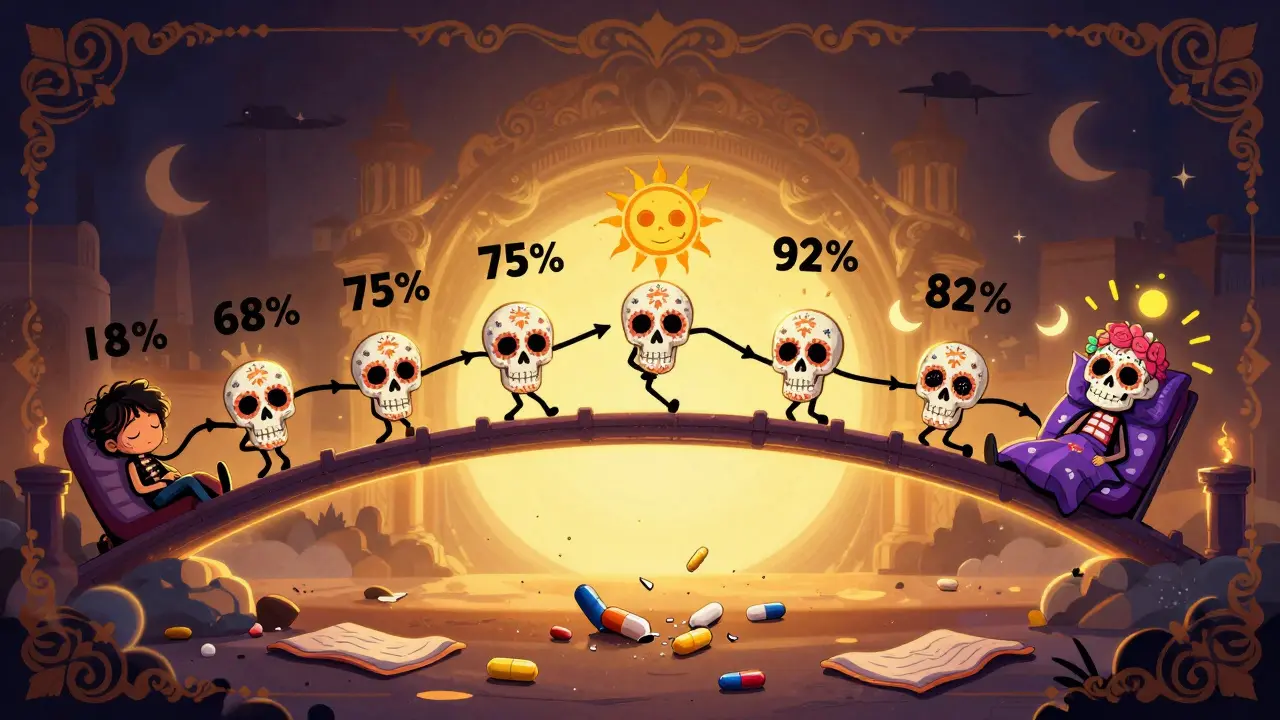
One Reddit user, SleepSeeker89, described their experience: “After 3 weeks of strict SRT, my sleep efficiency jumped from 68% to 89%. I fall asleep within 15 minutes instead of lying awake for hours.” That kind of turnaround is common-but only if you follow the rules.
What to Expect in the First Few Weeks
Day 1-3: You’ll feel exhausted. That’s normal. You’re sleep-deprived by design.
Day 4-7: Your body starts to adapt. You might notice you’re falling asleep faster once you’re in bed-even if you’re still only sleeping 5 hours.
Week 2-3: Nighttime awakenings begin to drop. You might wake up once, then go right back to sleep. That’s consolidation.
Week 4-6: You’ll start to feel more alert during the day. The fog lifts. You might even feel like you’re sleeping more, even though your time in bed hasn’t changed much yet.
By week 8, most people are sleeping 7-8 hours in 7-8 hours of time in bed-with almost no waking up in the middle of the night.
A 2023 study in the Journal of Clinical Sleep Medicine found that 54-60% of people using SRT had a strong response, compared to just 30-40% with sleeping pills. And the benefits kept growing after treatment ended.
Who Should Avoid SRT
SRT isn’t for everyone.
If you have severe depression, bipolar disorder, or untreated anxiety, SRT can make symptoms worse. The initial sleep deprivation can amplify mood instability. In these cases, SRT should only be done alongside cognitive therapy and under professional supervision.
Shift workers and people with irregular schedules also struggle. SRT relies on a fixed wake time. If you work nights or rotate shifts, maintaining that schedule is nearly impossible. For them, light therapy and melatonin timing are often better starting points.
And if you drive for a living, operate heavy machinery, or have a job where drowsiness is dangerous, proceed with caution. The first two weeks can impair reaction time. Talk to your doctor before starting.
How SRT Compares to Other Treatments
Let’s say you’ve tried melatonin. It might help you fall asleep 12-18 minutes faster-but it doesn’t help you stay asleep. And once you stop, insomnia returns.
Benzodiazepines? They work for about 60-70% of people, but they’re addictive. Withdrawal can cause rebound insomnia worse than before. Long-term use increases fall risk in older adults.
Sleep hygiene? “Avoid caffeine after 2 p.m.” “Take a warm bath.” These are helpful, but alone, they improve sleep efficiency by less than 10%. SRT improves it by 47%.
CBT-I-which includes SRT and stimulus control-is the only treatment proven to work long-term. The American College of Physicians gives it a “strong recommendation” based on solid evidence. And now, digital CBT-I apps like Somryst (FDA-cleared in October 2023) are making it accessible to people who can’t find a therapist.
Where to Get Help
You don’t have to do this alone.
If you have access to a sleep specialist trained in CBT-I, that’s ideal. There are about 1,200 certified providers in the U.S., according to the Society of Behavioral Sleep Medicine. But they’re hard to find, and insurance often doesn’t cover them.
That’s where digital tools come in. Apps like Sleepio and CBT-i Coach offer guided SRT programs. The VA Health System found CBT-i Coach had 72% user satisfaction. Prices range from $50 to $300-far less than in-person therapy, which can cost $300-$2,500.
Some employers now offer CBT-I through wellness programs. A 2024 SHRM report found 37% of Fortune 500 companies include it. Check with your HR department.
If you’re on a budget, start with a free sleep diary template (many are available online) and follow the steps above. Track everything. Be honest. Stick to your wake time.
The Long-Term Payoff
SRT isn’t a quick fix. It’s a reset.
Dr. Colleen Carney, a leading sleep researcher, calls it “the most durable insomnia treatment available.” Unlike drugs, which wear off, SRT teaches your brain how to sleep again. The effects don’t fade-they grow stronger.
One study tracked people for a year after completing SRT. Two-thirds still had better sleep than before they started. Only 29% of people who used medication did.
And it’s not just about sleep. Better sleep means better focus, less anxiety, improved mood, and more energy. People who complete SRT often say they feel like they’ve gotten their life back.
If you’ve been lying awake for years, waiting for sleep to come, it’s time to stop waiting. Start restricting. Your body already knows how to sleep. It just needs the right conditions to remember.
Can I do sleep restriction therapy on my own?
Yes, many people successfully complete SRT using sleep diaries and digital tools like CBT-i Coach. But if you have depression, anxiety, or other medical conditions, it’s safer to work with a CBT-I-certified clinician. The first two weeks can be tough, and professional guidance helps prevent setbacks.
How long does sleep restriction therapy take to work?
Most people see improvements in sleep efficiency within 2-3 weeks. Significant changes-like falling asleep faster and staying asleep-usually appear by week 4-6. Full results, including 7-8 hours of consolidated sleep, typically take 6-8 weeks. Some people need up to 3 months, depending on how long they’ve had insomnia.
Will I be too tired during the day?
Yes, especially in the first 1-2 weeks. Daytime fatigue is common and expected. It’s part of the process. Most people adapt by week 3. If your fatigue is extreme-like falling asleep at your desk or struggling to drive-you may need to delay starting or adjust your schedule with a clinician’s help.
Can I nap if I’m exhausted?
No. Napping reduces your sleep pressure, which defeats the purpose of SRT. If you’re tired, stay upright. Go for a walk, drink cold water, or do light chores. Don’t lie down. Even a 10-minute nap can delay progress by days.
What if I don’t improve after 6 weeks?
If your sleep efficiency stays below 85% after 6-8 weeks, you may need to revisit your sleep diary for accuracy, check for hidden naps, or consider combining SRT with stimulus control therapy. In some cases, underlying issues like sleep apnea or restless legs syndrome may be interfering. A sleep specialist can help identify those.
Is SRT better than sleeping pills?
Yes, for long-term results. Sleeping pills work temporarily but come with risks: dependency, rebound insomnia, grogginess, and increased fall risk. SRT has no side effects once you adjust. Studies show 78% of people maintain better sleep six months after SRT, compared to just 32% after stopping pills. SRT treats the cause-not the symptoms.
Can I use SRT if I work nights?
It’s very difficult. SRT requires a fixed wake time, which conflicts with rotating or night shifts. If you’re a shift worker, focus on light exposure, melatonin timing, and sleep environment first. SRT can be added later when your schedule stabilizes.
Lori Anne Franklin
December 27, 2025 AT 22:34i tried this after 3 years of lying awake staring at the ceiling and holy crap it actually worked. first week was brutal like someone punched me in the face with exhaustion but by week 4 i was falling asleep in 10 minutes. no pills, no fancy gadgets, just sticking to the schedule. i still wake up at 5:30am even on weekends because i dont trust myself to mess it up anymore.
Angela Spagnolo
December 28, 2025 AT 09:41so... i did this... and i think i did it wrong? i mean, i tracked my sleep, i didn't nap, i woke up at the same time... but i still feel like a zombie? maybe i'm just too tired to do this right? i'm on week 2 and i'm crying in the shower from fatigue. is this normal? i don't want to give up but i also don't want to die.
Michael Bond
December 29, 2025 AT 15:37Stick to the wake time. That's the whole game.
Kuldipsinh Rathod
December 30, 2025 AT 17:34i live in india and tried this with my cousin who had insomnia for 5 years. we both did it together. first week we were both falling asleep on the bus. but after 6 weeks? we both sleep like babies now. no more midnight chai runs just to stay awake. this is real magic. thank you for sharing.
SHAKTI BHARDWAJ
December 31, 2025 AT 11:18THIS IS A CULT!!! YOU'RE ALL BEING MANIPULATED BY SOME MEDICAL INDUSTRY BOTS!! SLEEP RESTRICTION IS JUST SLEEP DEPRIVATION WITH A PRETTY NAME!! WHY DO YOU TRUST A RANDOM GUY ON THE INTERNET OVER YOUR OWN BODY?!?! I'VE BEEN SLEEPING 9 HOURS MY WHOLE LIFE AND I'M FINE!! YOU PEOPLE ARE BROKEN!!
Matthew Ingersoll
January 1, 2026 AT 13:55As someone who spent 18 months in a sleep lab, I can confirm SRT works. The data doesn't lie. What's remarkable is how quickly your brain recalibrates. The first week feels like torture because your brain is screaming that you're dying. But it's not. It's just relearning. The body doesn't forget how to sleep. It just needs to be reminded. This isn't a hack. It's a biological reset.
david jackson
January 2, 2026 AT 13:26Okay, so I did this for 6 weeks. I tracked everything. I didn't nap. I woke up at 6am like a robot. I went from 4.2 hours of sleep to 7.8 hours. But here's the thing-I didn't just sleep better. I stopped having panic attacks at 3am. I stopped dreading bedtime. I started remembering dreams again. I started enjoying mornings. I cried the first time I woke up naturally without an alarm. This didn't fix my insomnia. It fixed my life. And I didn't even know how broken I was until it was fixed.
Jody Kennedy
January 2, 2026 AT 17:18Just started week 1 and already feeling like a zombie-but I’m telling myself: this is the price of peace. I’m doing this for me. No one else. If I can get back 3 hours of sleep a night, I’m getting back 21 hours a week. That’s like getting a whole extra day every week for the rest of my life. Worth every second of exhaustion.
christian ebongue
January 4, 2026 AT 17:05you didn't nap? wow. you're either a saint or lying. also, why are you using a sleep diary? your apple watch does that for you. also, why are you awake at 1am? go watch netflix or something. just don't lie there like a sad potato.
jesse chen
January 5, 2026 AT 11:21Christian, I get it-you're skeptical. But the diary isn't about the watch. It's about awareness. Your phone doesn't know if you were lying there wide-eyed for 45 minutes thinking about your ex. Only you know that. And that's the data that matters. I did this for 8 weeks. I still use the diary. Not because I need to. But because I don't want to forget how close I was to giving up.