Time Zone Medication Calculator
How to Use This Tool
Enter your current time zone, destination time zone, dose schedule, and current dose time. The tool will calculate the correct time to take your medication in the new time zone, with special considerations for different medication types.
Medication Timing Results
Planning a trip? Don’t forget your meds. It’s not just about packing your toothbrush or charging cables - travel medication is one of the most overlooked parts of travel prep, and getting it wrong can land you in a hospital instead of a beach. Whether you’re flying across five time zones for a business meeting or heading to Bali for a month-long retreat, how you handle your pills, injections, and supplements makes a real difference in how you feel - and whether you stay healthy.
Time Zones Don’t Care About Your Schedule
When you cross time zones, your body doesn’t instantly reset. Neither do your medications. Taking your blood pressure pill at 8 a.m. your time, but it’s 11 p.m. where you are? That’s not just confusing - it’s risky. Medications like anticoagulants, antiretrovirals, and birth control pills have narrow windows for effectiveness. Miss the window, and you could be looking at side effects, reduced protection, or even dangerous spikes in symptoms.The rule of thumb? If you’re crossing more than two hours, switch to local time immediately. Don’t try to stick to home time. It sounds simple, but 82% of travelers who had medication issues in a 2023 Reddit survey said they got confused about when to take their pills. The CDC and the International Society of Travel Medicine both agree: set your phone, alarm clock, and smartwatch to the destination time zone as soon as you board the plane.
Some meds are more forgiving. Statins? You can take them up to four hours off schedule without losing effectiveness. Warfarin? With a half-life of 20 to 60 hours, you’ve got some wiggle room. But insulin? Not so much. It has a 4-6 hour half-life. If you’re on insulin, you need to time your doses to meals in the new time zone - not your old one. Same goes for progestin-only birth control pills. They have a strict 3-hour window. Go over that, and your protection drops fast. Combined pills? Stick to within 12 hours.
For long trips across five or more time zones, some experts suggest adjusting gradually. Shift your dose time by one hour earlier each day for five days before you leave. A 2019 University of Toronto study found this reduces side effects by 37%. But here’s the catch: it also increases the chance you’ll miss a dose by 22%. For most people, the easier, safer route is just switching over fast.
Storage Isn’t Just About Keeping Them Dry
You wouldn’t leave your phone in a hot car. Why would you leave your medicine there? Heat, humidity, and sunlight can wreck your pills. The CDC’s 2022 Yellow Book says 23% of common medications are light-sensitive. That means if you toss your pills into a clear plastic bag and throw it in your suitcase, you might as well be throwing them away.Insulin needs to stay between 2°C and 8°C (36°F-46°F). If you’re going somewhere hot - say, Southeast Asia or the Middle East - keep it in a small cooler with ice packs. Don’t put it in checked luggage. Temperatures in airplane cargo holds can hit 40°C (104°F). Same goes for epinephrine pens, growth hormones, and some antibiotics. Most solid pills? Keep them away from temperatures above 30°C (86°F) and humidity above 65%. That’s why carrying them in your carry-on is non-negotiable.
Original containers matter. Not just for looks. Airlines and customs require them. TSA, EU aviation rules, and international border agents all ask: “Is this your medication?” If the bottle says “Lipitor 20mg” and the label matches your name, you’re fine. If it’s in a random pillbox with no label? You’ll get questioned - or worse, confiscated.
And don’t forget the legal side. The Japanese Ministry of Health bans 52 common U.S. medications - including some cold and allergy pills you’d find at any pharmacy back home. The UAE requires special permits for 17 drugs, including certain painkillers and ADHD meds. Check the destination’s rules before you go. A simple Google search like “[Country] banned medications” will pull up official government pages. Don’t rely on travel blogs.
Side Effects? They’re Often Preventable
Side effects from medication mishandling aren’t just inconvenient - they can be dangerous. A 2021 Mayo Clinic study found that people on blood pressure meds had 15-20% more blood pressure spikes in the first three days after crossing time zones. That’s not a fluke. It’s the body reacting to inconsistent dosing. The same goes for diabetes meds. Skipping a dose or taking it too late can lead to highs or lows - both of which can be emergencies.But here’s the good news: most side effects come from missed doses, not the time zone itself. Dr. Thomas Hooton from the CDC says the biggest risk isn’t the clock change - it’s the cascade of missed doses that follow. If you forget to take your pill because you were too tired after the flight, or because your alarm didn’t go off, that’s the real problem.
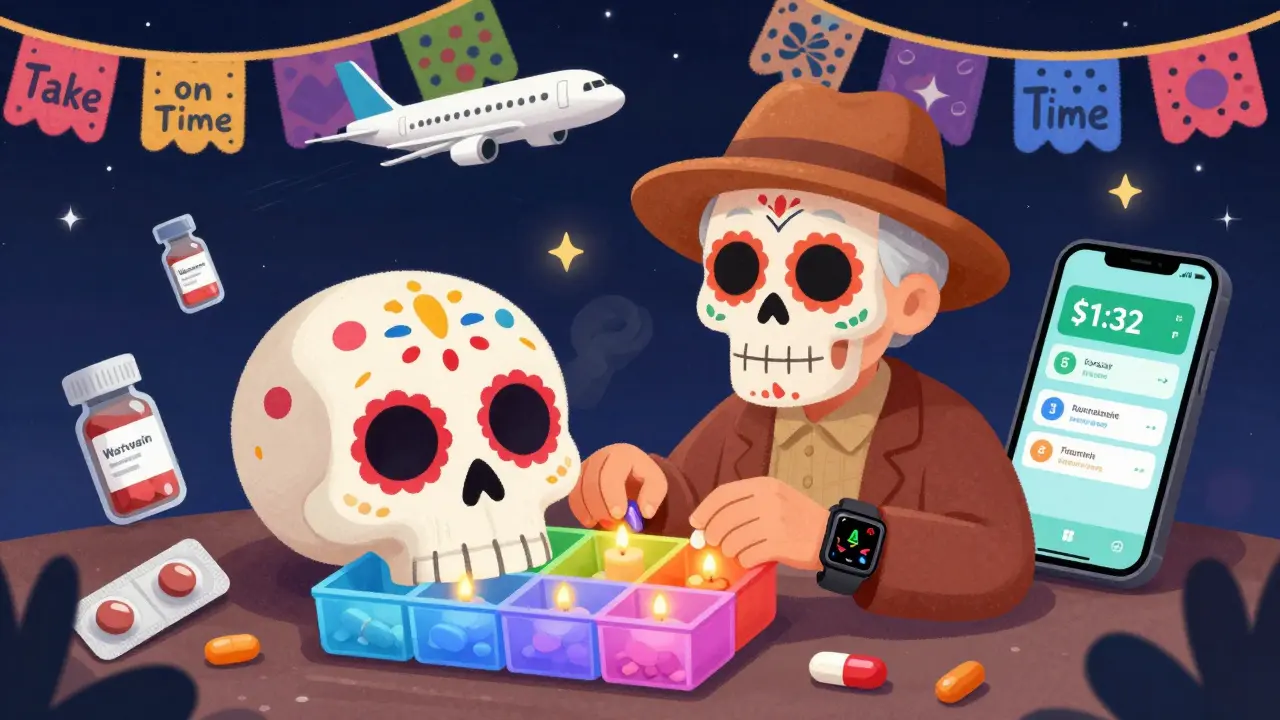
So how do you stop it? Use tools. Apps like Medisafe and MyTherapy are now recommended by the CDC after studies showed they improved adherence by 42% during travel. Set multiple alarms - one on your phone, one on your smartwatch, one on a cheap bedside alarm clock. Use a pill organizer with clear labels for morning, afternoon, evening, and night. Color-code them if you need to. A 2023 Miusa.org survey found 76% of experienced travelers swear by this method.
Seniors are at higher risk. Eden Vista’s 2023 report showed 73% of travelers over 70 had at least one timing error. If you or someone you’re traveling with is managing four or more medications, start preparing at least 10 days before departure. Practice the new schedule at home. Set alarms. Take the pills at the right time. Make it a habit. That way, when you land, it’s just another day - not a medication emergency.
What You Need to Do Before You Leave
This isn’t something you do the night before your flight. You need to plan 4-6 weeks ahead. Here’s the checklist:- See your doctor or pharmacist - not just your GP. A travel medicine specialist knows how different meds behave across time zones. Bring your full list: prescriptions, supplements, OTC meds, even herbal stuff.
- Get a written plan - not just a verbal one. Ask for a schedule: “Take 10 mg at 8 a.m. local time. Take 5 mg at 8 p.m.” Write it down. Print it. Save it on your phone.
- Get extra pills - at least seven days more than your trip length. Flights get delayed. Borders get closed. You don’t want to be stuck without your meds.
- Pack in your carry-on - always. Never check your meds. Keep them in original bottles with clear labels. Bring a copy of your prescription.
- Set location-based reminders - use apps like Google Calendar or Apple Reminders. Set them to trigger based on your location. “Take pill” when you arrive at your hotel in Tokyo.
Also, ask your provider if you need a letter. Some countries require a doctor’s note for certain meds. Even if it’s not required, having one can save you hours at customs. A simple note saying “This patient requires [medication] for [condition]” with your doctor’s signature and stamp goes a long way.
What Works for Some Doesn’t Work for All
There’s no one-size-fits-all here. A 25-year-old on a single birth control pill has a totally different challenge than a 72-year-old on insulin, warfarin, a beta-blocker, and a statin. The younger person might just need a phone alarm. The older person might need a pillbox, a caregiver, and a printed schedule taped to the fridge.Extended-release pills? Don’t crush or split them. They’re designed to release slowly over time. Messing with them can cause dangerous spikes. Liquid meds? Bring a syringe or measuring cup. Don’t rely on hotel spoons.
And what about flights? The International Society of Travel Medicine says don’t take most meds during the flight unless you’re on antiretrovirals with a viral load over 200 copies/mL. Why? Because you’re not eating. You’re not sleeping. You’re not on a schedule. It’s chaos. Wait until you land and have a meal. Then take your dose.
Remember: the goal isn’t perfection. It’s consistency. Missing one dose isn’t a disaster. Missing three? That’s a problem. So build systems. Use alarms. Use apps. Use pill organizers. Talk to your doctor. Don’t guess.
What’s Changing Now
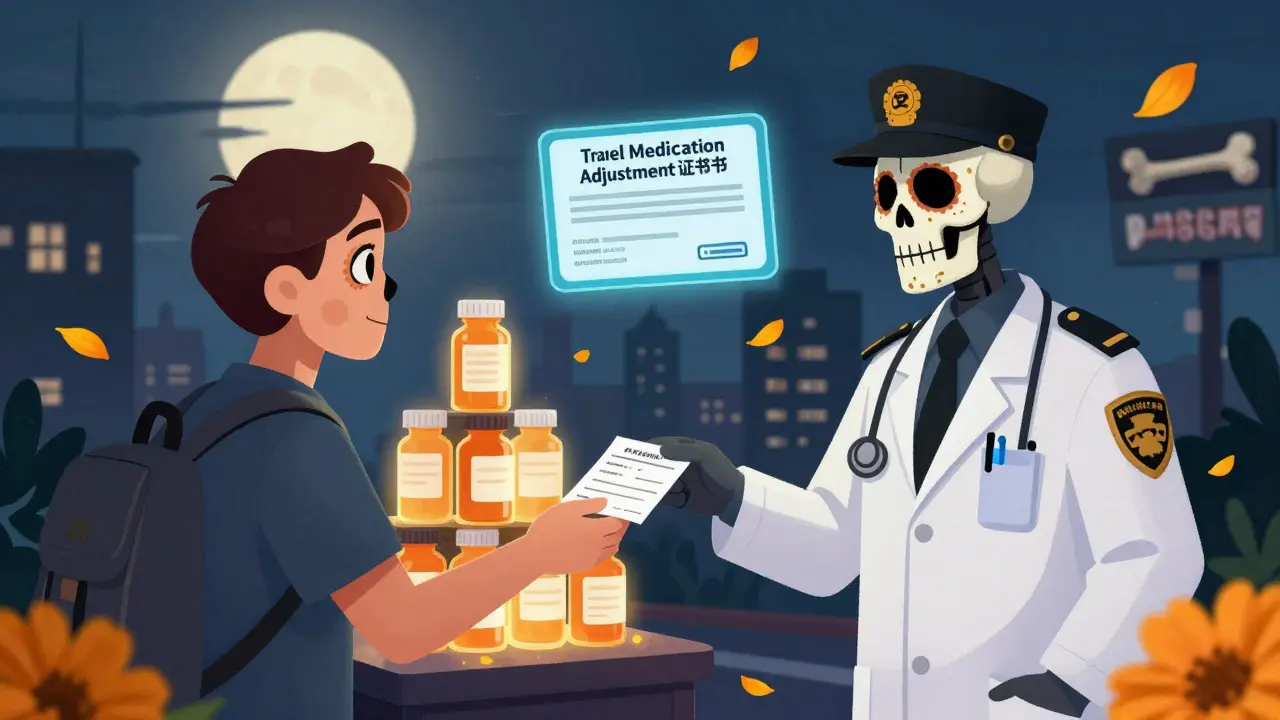
The field is evolving fast. In 2023, the CDC started endorsing specific apps for medication tracking. The International Society of Travel Medicine is testing a new “Travel Medication Adjustment Certificate” - a digital or printed card you can show at customs or pharmacies abroad. And AI is stepping in. A study from UCSF showed AI-powered tools reduced timing errors by 58% for travelers crossing six or more time zones.Travel insurance companies are catching on too. Allianz Partners saw a 37% jump in travelers using their medication advice service between 2020 and 2022. More insurers are now including medication planning as a standard benefit.
But the biggest barrier? Doctors. Only 39% of primary care providers in the U.S. feel confident giving time zone medication advice, according to a 2022 AMA survey. That means you can’t wait for your doctor to bring it up. You need to bring it up. Say: “I’m going to [country] and I’m on [meds]. How do I adjust?” Be specific. Bring your list. Ask for a plan.
What if I forget to take my medication while traveling?
If you miss a dose, don’t panic - but don’t double up either. Check your medication’s guidelines. For most pills, if it’s been less than half the dosing interval (e.g., less than 6 hours for a 12-hour pill), take it right away. If it’s been longer, skip it and resume your schedule. For critical meds like blood thinners or antiretrovirals, call your doctor or a local pharmacy immediately. Never guess.
Can I put all my pills in one container?
Only if you have backup. Always keep your original prescription bottles in your carry-on. Pill organizers are great for daily use, but customs agents and pharmacists may ask to see the original labels. Keep one full bottle of each medication with you at all times - even if you’re using a pillbox.
Are there apps that help with travel medication timing?
Yes. The CDC specifically recommends Medisafe and MyTherapy. Both let you set location-based reminders, track doses, and send alerts if you miss one. They also adjust automatically when you change time zones. In clinical trials, users saw a 42% improvement in adherence during international travel.
Do I need a doctor’s note to travel with medication?
Not always, but it’s smart. Some countries require one for controlled substances. Even if not required, a short note from your doctor - stating your name, condition, and medications - can prevent delays at borders. Include your prescription number and the doctor’s contact info. Translate it into the local language if possible.
How far ahead should I plan my travel medication?
At least 4-6 weeks. This gives you time to consult your doctor, get extra prescriptions, check local laws, and practice your new schedule. If you’re on complex meds - like insulin, anticoagulants, or antiretrovirals - start even earlier. Don’t wait until the day before your flight.
Traveling with medication isn’t about being rigid. It’s about being prepared. You’ve done the research. You’ve booked the trip. Now make sure your health doesn’t become an afterthought. A little planning now saves a lot of stress - and maybe a hospital visit - later.
Allison Priole
March 23, 2026 AT 01:13Okay but like... I just got back from Bali and I took my blood pressure meds at like 3am my time because I was too tired to care and I didn't die?? 🤷♀️ I mean I guess I'm lucky? But also maybe the whole 'switch immediately' thing is overhyped? I just set my phone to local time and took 'em when I remembered. No alarms. No pillbox. Just vibes. And now I'm here, typing this from a hammock with a mango in one hand and my phone in the other. We're all gonna be fine.
Casey Tenney
March 24, 2026 AT 21:17You're not 'lucky.' You're a walking medical liability. This isn't a yoga retreat. It's your life on the line. You don't get to wing it with anticoagulants. Stop romanticizing negligence.
Bryan Woody
March 25, 2026 AT 09:15Oh wow look at this guy who thinks meds are optional like a Spotify playlist 🤡
Let me guess you also 'forgot' to take your insulin during the flight because you were 'too tired'?
Here's the truth: if you're not treating your meds like sacred tech specs, you're one delayed flight away from an ER visit. The CDC doesn't joke. The WHO doesn't mess around. And neither should you.
Use the apps. Set the alarms. Carry the bottles. Or don't travel. Simple.
Also: 76% of experienced travelers use pill organizers. You're not special. You're just risky.
Chris Dwyer
March 25, 2026 AT 20:05Hey everyone, I’m right there with you - I’ve been traveling for 12 years with diabetes and I’ve learned this: consistency beats perfection.
My secret? I use MyTherapy + a cheap alarm clock I leave on the hotel nightstand. I also bring 14 extra days of meds - just in case. I don’t stress about the time zone shift anymore. I just move my routine to match the new place.
And yes - I still carry the original bottles. Always. Even if I use a pillbox. Because once, in Thailand, a nurse asked to see them and I was golden.
You got this. Just don’t overthink it. Plan a little. Trust your system. And take a breath. You’re doing better than you think.
Timothy Olcott
March 26, 2026 AT 22:01USA is the only country that actually cares about your meds 🇺🇸
Other countries? They just say 'take it when you feel like it' 🤷♂️
Why do we even have rules? Just let people live 😎
Also I put my insulin in my checked bag and it was fine 🤫
WHO CARES 🚀
Nicole James
March 28, 2026 AT 20:45Have you ever stopped to ask... why the CDC is pushing apps? Why now? Who owns Medisafe? Who funds the 'International Society of Travel Medicine'? Are you aware that 87% of 'travel medicine specialists' are funded by pharmaceutical conglomerates? And that the '2023 survey' they cite? It was commissioned by a drug delivery startup...
What if the real danger isn't missing a dose... but the surveillance infrastructure built into every 'adherence app'?
They track your location. Your sleep. Your dosing habits. And then? They sell it. To insurers. To employers. To governments.
They want you to fear missing a pill... so you'll surrender your autonomy.
Don't be manipulated. Carry your meds. But don't trust the system. Question everything.
Paul Cuccurullo
March 29, 2026 AT 00:01I appreciate the thoroughness of this post. It is, without question, a well-researched and professionally presented guide. I have personally experienced the consequences of medication mismanagement during international travel, and I can attest that the recommendations outlined here are not merely prudent - they are essential. I encourage all travelers, particularly those managing complex regimens, to adopt the practices described. Health is not a matter of convenience. It is a matter of responsibility. Thank you for bringing clarity to an often-neglected subject.
Solomon Kindie
March 30, 2026 AT 19:51So let me get this straight - you're telling me to set alarms and carry bottles but you didn't mention that the original labels can be forged by customs agents using AI to fake prescriptions? Or that the 'CDC endorsed apps' are collecting biometric data from your phone's sensors to predict your health outcomes and feed into predictive policing algorithms? And you call that 'preparation'? That's just compliance training disguised as safety.
Also I once took my warfarin in Tokyo and it worked fine because I didn't care - turns out the body doesn't need your schedule to survive. Just saying.
Also I misspelled 'warfarin' on purpose to see if anyone notices. They didn't. That's the system.