Right now, every major car company, tech giant, and energy startup is racing to build a battery that doesn’t exist yet. Not a better version of what’s in your phone or electric car today - but something completely different. Solid-state lithium batteries. And if they deliver on their promise, they could rewrite the rules of everything from electric vehicles to smartphones to grid storage.
Why we’re stuck with today’s lithium-ion batteries
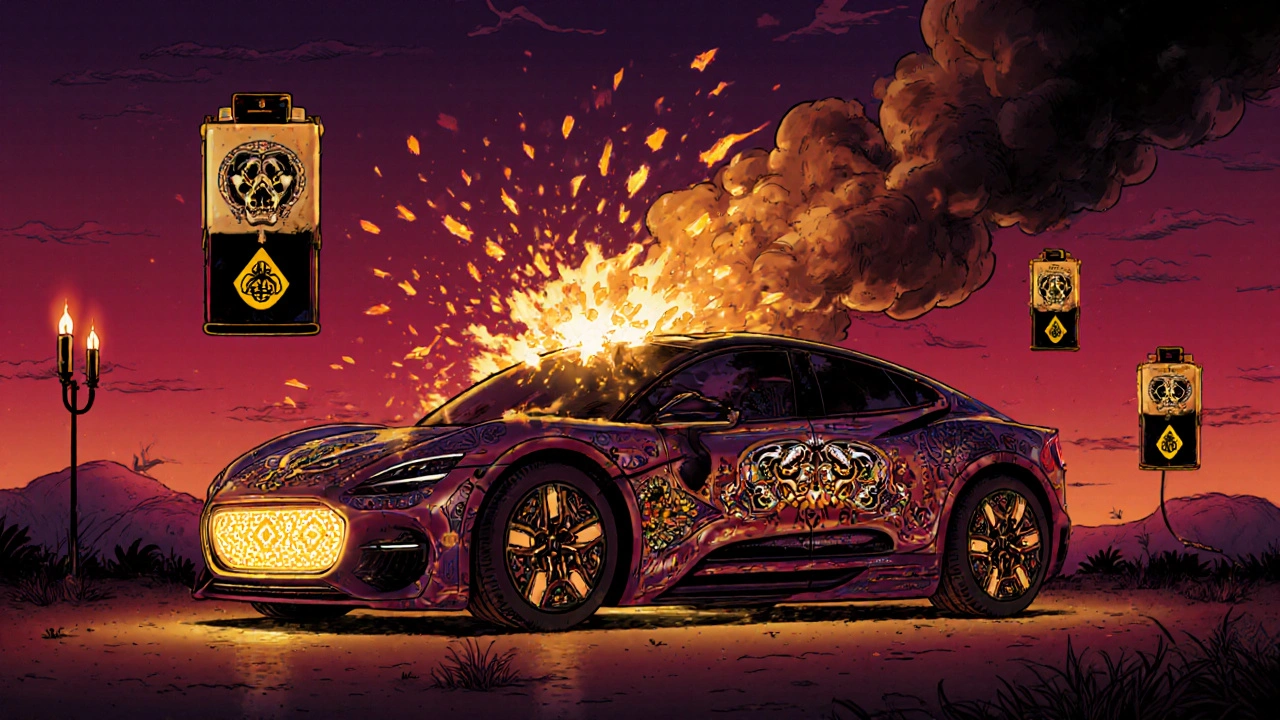
Most phones, laptops, and EVs today use lithium-ion batteries. They’re good - really good. They’ve powered the mobile revolution. But they have serious flaws. They catch fire. Not often, but often enough to make headlines. In 2023, Tesla recalled over 2,000 Model S vehicles in Europe after reports of battery packs overheating. Samsung’s Galaxy Note 7 fiasco in 2016 cost the company $5 billion. These aren’t rare accidents. They’re built into the design.
The problem? Liquid electrolyte. It’s flammable. It degrades over time. It forms dendrites - tiny metal spikes that grow inside the battery and eventually pierce the separator, causing a short circuit. That’s when things go boom. And even when they don’t, these batteries lose capacity. After 500 charge cycles, most EV batteries hold only 80% of their original power. That’s why your 2020 Tesla doesn’t go as far as it did in 2021.
What makes solid-state lithium batteries different
Solid-state batteries swap that risky liquid for a solid material - ceramic, glass, or polymer. No flammable goo. No dendrites. No thermal runaway. That’s the big sell. And it’s not just theory. Toyota has been testing solid-state prototypes since 2020. In 2024, they showed a prototype EV that could charge to 80% in 10 minutes and go 700 miles on a single charge. No overheating. No swelling. No degradation after 1,000 cycles.
The solid electrolyte also lets manufacturers use lithium metal anodes. Current lithium-ion batteries use graphite anodes. Lithium metal holds 10 times more energy. But it’s too reactive with liquid electrolytes. Solid materials can handle it. That’s why energy density jumps from 250 Wh/kg in today’s best batteries to 400-500 Wh/kg in solid-state. That means either smaller batteries for the same range, or way longer range for the same size.
The real game changer: safety and speed
Safety isn’t just a nice bonus - it’s the killer feature. Imagine an EV that can’t catch fire, even if you crash it. That changes everything. Insurance companies could slash premiums. Cities could allow EVs in underground parking without fire suppression systems. Emergency responders wouldn’t need special training to handle battery fires.
Charging speed is another game changer. Lithium-ion batteries can’t charge too fast without overheating. Solid-state batteries can. In lab tests, QuantumScape’s cells charged from 10% to 80% in 15 minutes at room temperature. No cooling systems needed. That’s faster than filling a gas tank. And it works in freezing weather - something current EVs struggle with.
Who’s leading the race - and who’s falling behind
Toyota still leads in patents and real-world testing. They’ve filed over 1,000 solid-state battery patents since 2010. Their plan? Start with hybrid vehicles in 2027, then roll out full EVs by 2030.
QuantumScape, backed by Volkswagen, is the U.S. front-runner. They’ve shown production-ready cells that meet all performance targets. Their factory in California is now scaling up. But they’ve missed deadlines before. Investors are watching closely.
BMW, Ford, and Hyundai have all signed deals with solid-state startups. Tesla? Quiet. They’re betting on their 4680 cell design and lithium-iron-phosphate chemistry. Some analysts say they’re waiting to see who wins before jumping in.
China is playing a different game. CATL, the world’s largest battery maker, says it has a solid-state prototype ready for testing. But they’re not sharing details. They’re moving fast, quietly, and with state support.
Why it’s taking so long
It’s not that the science is impossible. It’s that making these batteries at scale is brutally hard. Solid electrolytes are brittle. They crack when the battery expands and contracts during charging. They don’t stick well to electrodes. Manufacturing them requires ultra-dry rooms, expensive materials, and precision equipment you can’t buy off the shelf.
Cost is another wall. Today’s lithium-ion batteries cost about $100 per kWh. Solid-state prototypes cost $300-$500. That’s not competitive. But experts say costs will drop fast once production hits 10 million units a year. That’s the target for 2028-2030.
What this means for you
If you own an EV today, don’t expect your car to get a solid-state battery upgrade. These aren’t drop-in replacements. They need new cell designs, new pack architectures, and new charging systems. You’ll need to buy a new car.
But if you’re shopping for your next EV in 2028 or 2029, you’ll have choices. Cars with 500+ mile range. 10-minute charges. No range anxiety in winter. And no fear of fire.
For your phone? Maybe not right away. Solid-state batteries are bulky compared to thin, flexible lithium-ion cells. But by 2030, we could see smartphones that last two days on a charge and never bulge or swell.
The bigger picture: energy storage and renewables
This isn’t just about cars and phones. Solid-state batteries could revolutionize grid storage. Right now, lithium-ion batteries degrade too fast and cost too much for long-term renewable energy storage. A solid-state battery that lasts 15 years and holds its capacity could make solar and wind power truly reliable - day and night, summer and winter.
Imagine neighborhoods with rooftop solar and home battery systems that never need replacing. Or wind farms in Scotland storing excess energy for weeks, not hours. That’s the real potential.
When will you see them?
Don’t expect them in stores next year. Not even in 2026. The first commercial products will likely be in premium EVs - think BMW iX or Audi e-tron - around 2027. Mass-market adoption? 2030 is the realistic target.
But the race is real. And the winner won’t just control the battery market. They’ll control the future of transportation, energy, and maybe even how we live.
Are solid-state lithium batteries safer than current batteries?
Yes, significantly. Current lithium-ion batteries use flammable liquid electrolytes that can ignite if damaged or overheated. Solid-state batteries replace that liquid with a non-flammable solid material, eliminating the main cause of battery fires. They also resist dendrite formation, which prevents internal short circuits. Real-world tests by Toyota and QuantumScape show no thermal runaway even under extreme conditions like puncture or crush.
Will solid-state batteries make my current EV obsolete?
Not directly. Solid-state batteries require different cell designs, packaging, and charging systems. You can’t swap them into your 2023 Nissan Leaf or Tesla Model 3. But as they become mainstream, new EV models will offer much longer range, faster charging, and better longevity. Your current car will still work - but you’ll likely want to upgrade when the next generation hits the market around 2028-2030.
How much longer will solid-state batteries last?
Lab tests show solid-state batteries can handle over 1,000 full charge cycles with less than 10% capacity loss. That’s roughly double the lifespan of today’s lithium-ion batteries, which typically degrade to 80% capacity after 500-700 cycles. For EV owners, that could mean 15-20 years of reliable use without needing a battery replacement.
Can solid-state batteries be charged quickly?
Yes, and that’s one of their biggest advantages. Solid-state batteries can accept high charging currents without overheating. QuantumScape’s prototypes have charged from 10% to 80% in 15 minutes at room temperature - no special cooling needed. This is faster than refueling a gasoline car and far quicker than current EVs, which often slow down charging after 70% to protect the battery.
Why aren’t solid-state batteries in phones yet?
Solid-state batteries are currently bulkier and harder to manufacture in the thin, flexible shapes phones require. Lithium-ion cells are optimized for slim designs. Solid-state tech is being developed for EVs and grid storage first, where size and weight matter less than safety and longevity. Phone manufacturers will likely adopt it once production scales and miniaturization improves - probably around 2030 or later.
Mamadou Seck
October 30, 2025 AT 09:48Anthony Griek
October 31, 2025 AT 00:53Norman Rexford
October 31, 2025 AT 05:24Wayne Keller
November 2, 2025 AT 03:39Shana Labed
November 3, 2025 AT 15:46California Daughter
November 5, 2025 AT 09:42Vishwajeet Gade
November 6, 2025 AT 23:27Casey Crowell
November 8, 2025 AT 00:35Shanna Talley
November 9, 2025 AT 17:43Samuel Wood
November 11, 2025 AT 16:29ridar aeen
November 13, 2025 AT 03:12chantall meyer
November 15, 2025 AT 01:08Lorne Wellington
November 16, 2025 AT 00:56