When a child develops a rash, fever, and swollen joints a week after starting an antibiotic, it’s easy to assume it’s an allergic reaction. But what if it’s not? What if the real issue is something called a serum sickness-like reaction - a delayed immune response that mimics allergy but carries completely different rules for treatment and future antibiotic use?
What Exactly Is a Serum Sickness-Like Reaction?
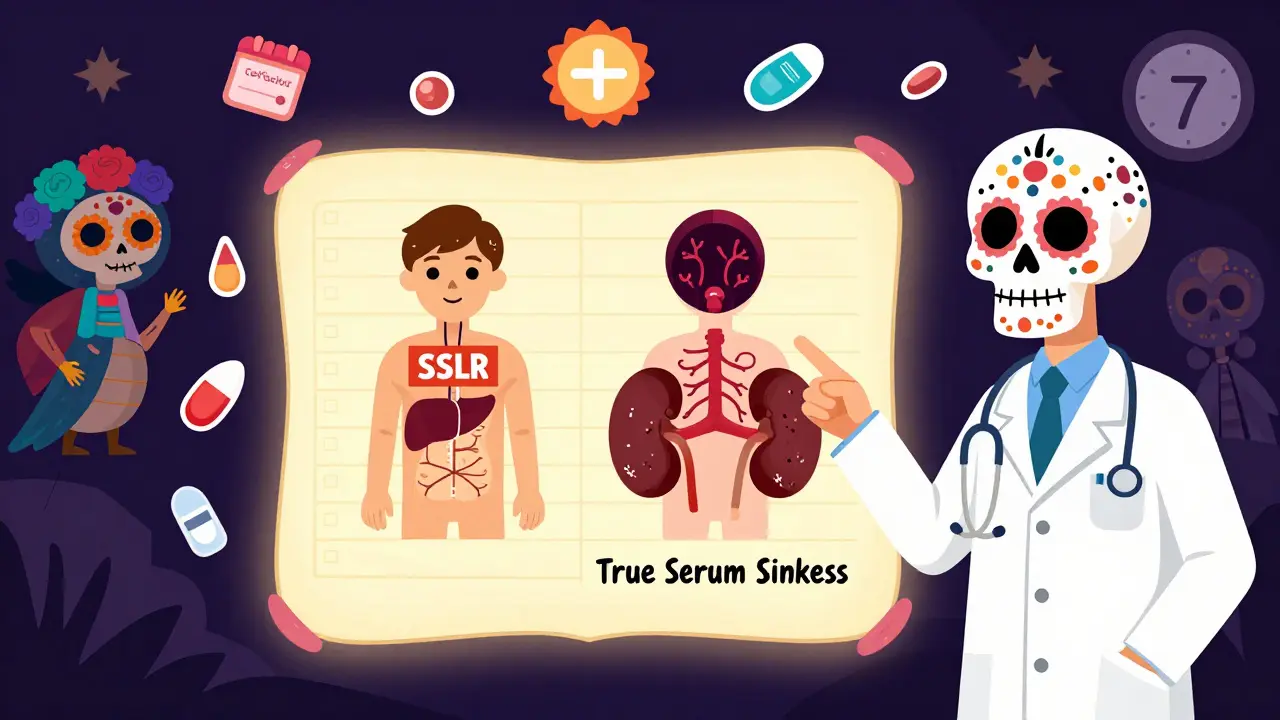
A serum sickness-like reaction (SSLR) isn’t a true allergy. It doesn’t involve IgE antibodies like anaphylaxis. Instead, it’s a delayed immune response, usually triggered by certain antibiotics, that shows up 1 to 21 days after taking the drug - most often around day 7 to 10. Unlike true serum sickness from old antiserum treatments (like those used for snake bites), SSLR doesn’t show immune complexes in the blood, doesn’t damage kidneys, and doesn’t cause vasculitis. It’s milder, more common in kids, and frequently mistaken for something else.The biggest culprit? Cefaclor. This antibiotic, once widely used for ear infections and sinusitis in children, causes 65% to 80% of pediatric SSLR cases. Amoxicillin is another common trigger. The reaction isn’t about the whole class of antibiotics - it’s specific to the drug itself. That’s critical, because many parents and even some doctors end up labeling the child as allergic to all penicillins or cephalosporins, when they only reacted to one specific drug.
The Classic Triad: Rash, Fever, Joint Pain
If you see these three symptoms together in a child who took an antibiotic recently, think SSLR:- Urticarial rash: Raised, itchy, red welts that move around the body - one spot fades, another appears. They last minutes to hours, then reappear elsewhere. This isn’t a fixed rash. It’s migratory and intensely itchy.
- Fever: Usually between 38°C and 39°C (100.4°F to 102.2°F). Not always present, but common.
- Joint pain or swelling: Often affects knees, wrists, and ankles symmetrically. The child may limp or refuse to use an arm. No joint deformity, no permanent damage.
Other signs include swollen lymph nodes, tiredness, and muscle aches. But here’s what’s NOT seen: protein in the urine, low complement levels, or signs of organ damage. That’s the key difference from true serum sickness.
Why It’s Often Misdiagnosed
Many pediatricians mistake SSLR for a viral rash - especially if the child had a cold or strep throat before starting the antibiotic. Others think it’s just hives from an allergy and assume the child can’t take any penicillin-like drugs again. A 2022 audit from Royal Children’s Hospital Melbourne found 23% of SSLR cases were first labeled as viral exanthems. Another 18% were mislabeled as penicillin allergy in electronic records.That’s dangerous. If a child is incorrectly labeled allergic to penicillin, they’re often given broader-spectrum antibiotics like vancomycin or azithromycin for future infections. These drugs cost more, cause more side effects, and increase the risk of antibiotic-resistant infections. Cincinnati Children’s Hospital data shows 42% of SSLR patients end up on unnecessary broad-spectrum antibiotics because of misdiagnosis.
How It’s Different from True Serum Sickness
| Feature | SSLR | True Serum Sickness |
|---|---|---|
| Primary trigger | Cefaclor, amoxicillin | Antivenoms, monoclonal antibodies (infliximab, rituximab) |
| Typical age group | 6 months to 6 years (78% of cases) | Adults (65% of cases) |
| Fever | 85% of cases | 98% of cases |
| Joint pain | 72% of cases | 80% of cases |
| Kidney involvement | 0% | 15-25% |
| Immune complexes in blood | Not detectable | Yes |
| Complement levels (C3/C4) | Normal | Low |
| Typical resolution time | 3-7 days after stopping drug | 10-14 days |
SSLR is almost always self-limiting. Once the antibiotic is stopped, symptoms usually clear up in under a week. True serum sickness often needs corticosteroids and takes longer to resolve. The biggest takeaway? SSLR doesn’t mean lifelong antibiotic avoidance.
What to Do When SSLR Is Suspected
If your child develops a rash, fever, and joint pain after taking an antibiotic:- Stop the antibiotic immediately. Don’t wait for a doctor’s appointment. Discontinuation within 24 hours of symptom onset improves recovery speed.
- Use antihistamines. Second-generation ones like cetirizine (0.25 mg/kg every 12 hours) help with itching and rash. Avoid older antihistamines like diphenhydramine - they cause drowsiness and aren’t more effective.
- Treat joint pain with ibuprofen. Dose: 10 mg/kg every 8 hours as needed. Avoid aspirin in children.
- Call your pediatrician. Don’t assume it’s an allergy. Ask: Could this be a serum sickness-like reaction?
- Request an allergist referral. This is critical. Only an allergist can properly document the reaction and test for future tolerance.
Corticosteroids like prednisone (1 mg/kg/day for 7-10 days) are only needed if symptoms are severe - if the child can’t walk, sleep, or eat because of pain or itching. Most cases don’t need them.
Can They Take Antibiotics Again?
Yes - but only the right ones.SSLR is not a class allergy. If cefaclor triggered it, your child can still safely take other cephalosporins like cefdinir or cefuroxime. The same goes for amoxicillin: if that was the trigger, other penicillins like ampicillin may still be tolerated. Studies show 89% of children who had SSLR from cefaclor tolerate other cephalosporins without issue.
For confirmation, allergists often perform an oral challenge 6 to 36 months after the reaction. At Cincinnati Children’s, 92% of children passed the challenge - meaning they had no reaction when given the same antibiotic again under supervision. That’s not a mistake. It’s proof the reaction wasn’t an allergy.
Some parents worry about rechallenge. One Reddit user wrote: “My son had SSLR after amoxicillin. We were terrified to give him any antibiotic again. We waited 18 months. The allergist gave him a full dose in the office. Nothing happened. He’s now on amoxicillin for every ear infection.”
The Bigger Problem: Mislabeling in Medical Records
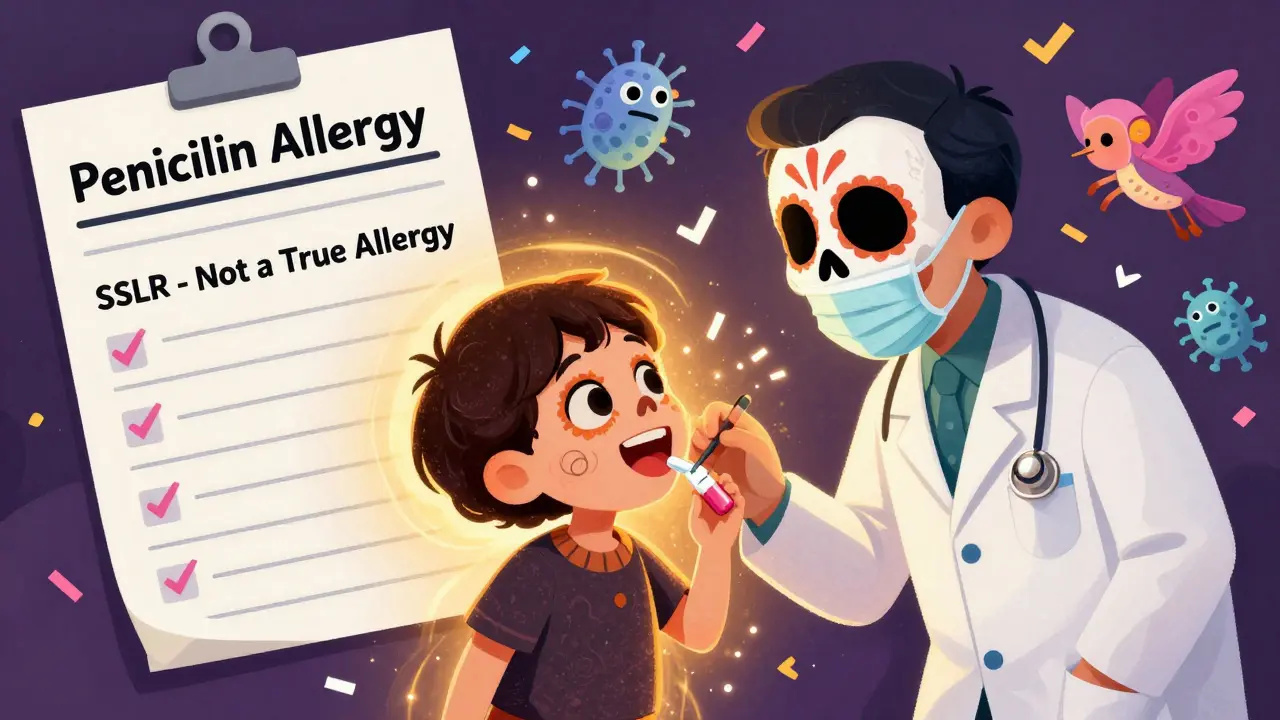
A 2022 study in the Journal of Allergy and Clinical Immunology: In Practice found that 74% of pediatricians incorrectly write “penicillin allergy” in electronic health records after a serum sickness-like reaction. That label sticks. It follows the child into adulthood. It changes every future treatment decision.That’s why allergist consultation isn’t optional - it’s essential. An allergist will document the exact drug, the symptoms, the timeline, and the lack of immune complex involvement. They’ll classify it as “SSLR - not a true allergy.” That changes everything.
Without that correction, kids get stuck with vancomycin, clindamycin, or azithromycin - drugs that are more expensive, harder on the gut, and contribute to antibiotic resistance. The American Journal of Managed Care estimates misdiagnosed SSLR leads to $187 million in unnecessary antibiotic costs every year in the U.S. alone.
What’s New in 2026?
In 2024, the International Consensus Document on Drug Hypersensitivity officially gave SSLR its own ICD-11 code: RA43.1. That means it’s now recognized as a distinct diagnosis - not a vague “drug reaction.”Research is moving fast. A study at the University of California is testing a urine test that detects specific metabolites of cefaclor in children with SSLR. Early results show 94% accuracy in distinguishing it from true allergy. Another project, the PREDICT study, is looking at a genetic variant (CYP2C9*3) found in 72% of SSLR cases - it affects how the body breaks down cefaclor, leading to buildup of a reactive metabolite.
At Boston Children’s Hospital, an AI tool is being tested to scan electronic records and flag cases that look like SSLR. In a 2023 trial, it had 88% sensitivity and 91% specificity. If rolled out widely, it could cut misdiagnosis rates from 30% to under 15% by 2030.
Final Takeaway
A rash after an antibiotic doesn’t mean your child is allergic for life. If it’s a serum sickness-like reaction - and it often is - the good news is: it’s not dangerous in the long term, it clears up quickly, and it doesn’t mean avoiding all penicillins or cephalosporins. The real risk isn’t the reaction itself. It’s the mislabeling that follows.Stop the antibiotic. Treat the symptoms. Call an allergist. Don’t let a temporary immune response turn into a lifelong restriction.
Is serum sickness-like reaction the same as a penicillin allergy?
No. A penicillin allergy involves IgE antibodies and can cause anaphylaxis - a life-threatening reaction that happens within minutes. SSLR is a delayed immune response that occurs days after taking the drug. It causes rash, fever, and joint pain but doesn’t involve the same immune mechanism. It’s not life-threatening and doesn’t mean your child can’t take other penicillin-type antibiotics.
Which antibiotics cause serum sickness-like reactions?
Cefaclor is the most common trigger, responsible for 65-80% of pediatric cases. Amoxicillin is the second most common. Other antibiotics like minocycline and cefuroxime have been reported, but much less frequently. The reaction is specific to the drug, not the entire class. So if cefaclor caused it, other cephalosporins may still be safe.
How long does a serum sickness-like reaction last?
Most cases resolve within 3 to 7 days after stopping the antibiotic. About 8% of children may have lingering symptoms - like a mild rash - for up to 3 months, but these are usually not severe and don’t require treatment. The key is stopping the drug early. The sooner you do, the faster it clears.
Should I avoid all antibiotics if my child had SSLR?
No. Only avoid the specific antibiotic that caused the reaction. Studies show 89% of children who had SSLR from cefaclor can safely take other cephalosporins. An allergist can perform a supervised oral challenge to confirm tolerance. Avoiding all antibiotics unnecessarily increases the risk of harder-to-treat infections and antibiotic resistance.
Can a child with SSLR get vaccinated?
Yes. SSLR is not a reason to delay or avoid any vaccine, including the rabies vaccine. The American Academy of Allergy, Asthma & Immunology confirmed in 2023 that there is no link between SSLR and vaccine reactions. The rare cases of SSLR after rabies vaccine were linked to the antiserum component, not the vaccine itself, and are extremely uncommon (0.003% incidence).
What should I do if my child was labeled with a penicillin allergy after SSLR?
Request a referral to a pediatric allergist. Bring all medical records, including the date of the reaction, the antibiotic used, and the symptoms. Ask for a formal reclassification from “penicillin allergy” to “serum sickness-like reaction to [specific drug].” This correction can prevent unnecessary use of broader-spectrum antibiotics in the future and reduce long-term health risks.
Anthony Capunong
January 8, 2026 AT 10:01Man, I can't believe how many parents are still getting scammed by this. I work in a clinic and half the kids labeled 'penicillin allergic' never even had a real allergy. They just got a rash after cefaclor and now they're on azithromycin for every sniffle. Bro, that's just lazy medicine.
Aparna karwande
January 9, 2026 AT 22:02Oh my god, this is such a crucial post! In India, we see this ALL the time - mothers panic and swear their child is 'allergic to all antibiotics' after one rash. I had a cousin whose daughter was banned from penicillins for five years because of a mild SSLR. She ended up with a resistant UTI because they gave her clindamycin instead. This needs to be shouted from the rooftops.
Vince Nairn
January 11, 2026 AT 02:21So let me get this straight - we're telling parents to stop the antibiotic, give antihistamines, and then go find an allergist who might not even be available for six months? And meanwhile, the kid's fever's still up and the joints are throbbing? Sounds like a beautiful system where the solution is just... more bureaucracy. 🙃
Ayodeji Williams
January 11, 2026 AT 05:19bro this is wild 😳 i had this happen to my lil bro after amoxicillin - rash everywhere, fever, couldn't walk for 3 days. we thought he was dying. turns out? just SSLR. doc said 'allergic to penicillin' and we believed it. 3 years later we found out he could take it again. i'm still mad. 🤬
Kyle King
January 11, 2026 AT 16:04Wait… so you're telling me the government and Big Pharma are letting kids get misdiagnosed on purpose so they can sell more expensive antibiotics? I mean, look at the stats - $187 million? That's not a mistake. That's a profit margin. They don't want you to know cefaclor is the problem - they want you scared of ALL antibiotics. Wake up.
Kamlesh Chauhan
January 13, 2026 AT 01:34lol this whole thing is just overcomplicated. kid gets rash after antibiotic = allergic. stop giving it. done. why do we need AI tools and urine tests and allergists? just avoid the drug. simple. why make it a science project?
Emma Addison Thomas
January 14, 2026 AT 01:54This is such a thoughtful breakdown. I'm a GP in London and we see this constantly - parents terrified to let their children have any antibiotic after a single episode. I've started carrying a printed one-pager to hand out. It's shocking how few GPs even know the difference between SSLR and true allergy. Thank you for the clarity.
Mina Murray
January 14, 2026 AT 20:48Let me guess - the 'allergist referral' is just a money grab. You think they're gonna do a 'challenge' and say 'you're fine'? Nah. They'll charge you $500, give you a patch test that's 40% accurate, then tell you to avoid penicillin anyway. I've seen it. It's a racket. Just don't give them antibiotics. Problem solved.
Rachel Steward
January 15, 2026 AT 12:48Here's the real question nobody's asking: Why are we even giving cefaclor to kids in the first place? It's an old, poorly metabolized antibiotic with a known, predictable, and frequent immune-triggering profile. We have dozens of safer, better-tolerated alternatives. This isn't about misdiagnosis - it's about systemic medical inertia. We're still prescribing drugs from the 1980s because they're cheap and the pharma reps still visit the office. The real tragedy isn't the SSLR - it's that we haven't moved on.
Christine Joy Chicano
January 16, 2026 AT 15:28I love how this post distinguishes between SSLR and true serum sickness - I didn't even know they were different until now. The table comparing immune complexes and complement levels was so helpful. I'm a nurse and I've seen so many kids get mislabeled. I'm printing this out for our pediatric unit. Thank you for the precision.
Adam Gainski
January 17, 2026 AT 05:42This is exactly the kind of info every parent needs. I had a friend whose kid got mislabeled as penicillin-allergic - ended up on vancomycin for a simple ear infection. Took 3 weeks to recover. We're sharing this everywhere. Also, the part about oral challenges? Huge. My cousin did one at 18 months post-reaction and had zero issues. Now she's on amoxicillin every winter. Life-changing.
Sai Ganesh
January 18, 2026 AT 14:28Interesting. In India, many doctors still don't even know the term SSLR. They just say 'allergy' and move on. I've seen kids denied cefdinir because of a past cefaclor reaction. This post should be translated into Hindi and Tamil. It could save so many children from unnecessary antibiotics.
Paul Mason
January 18, 2026 AT 19:07Wait, so if my kid had SSLR from amoxicillin, I can still give them ampicillin? That’s wild. I always thought if one penicillin messed them up, they’re allergic to the whole family. So… it’s like a specific brand, not the whole line? Mind blown.