If you're taking blood pressure medication and trying to eat healthier, you might be surprised to learn that some of the healthiest foods on your plate could be putting you at risk. High-potassium foods like bananas, spinach, and sweet potatoes are often recommended for lowering blood pressure-but when combined with certain medications, they can push your potassium levels into dangerous territory. This isn't theoretical. Real people end up in the ER every year because they didn’t know their diet and meds were working against each other.
Why Potassium Matters for Blood Pressure
Potassium isn’t just another mineral. It’s one of the body’s natural ways to fight high blood pressure. When you eat more potassium, your kidneys flush out extra sodium, which reduces fluid buildup in your blood vessels. At the same time, potassium helps relax the walls of your arteries. Together, these effects can drop your systolic blood pressure by more than 5 points-enough to move someone from "high" to "normal" on the chart.
The American Heart Association recommends 3,500 to 5,000 mg of potassium daily. But the average American gets only about 2,400 mg. That gap matters. Studies show that people who eat more potassium have lower rates of stroke and heart disease. The problem isn’t getting enough-it’s getting too much when you’re on certain meds.
Which Blood Pressure Medications Raise the Risk?
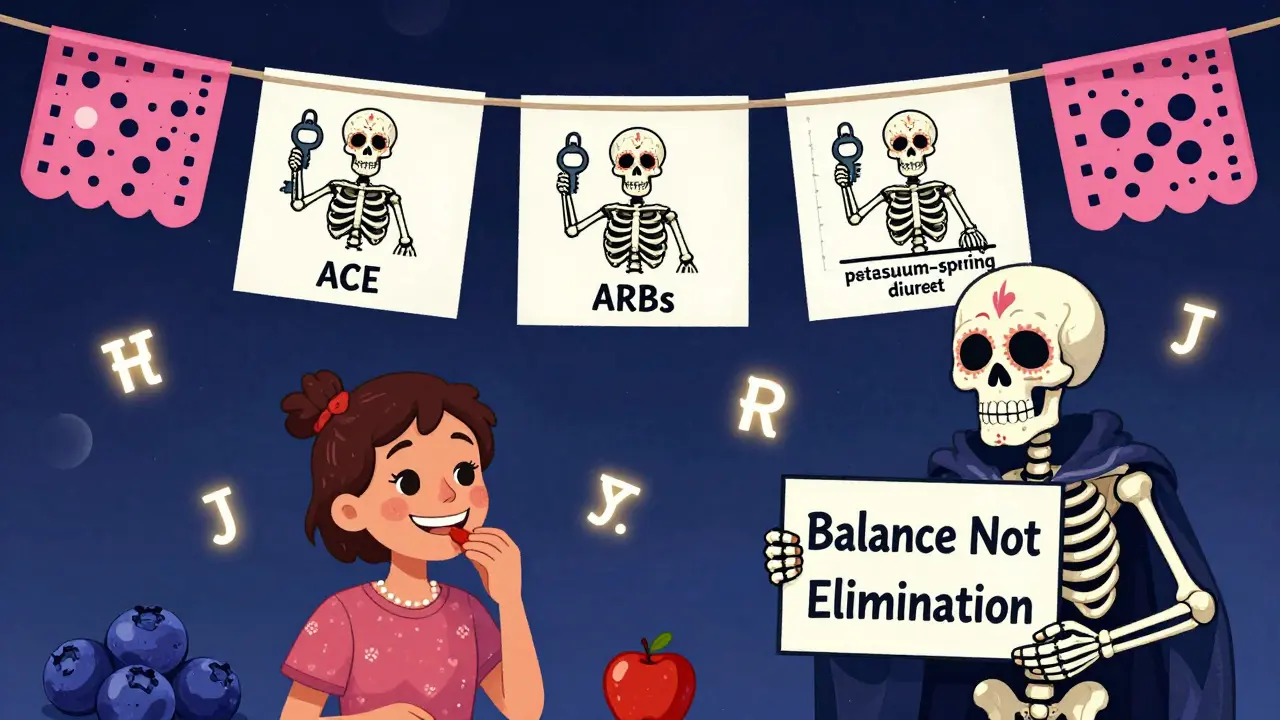
Not all blood pressure drugs interact with potassium the same way. The real danger comes from three main classes:
- ACE inhibitors (like lisinopril, enalapril)
- ARBs (like losartan, valsartan)
- Potassium-sparing diuretics (like spironolactone, eplerenone)
These medications work by blocking hormones that cause your body to hold onto sodium and water. But they also reduce how much potassium your kidneys remove. That means potassium builds up-fast. About 40% of people on blood pressure meds are prescribed one of these three types. If you’re on any of them, your diet needs a closer look.
What Counts as "High-Potassium"?
Some foods are packed with potassium. A medium banana has 422 mg. A cup of cooked spinach? 839 mg. One avocado? Nearly 1,000 mg. Even a single cup of coconut water contains 600 mg. These aren’t outliers-they’re everyday foods.
Here’s a quick reference:
| Food | Amount | Potassium (mg) |
|---|---|---|
| Sweet potato | 1 medium | 542 |
| Salmon | 3 oz cooked | 534 |
| White beans | 1/2 cup | 595 |
| Yogurt | 1 cup | 579 |
| Orange juice | 1 cup | 496 |
| Banana | 1 medium | 422 |
| Milk | 1 cup | 366 |
These numbers aren’t just for show. A person on spironolactone who eats two avocados, a banana, and a cup of spinach daily could easily exceed 3,000 mg of extra potassium from food alone-on top of what their body already holds.
The Danger Zone: Hyperkalemia
Normal potassium levels sit between 3.5 and 5.0 mmol/L. Anything above 5.0 is considered high. Above 6.0? That’s life-threatening. At those levels, your heart rhythm can go haywire. You might feel your heart skip, your arms go numb, or your muscles weaken. In severe cases, it leads to cardiac arrest.
Here’s the scary part: hyperkalemia often has no warning signs until it’s too late. A 2023 survey of 872 hypertension patients found that 19% had symptoms like muscle weakness or palpitations after ramping up potassium-rich foods. Seven percent ended up in the ER. Most had no idea their meds made them vulnerable.
People with kidney problems are at highest risk. If your kidneys can’t filter potassium well-even slightly impaired function-your body can’t keep up. One study showed 28% of patients with reduced kidney function developed dangerous potassium levels when eating a normal potassium-rich diet.
Can You Still Eat These Foods?
Yes-but not without strategy. The key is balance, not elimination.
Research from the 2016 American Journal of Clinical Nutrition tracked 120 hypertensive patients on ACE inhibitors who increased their potassium intake through food. Their blood potassium stayed stable. Why? Because whole foods release potassium slowly. Supplements, salt substitutes, and concentrated juices spike levels fast.
Here’s what works:
- Keep eating vegetables, beans, and fruits-but vary them. Don’t eat spinach every day.
- Swap high-potassium fruits for lower ones: blueberries, apples, grapes, and pineapple are safer.
- Avoid potassium salt substitutes (like NoSalt or Lite Salt). These can add 250-700 mg per teaspoon.
- Don’t drink coconut water daily. One cup = 600 mg. That’s almost a full day’s worth for some.
One Reddit user, u/HypertensionWarrior, shared: "Switching from bananas to blueberries while on spironolactone stabilized my potassium from 5.4 to 4.8. My doctor was shocked I didn’t need a dose change."
What Should You Do?
Don’t panic. Don’t cut out healthy foods. Do this instead:
- Check your meds. Are you on an ACE inhibitor, ARB, or potassium-sparing diuretic? If yes, talk to your doctor.
- Ask for a blood test. Get your serum potassium checked before making big diet changes. Repeat it 2-4 weeks after adjusting your food.
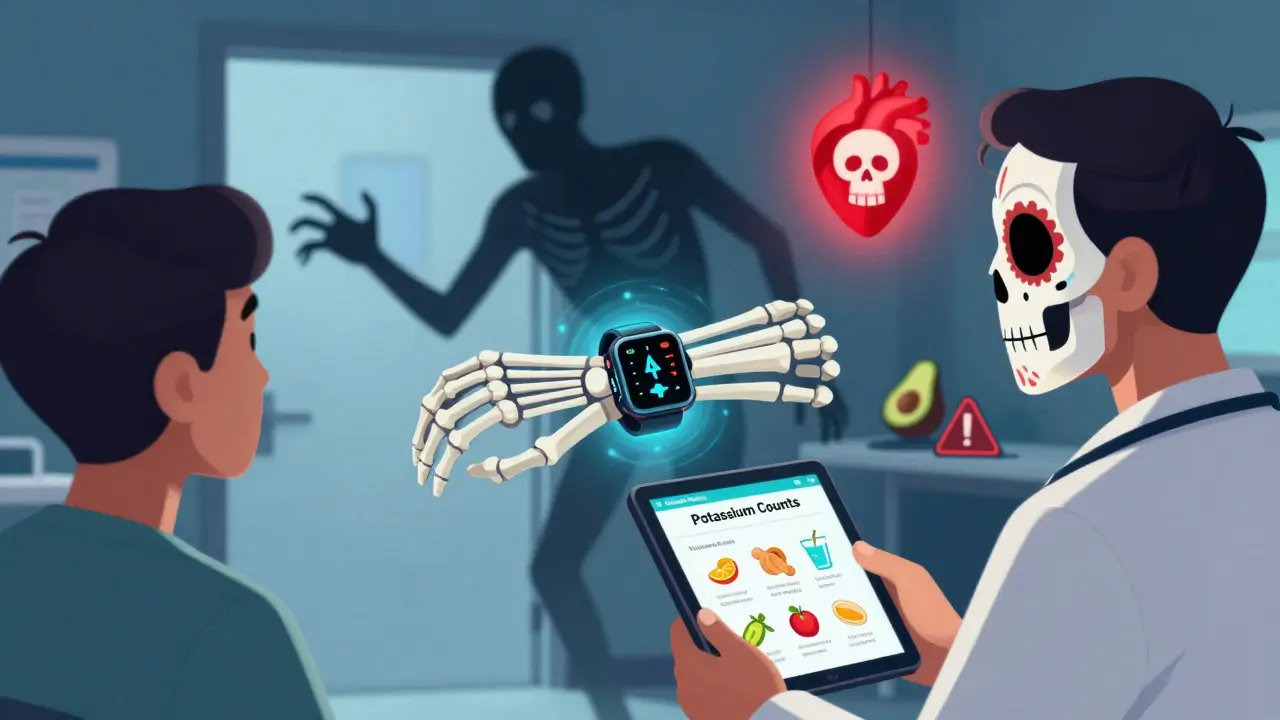
- Use an app. The National Kidney Foundation’s "Potassium Counts" app (used by over 285,000 people) lets you log meals and track intake.
- Space out meals and meds. Take your blood pressure pill at least 2 hours before or after a high-potassium meal. This reduces absorption spikes.
- Monitor symptoms. Muscle cramps, tingling fingers, or irregular heartbeat? Call your doctor. Don’t wait.
Many patients don’t realize their doctor can help them eat better without risking danger. A 2023 survey found that 72% of U.S. hypertension patients get dietary advice-but only 38% are told about potassium-medication risks.
What’s New in 2026?
There’s progress. The FDA now requires potassium warnings on packaging for ACE inhibitors and ARBs. In 2023, the FDA approved patiromer (Veltassa), a medication that binds excess potassium in the gut, letting people stay on life-saving drugs while eating more vegetables.
And new tech is coming. Omron’s HeartGuide smartwatch, launching in Q2 2024, will monitor potassium trends through skin sensors-no blood draws needed. It’s still in trials, but early results show it can detect dangerous shifts 24-48 hours before they become emergencies.
For now, the best tool you have is awareness. Potassium isn’t the enemy. It’s a tool. Used right, it lowers blood pressure. Used wrong, it can stop your heart.
Can I still eat bananas if I’m on blood pressure medication?
It depends. If you’re taking an ACE inhibitor, ARB, or potassium-sparing diuretic, eating one banana a day is usually fine-but not multiple per day. Two or more bananas daily, especially with other high-potassium foods, can push levels into the danger zone. Talk to your doctor and get your potassium checked before making changes.
Do all blood pressure meds affect potassium?
No. Only ACE inhibitors, ARBs, and potassium-sparing diuretics (like spironolactone) reduce potassium excretion. Other common drugs like calcium channel blockers (amlodipine), thiazide diuretics (hydrochlorothiazide), and beta-blockers (metoprolol) do not increase potassium risk. Always check your specific medication label or ask your pharmacist.
What are the early signs of high potassium?
Early signs are subtle and often mistaken for fatigue or stress: muscle weakness (especially in arms or legs), tingling or numbness in hands/feet, irregular heartbeat, nausea, or feeling unusually tired. If you’re on a high-risk medication and notice these symptoms, get tested immediately. Severe hyperkalemia can cause cardiac arrest without warning.
Should I take a potassium supplement?
Absolutely not if you’re on ACE inhibitors, ARBs, or spironolactone. Supplements deliver potassium in concentrated doses that your body can’t regulate properly. Even healthy people can develop dangerous levels. The 2022 JAMA Internal Medicine study found a 1.8-fold increase in death risk among CKD patients taking potassium supplements. Get potassium from food, not pills.
How often should I get my potassium checked?
If you’re on a high-risk medication and making dietary changes, get tested at baseline, then again at 2 weeks and 4 weeks. After that, every 3-6 months is standard. If you have kidney disease or are over 65, your doctor may want checks every 3 months. Don’t wait for symptoms-by then, it’s often too late.
Sarah Barrett
February 15, 2026 AT 11:21The elegance of potassium’s dual nature never ceases to amaze me. It’s not just a mineral-it’s a quiet conductor in the symphony of cardiovascular health, orchestrating sodium excretion and arterial relaxation with such poetic precision. And yet, in the hands of modern pharmacology, it becomes a double-edged blade, slicing through the very wellness we seek to cultivate. The irony is almost Shakespearean: the foods that nurture us become silent assassins when paired with life-saving drugs. We’re taught to eat the rainbow, but no one warns us that some hues carry hidden weights.
It’s a reminder that biology doesn’t care about intentions. A banana is not ‘good’ or ‘bad’-it simply is. Its power lies in context, in the invisible calculus of renal filtration, hormonal blockade, and metabolic load. We need more nuanced conversations-not fear, not dogma-but a deeper literacy in how physiology and pharmacology dance together.
And yet, here we are, navigating this minefield with apps and blood tests, like modern alchemists trying to transmute nutrition into safety. The real breakthrough isn’t in new drugs, but in empowering patients to understand their own biochemistry-not as patients, but as stewards of their own systems.
Erica Banatao Darilag
February 15, 2026 AT 21:12i just found out i’m on an arbs and i’ve been eating spinach for breakfast every day for 3 years… oh no. i didn’t even know this was a thing. my doctor never mentioned it. i’m gonna go check my last bloodwork. i hope i’m okay. i really love spinach. :/
Michael Page
February 17, 2026 AT 18:18The human body is not a machine with interchangeable parts. It is a dynamic equilibrium, a fragile negotiation between intake, excretion, and regulatory feedback loops. To treat potassium as a variable to be optimized is to misunderstand the essence of physiology. It is not a nutrient to be maximized or minimized-it is a signal, a rhythm, a whisper in the electrochemical chorus of life. When we interfere with its flow through pharmaceutical levers, we do not ‘manage’ health-we disrupt harmony. The real danger is not hyperkalemia itself, but our arrogance in believing we can control complexity with checklists and apps. The body remembers what the algorithm forgets.
Charlotte Dacre
February 18, 2026 AT 14:35So let me get this straight. We’re told to eat more vegetables because they’re ‘healthy,’ then told to avoid them because they might kill us if we’re on meds we didn’t even know had this side effect? Brilliant. Just brilliant. Who came up with this? A marketing team? A pharmaceutical focus group? I’m starting to think the real epidemic isn’t high blood pressure-it’s the lack of coherent medical communication. Can we at least put a warning sticker on spinach? ‘Caution: May cause cardiac arrest if taken with lisinopril. Do not consume with avocado.’
Kaye Alcaraz
February 19, 2026 AT 09:21Thank you for this comprehensive overview. The clarity here is invaluable. Many patients are left to navigate this alone, and the stakes are too high for ambiguity. I’ve worked with hypertensive patients for over a decade, and the number who are unaware of this interaction is staggering. The five-step action plan you outlined is spot-on. Baseline testing, food variation, avoiding supplements, spacing intake, and symptom awareness-these are not suggestions. They are essential protocols. I encourage every clinician to print this and hand it out. Knowledge is the most effective medication we can offer.
Esha Pathak
February 20, 2026 AT 08:52Life is a paradox wrapped in a cellular membrane. We are told to eat plants because they are life-giving, yet the same plants that nourish the body can, in the right chemical context, become its undoing. This is the dance of existence-balance, not extremes. The banana is not the villain. The silence of the physician is.
I think of my grandmother in Kerala, who ate three bananas a day and lived to 92. She never took medicine. But today, in our world of pharmacological precision, even the most innocent things must be weighed, measured, and interrogated. We have lost the art of intuition. Now we rely on apps. Perhaps that is progress-or perhaps it is just another form of control.
Mike Hammer
February 21, 2026 AT 20:03man i just switched to eating sweet potatoes instead of rice and now i’m paranoid. i had no idea. i’ve been on lisinopril for 5 years. i’m gonna go check my last labs. also coconut water is basically potassium juice? wow. that’s wild. i thought it was just a ‘healthy’ drink. guess not. thanks for the heads up.
also i’m not eating avocado anymore. bye bye guac.
Daniel Dover
February 23, 2026 AT 00:12One banana a day is fine. Two is risky. Avoid salt substitutes. Get tested. Done.
Chiruvella Pardha Krishna
February 24, 2026 AT 16:57There is a profound truth here, buried beneath clinical data and dietary charts: modern medicine has made us dependent on surveillance. We no longer trust our bodies. We trust blood tests. We no longer eat for nourishment-we eat for compliance. The irony is that the very tools designed to preserve life have made us afraid of life itself. Potassium is not the enemy. Our fear of complexity is. The body, in its ancient wisdom, knew how to balance. We, with our algorithms and apps, have forgotten how to listen.
Joe Grushkin
February 26, 2026 AT 04:47Let’s be real. This is just another way for Big Pharma to sell more tests, more apps, more drugs. Patiromer? Veltassa? Please. The real solution is to stop prescribing ACE inhibitors to people who like vegetables. Or better yet-stop telling people to eat ‘healthy.’ Why not just take a pill and eat whatever you want? Simpler. Cheaper. Less anxiety. And honestly, how many people even know what an ARB is? This whole thing feels like a marketing campaign disguised as medical advice.
Virginia Kimball
February 28, 2026 AT 03:36This is such a needed conversation. I’ve seen so many people panic and cut out all fruits and veggies because they were scared-only to end up with worse blood pressure and constipation. You don’t have to give up your favorite foods. You just need to be smart about it. Swap spinach for kale one day, try apples instead of bananas, drink water instead of coconut water. Small changes. Big impact. And please, talk to your doctor. Don’t Google it at 2 a.m. You’ve got this. You’re not alone in this. ❤️