Generic medications make up about 90% of prescriptions dispensed in the United States. They save billions of dollars annually but introduce unique safety challenges that brand-name drugs do not. When a patient picks up a generic version of their usual medication, they might notice a different color, shape, or even taste. These physical changes can lead to confusion, dosing mistakes, and potentially serious health consequences. Understanding how these errors happen and how to stop them is critical for every pharmacist.
The scale of the problem is significant. The Institute of Medicine estimated that 1.5 million preventable adverse drug events occur each year in the U.S., costing approximately $77 billion. While not all of these involve generics specifically, the complexity of generic substitution adds layers of risk. Community pharmacies see prescription correction rates of roughly 23 per 10,000 prescriptions. A large portion of these corrections stem from administrative issues or clinical discrepancies like dosage errors and strength mismatches. For pharmacists, preventing these errors isn't just about following rules; it's about protecting patients who rely on consistent care.
Why Generic Medications Pose Unique Risks
Generic drugs must meet strict bioequivalence standards set by the FDA, meaning they deliver between 80% and 125% of the active ingredient compared to the brand name. However, this range allows for variations in inactive ingredients, known as excipients. These differences can affect how quickly the drug dissolves or how a patient tolerates it. More importantly, different manufacturers produce the same generic drug with varying colors, shapes, and imprints. This variability creates a perfect storm for look-alike/sound-alike (LASA) errors.
Consider a scenario where a patient receives a generic atorvastatin from Manufacturer A, which is white and oval. Months later, due to supply chain issues, the pharmacy switches to Manufacturer B, producing a yellow, round tablet. If the patient doesn't understand why the pill changed, they might suspect it's the wrong medication and skip doses. Alternatively, if two different generics have similar names-like 'Zoloft' (sertraline) and 'Zolpidem' (Ambien)-a hurried pharmacist could easily pick the wrong bottle. Studies show that 35% of preventable adverse drug events result from inadequate drug information, often because prescribers or pharmacists aren't aware of specific manufacturer formulations.
Common Types of Generic-Related Errors
Errors involving generics typically fall into three categories: dispensing mistakes, substitution confusion, and communication breakdowns. Dispensing errors occur when the wrong strength or form is given. For example, a prescription calls for 10 mg, but the pharmacist accidentally grabs a 20 mg generic tablet because the bottles look similar. Substitution confusion happens when a patient expects one manufacturer's product but receives another, leading to non-adherence. Communication breakdowns are perhaps the most dangerous. If a label incorrectly states "take twice daily" instead of "twice weekly," the patient may overdose before realizing the mistake.
- Dosage Errors: Accounting for 37.4% of clinical corrections, these involve giving too much or too little active ingredient.
- Strength Discrepancies: Making up 19.2% of errors, these occur when the selected tablet strength doesn't match the prescription.
- Dispensing Form Issues: Representing 14.4% of cases, these involve providing a tablet instead of a capsule, or vice versa.
- Quantity Mistakes: Comprising 11.3% of errors, these relate to the number of pills dispensed versus prescribed.
These statistics highlight that while technology helps, human factors remain central. A pharmacist distracted by phone calls or rushing to meet workflow demands is more likely to miss subtle differences between generic packages.
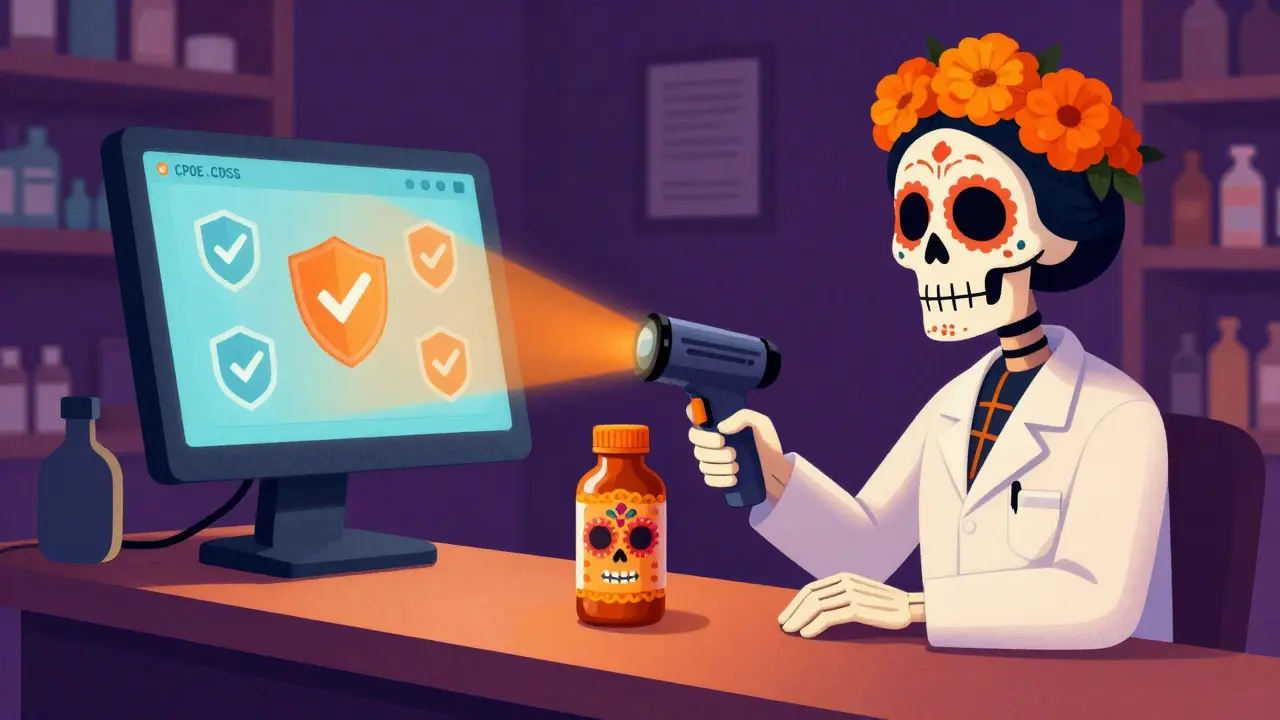
Prevention Strategies: Technology and Protocols
Preventing generic-related errors requires a multi-layered approach combining technology, standardized protocols, and vigilant staff training. The first line of defense is Computerized Physician Order Entry (CPOE). CPOE systems reduce medication errors by 55% in hospital settings by eliminating handwritten prescriptions that are prone to misinterpretation. When integrated with Clinical Decision Support Systems (CDSS), these tools can flag potential issues such as duplicate therapies, incorrect dosages, or dangerous drug interactions.
| Technology | Error Reduction Rate | Primary Benefit |
|---|---|---|
| CPOE | 55% | Eliminates handwriting errors |
| BCMA | 50% | Verifies right patient/drug at bedside |
| CDSS | Variable | Flags interactions and dosing issues |
Bar Code Medication Administration (BCMA) is another powerful tool, reducing potential adverse drug events by 50%. By scanning the patient's wristband and the medication barcode, BCMA ensures the "right patient, right drug, right dose." However, technology has limits. Alert fatigue is a real concern; if CDSS systems generate too many low-priority warnings, pharmacists may start ignoring them. To combat this, alerts must be tailored to high-risk scenarios, such as narrow therapeutic index drugs or complex generic substitutions.
Standardized protocols like the "8 R's of medication safety" provide a framework for manual checks. These include verifying the right patient, drug, time, dose, route, documentation, reason, and response. Implementing this framework requires 8-12 hours of initial training for pharmacy teams. While it seems basic, adhering strictly to these steps catches errors that technology misses. For instance, a pharmacist reviewing the "reason" for a prescription might notice that a generic substitution contradicts the patient's allergy history, even if the system didn't flag it.
The Role of Medication Reconciliation
Medication reconciliation is arguably the most effective strategy for preventing generic-related errors, especially during transitions of care. When a patient is discharged from the hospital, their medication list must be updated to reflect any changes made during their stay. Pharmacists spend 15-20 minutes per patient conducting comprehensive reviews, identifying an average of 2.3 medication discrepancies per case. This process is crucial for generics because hospitals often use different manufacturers than community pharmacies.
If a patient was stabilized on a specific generic formulation in the hospital, switching to a different manufacturer upon discharge could destabilize their condition. Reconciliation involves comparing the home medication list with the discharge orders and resolving any differences. It also provides an opportunity to educate the patient about expected changes in appearance. Without this step, patients may assume they received the wrong medication and stop taking it entirely.
Correcting Errors: Immediate Actions and Reporting
Despite best efforts, errors will still occur. How a pharmacy responds determines whether a minor mistake becomes a major harm. The first step is immediate recognition. If a pharmacist realizes they dispensed the wrong strength, they must contact the patient immediately. Transparency is key. Admitting the error, apologizing sincerely, and explaining the corrective action builds trust rather than destroying it.
- Contact the Patient: Inform them of the error clearly and calmly. Ask if they have taken any doses.
- Assess Harm: Determine if the patient needs medical attention. For minor errors, monitor via phone; for serious ones, direct them to urgent care.
- Provide Correct Medication: Replace the erroneous drug free of charge and ensure proper counseling.
- Document the Incident: Record details in the pharmacy's error tracking system. Only 28% of community pharmacies maintain formal error tracking, making this step often overlooked but vital for improvement.
- Conduct Root Cause Analysis: Identify why the error happened. Was it a labeling issue? Staff fatigue? System failure?
Reporting errors to external bodies like the FDA's MedWatch program helps identify systemic issues. If multiple pharmacies report problems with a specific generic manufacturer's packaging, regulatory action can be taken. Internally, analyzing trends allows pharmacies to adjust workflows. For example, if LASA errors are frequent, separating visually similar drugs on shelves can mitigate risk.
Patient Counseling as a Final Safeguard
Mandatory counseling for first-fill medications acts as a critical final checkpoint. Pharmacists report that 15-20% of counseling sessions catch potential misunderstandings about generic substitutions. During counseling, the pharmacist should explicitly mention if the medication is a generic and describe its appearance. Asking open-ended questions like, "What did you expect your pill to look like?" can reveal discrepancies before the patient leaves the counter.
In high-volume retail settings, time pressure often compromises counseling quality. Yet, skipping this step increases risk. Even a brief 3-5 minute conversation can clarify dosing instructions and reassure anxious patients. Encouraging patients to ask questions empowers them to participate in their own safety. After all, the patient is the last person to handle the medication before ingestion.
Are generic medications less safe than brand-name drugs?
No, generic medications are required by the FDA to be bioequivalent to brand-name drugs, meaning they contain the same active ingredients and work the same way in the body. However, differences in inactive ingredients and physical appearance can lead to confusion or allergic reactions in rare cases, necessitating careful monitoring and patient education.
What should I do if my generic pill looks different from before?
Do not stop taking your medication immediately. Contact your pharmacist or doctor to verify if the change is due to a manufacturer switch. Pharmacies often switch suppliers based on availability and cost. Your pharmacist can confirm the drug's identity and explain the new appearance to ensure you feel confident continuing treatment.
How common are pharmacy errors with generic drugs?
While exact figures for generic-specific errors are hard to isolate, community pharmacies experience prescription correction rates of about 23 per 10,000 prescriptions. Many of these involve dosage or strength discrepancies that can be exacerbated by the visual similarities among various generic manufacturers.
Can technology prevent all generic medication errors?
Technology significantly reduces errors but cannot eliminate them entirely. Systems like CPOE and CDSS catch many issues, but alert fatigue and database inaccuracies remain challenges. Human verification through medication reconciliation and patient counseling remains essential for catching errors that technology misses.
What is medication reconciliation and why is it important for generics?
Medication reconciliation is the process of creating the most accurate list possible of all medications a patient is taking. It is crucial for generics because patients may receive different manufacturers' products in hospitals versus outpatient settings. Reconciliation ensures continuity of care and prevents adverse reactions from unexpected formulation changes.