You took a pill, and within an hour, your skin broke out in itchy red bumps. Or maybe you got nauseous after swallowing your antibiotic. Which one is it-a true drug allergy or just a side effect? The difference isn’t just academic. Getting it wrong can mean avoiding life-saving medications, ending up in the hospital, or even contributing to antibiotic resistance. And here’s the kicker: 90% of people who think they’re allergic to penicillin aren’t.
What’s Really Going On Inside Your Body?
A drug allergy isn’t just a bad reaction. It’s your immune system going haywire. When you have a true drug allergy, your body mistakes the medication for a threat-like a virus or pollen-and launches an attack. This triggers the release of histamine and other chemicals, causing symptoms like hives, swelling, trouble breathing, or even a drop in blood pressure. These reactions are mediated by IgE antibodies, the same ones involved in peanut or bee sting allergies. A side effect? That’s something completely different. It’s the drug doing exactly what it’s supposed to do-but in the wrong place. Take aspirin: it thins your blood to prevent clots, but that same action can irritate your stomach lining and cause nausea. That’s not your immune system reacting. That’s pharmacology in action. Side effects are predictable, often dose-dependent, and usually don’t get worse each time you take the drug.Timing Tells the Story
When did your symptoms show up? That’s your first clue. If you broke out in hives or felt your throat close up within minutes to an hour after taking the pill, that’s a classic sign of an IgE-mediated allergic reaction. These are immediate. They can escalate fast. Anaphylaxis-the most dangerous form-can kill within minutes if not treated. Delayed reactions are trickier. A rash that appears 7 to 14 days after starting a new antibiotic? That’s often a T-cell mediated reaction, still a true allergy. So is DRESS syndrome (Drug Reaction with Eosinophilia and Systemic Symptoms), which can hit 2 to 6 weeks later with fever, swollen lymph nodes, and organ involvement. These aren’t side effects. They’re immune responses, just slower. Side effects? They usually show up within hours, but they don’t follow a pattern of worsening with each dose. If you got dizzy after your first blood pressure pill and it got worse the second day? That’s probably still a side effect. But if you got dizzy the first time, then broke out in hives the second time? That’s a red flag for allergy.Symptoms: One System or Many?
Side effects usually stick to one system. Nausea? That’s the gut. Headache? That’s the brain. Dizziness? That’s your inner ear or blood pressure. True drug allergies? They rarely stay put. If you have a rash and swelling and trouble breathing and stomach cramps-all at once-that’s not a side effect. That’s your immune system going full alert. According to data from Premier Health, 87% of confirmed drug allergies involve two or more body systems. Only 22% of side effects do. That’s why nausea alone doesn’t mean you’re allergic. A 2022 study in JAMA Internal Medicine found that 68% of people who said they were allergic to penicillin because they got sick to their stomach were actually just experiencing a common side effect. They didn’t need to avoid all penicillin-class antibiotics. They just needed to know the difference.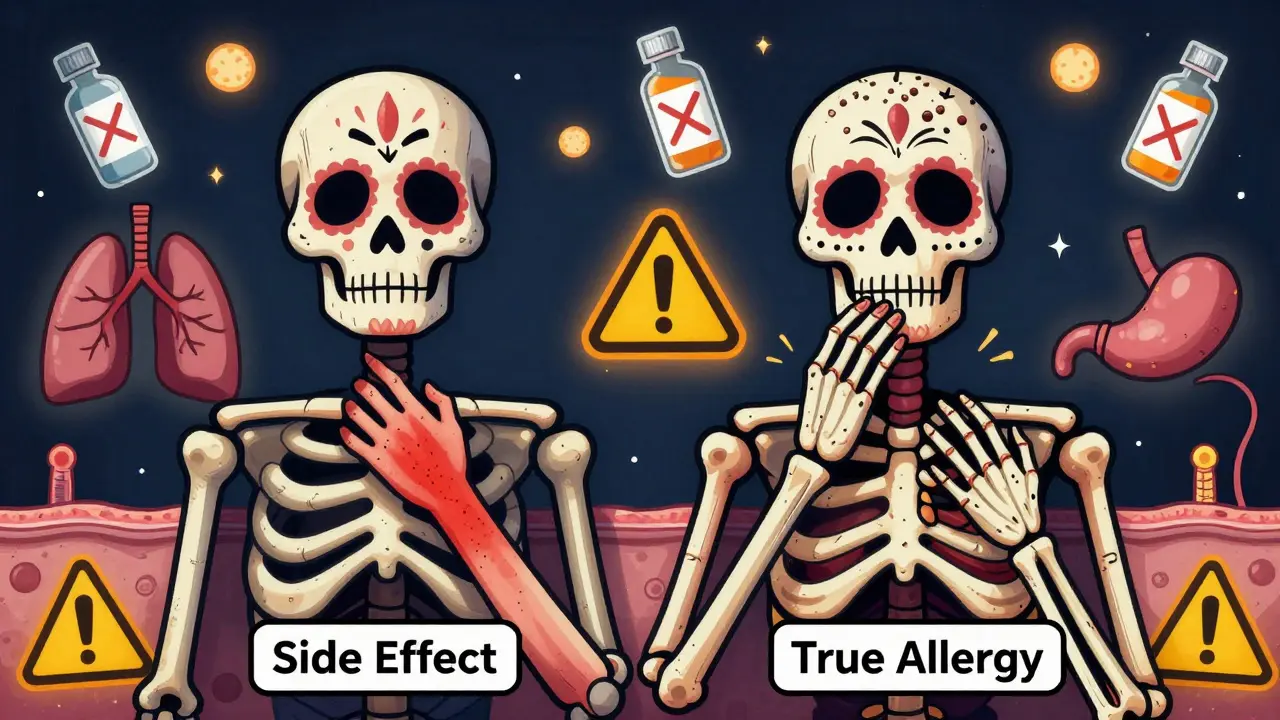
The Penicillin Myth
Penicillin is the biggest offender here. About 10% of Americans say they’re allergic to it. But when they’re tested-really tested, with skin tests or oral challenges-90 to 95% turn out not to be allergic at all. Why? Because they got a rash as a kid, or felt queasy once, or were told by a parent or a nurse decades ago, and never questioned it. The problem? Doctors avoid penicillin and reach for broader-spectrum antibiotics like vancomycin or ciprofloxacin. These drugs are more expensive, more likely to cause C. diff infections, and more likely to fuel antibiotic resistance. A 2022 study in JAMA Network Open showed patients with falsely labeled penicillin allergies had 69% higher rates of C. diff and stayed in the hospital 30% longer. And here’s the good news: if you’ve been avoiding penicillin because of a childhood reaction, you can probably take it safely now. Mayo Clinic’s de-labeling program successfully reclassifies 92% of low-risk patients. All it takes is a simple skin test and, if needed, a supervised dose under medical care.When It’s Not an Allergy-But Still Bad
Not every bad reaction is an allergy. Some are serious, but not immune-driven. For example:- Stevens-Johnson Syndrome (SJS) and Toxic Epidermal Necrolysis (TEN): These are rare but deadly skin reactions that destroy the top layer of skin. They’re immune-mediated, so they count as true allergies-even though they look like burns.
- Drug-induced liver injury: This isn’t allergic. It’s direct toxicity, often dose-related. But it still requires stopping the drug.
- Photosensitivity: Some drugs make your skin burn in the sun. That’s a pharmacological quirk, not an allergy.

How Doctors Tell the Difference
If you’re unsure, your doctor doesn’t guess. They use tools:- Drug Allergy Clinical Assessment Score (DACA): This assigns points for symptoms: 1 point for hives, 2 for breathing trouble, 3 for anaphylaxis. A score of 3 or higher means you need a specialist.
- Skin testing: For penicillin, a tiny amount of the drug is pricked into your skin. If you’re allergic, a red bump appears within 20 minutes. It’s 95% accurate.
- Oral challenge: If skin tests are negative, you might be given a small, controlled dose under supervision. If nothing happens? You’re not allergic.
- Blood tests: The Penicillin ImmunoCAP test, approved by the FDA in 2023, detects specific IgE antibodies with 97% accuracy.
What You Should Do
If you’ve ever had a reaction to a drug, write it down. Not just “I’m allergic to penicillin.” Write:- What drug?
- When did it happen?
- What exactly happened? (Rash? Swelling? Vomiting? Trouble breathing?)
- How long after taking it?
- Did you need emergency care?
Why This Matters More Than You Think
This isn’t just about you. It’s about the whole healthcare system. The CDC estimates that mislabeled penicillin allergies cost the U.S. over $1 billion a year in unnecessary antibiotics, longer hospital stays, and avoidable infections. Every time someone avoids penicillin because they think they’re allergic, they’re increasing the risk of drug-resistant superbugs. And it’s getting worse. The FDA now requires drug labels to clearly separate side effects from allergies. By 2025, electronic health records must mark reactions as “allergy,” “intolerance,” or “side effect”-no more vague “allergic reaction” notes. The future is clearer labeling, better testing, and smarter systems. But until then, the power is in your hands. Know the difference. Speak up. Ask questions. Don’t let a misunderstanding keep you from the right medicine.Can I outgrow a drug allergy?
Yes, especially with penicillin. Many people who had a reaction as a child lose their sensitivity over time. Studies show that up to 80% of people who were once allergic to penicillin no longer react after 10 years. That’s why it’s important to get retested if you haven’t taken the drug in over a decade.
If I’m allergic to penicillin, am I allergic to all antibiotics?
No. Penicillin allergies are specific to that class of drugs. Being allergic to penicillin doesn’t mean you’re allergic to amoxicillin, ciprofloxacin, azithromycin, or doxycycline. These are different chemical families. Cross-reactivity is rare-only about 10% of penicillin-allergic people react to amoxicillin, and even then, it’s not guaranteed. Always get tested before assuming.
Can I have an allergic reaction the first time I take a drug?
Yes. While some allergies develop after prior exposure, your immune system can react to a drug the very first time you take it. This happens when your body has been sensitized through another route-like trace exposure in food, environmental contamination, or even a previous infection that mimicked the drug’s structure. It’s rare, but it happens.
Are all rashes from drugs allergies?
No. Many rashes are side effects or unrelated. Viral infections, heat, or even stress can cause rashes around the same time you start a new medication. A drug-induced rash that’s an allergy usually appears as raised, itchy welts (hives) or a flat, red, spreading rash. But if it’s just a mild, non-itchy redness that fades in a few days, it’s more likely a side effect. Always get it checked.
What should I do if I think I’m having an allergic reaction?
Stop the drug immediately. If you have trouble breathing, swelling of the face or throat, dizziness, or a rapid heartbeat, call emergency services right away. These are signs of anaphylaxis. If you have an epinephrine auto-injector (like an EpiPen), use it. Even if symptoms improve, go to the hospital-reactions can come back. Afterward, see an allergist to confirm what happened.
Nicole Beasley
December 28, 2025 AT 19:23sonam gupta
December 29, 2025 AT 17:48Julius Hader
December 30, 2025 AT 18:42Vu L
December 31, 2025 AT 16:34Kelsey Youmans
January 1, 2026 AT 03:31Debra Cagwin
January 2, 2026 AT 03:02Celia McTighe
January 3, 2026 AT 15:54Ryan Touhill
January 5, 2026 AT 00:03Teresa Marzo Lostalé
January 6, 2026 AT 11:19James Hilton
January 7, 2026 AT 21:19Mimi Bos
January 9, 2026 AT 09:22Payton Daily
January 9, 2026 AT 21:31