One glass of grapefruit juice in the morning might seem like a healthy choice-until it turns dangerous. For people taking certain medications, that refreshing citrus drink can trigger life-threatening side effects, even if they’ve never had a problem before. It’s not about allergies or sugar. It’s about chemistry. And it’s more common than most people realize.
How Grapefruit Juice Changes How Your Body Handles Medication
Grapefruit juice doesn’t just taste different from orange juice-it works differently inside your body. The problem lies in chemicals called furanocoumarins, mainly bergamottin and 6’,7’-dihydroxybergamottin. These compounds don’t just sit there. They actively shut down an enzyme in your gut called CYP3A4, which normally breaks down about half of all prescription drugs before they even enter your bloodstream.
When CYP3A4 is blocked, your body absorbs way more of the drug than intended. A single 200ml glass of grapefruit juice-about one small cup-can boost drug levels by 300% to 800%. That’s not a little bump. That’s like taking five pills instead of one. And because the enzyme doesn’t bounce back quickly, the effect lasts for days. Even if you drink grapefruit juice at breakfast and take your pill at night, the damage is already done.
Which Medications Are Most at Risk?
Not all drugs are affected the same way. Some are barely touched. Others can turn deadly. The most dangerous ones fall into a few key categories:
- Statins (cholesterol drugs): Simvastatin and lovastatin are big risks. A 200ml glass of grapefruit juice can raise simvastatin levels by 330%, increasing the chance of muscle damage, kidney failure, or even death. Atorvastatin is also risky, but pravastatin, rosuvastatin, and fluvastatin are safe-they use different breakdown pathways.
- Calcium channel blockers (blood pressure meds): Felodipine and nifedipine can spike dangerously high. Amlodipine? No problem. The difference comes down to how much each drug relies on CYP3A4.
- Benzodiazepines (anxiety/sleep meds): Oral midazolam sees a 515% increase in blood levels. Triazolam? Still risky, but less so. Injected versions aren’t affected because they bypass the gut.
- Immunosuppressants: Cyclosporine and tacrolimus, used after transplants, can reach toxic levels. One patient died from kidney failure after drinking grapefruit juice while on cyclosporine.
- Antiarrhythmics: Amiodarone can cause irregular heart rhythms if levels climb too high.
On the flip side, some drugs like theophylline and itraconazole actually drop in concentration when taken with grapefruit juice-though why remains unclear. And fexofenadine (Allegra) gets less effective because grapefruit juice blocks the transporters that pull it into your blood. So it’s not always about higher levels. Sometimes, it’s about lower ones.
Why Some People Are More at Risk Than Others
You might wonder: if I drank grapefruit juice for years with no issues, why should I worry now? The truth is, it’s not about how long you’ve been drinking it-it’s about your body’s natural enzyme levels. Studies show some people have up to eight times more CYP3A4 in their gut than others. That means one person might see a 20% increase in drug levels, while another’s levels skyrocket. Age plays a role too. Older adults often take more medications and naturally produce less of these enzymes, making them more vulnerable.
Genetics also matter. A variant called CYP3A4*22 makes people more sensitive to grapefruit juice’s effects. Researchers are now looking at genetic testing to predict who’s at highest risk. But right now, there’s no easy way to know if you’re in the high-risk group-so the safest rule is to avoid it entirely if you’re on a high-risk medication.

What Counts as ‘Grapefruit’?
You don’t need to avoid just the juice. All forms of grapefruit carry the same risk:
- Fresh fruit
- Frozen concentrate
- 100% juice (even if it’s diluted)
- Smoothies with grapefruit
- Essential oils (if ingested)
White grapefruit has 20-50% more furanocoumarins than pink, but both are dangerous. Even a small amount-like half a fruit-can cause a reaction. And it doesn’t matter if you drink it an hour before or after your pill. The enzyme stays blocked for up to 72 hours. That’s three full days. So if you take your medication daily, you can’t just space it out. You have to cut it out completely.
Don’t assume other citrus fruits are safe. Seville oranges (used in marmalade) and pomelos contain the same chemicals. Regular oranges, tangerines, and clementines? Safe. They don’t have furanocoumarins. So if you’re looking for a citrus alternative, stick to those.
What Doctors and Pharmacies Are Doing About It
This isn’t just a theory. It’s a documented public health issue. The FDA now requires warning labels on 21 high-risk medications, including Zocor, Plendil, and Neoral. About 19% of all prescription labels in the U.S. now mention grapefruit juice-a big jump from 12% in 2015. Electronic health records now trigger alerts when a doctor prescribes a high-risk drug to someone with a history of grapefruit consumption.
But awareness still lags. A 2021 study found only 28% of patients could name even one medication affected by grapefruit juice-even after being told. And 47% of patients on high-risk drugs still consume grapefruit, especially those over 65. Pharmacists report that 63% of elderly patients ignore the warning, often because they think it’s just a myth or they’ve been drinking it for decades without problems.
Some pharmacies now offer free alternatives. The American Pharmacists Association’s ‘Grapefruit-Free Alternatives’ program has helped over 14,000 patients switch to safer versions of their meds since 2020. For example, switching from simvastatin to pravastatin removes the risk entirely. No side effects. No restrictions. Just as effective.
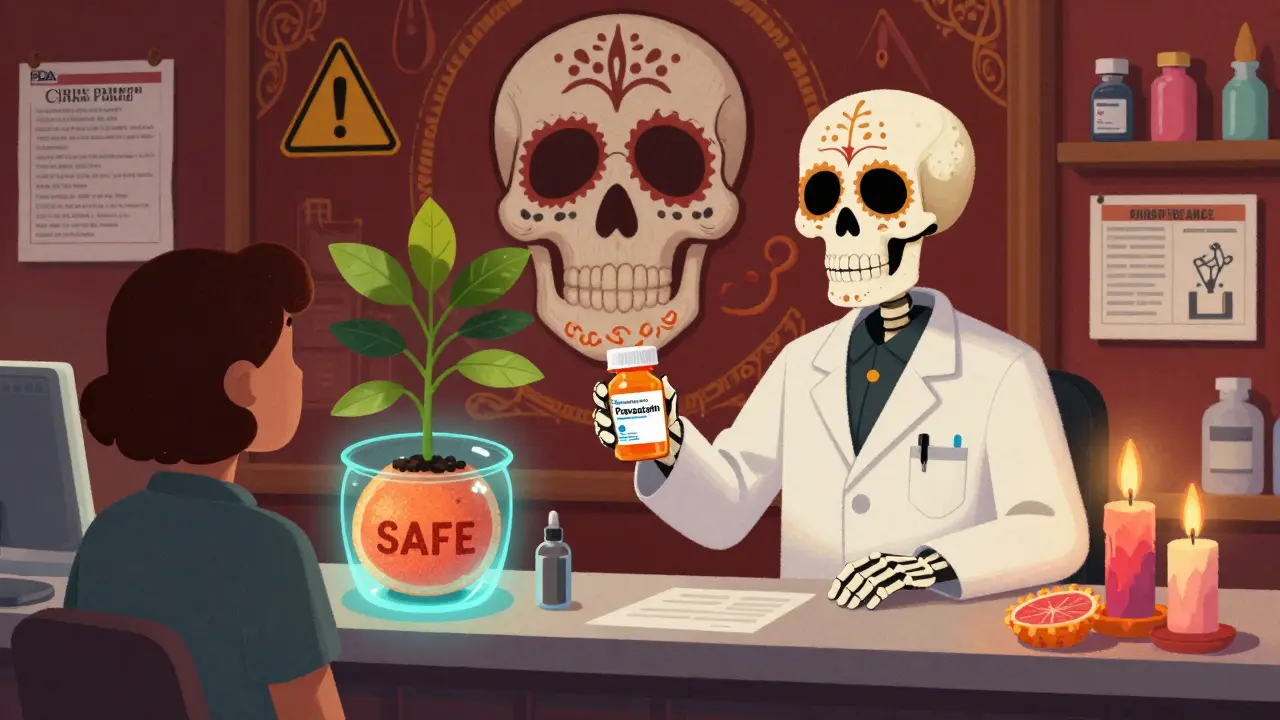
What You Should Do Right Now
If you’re on any prescription medication, here’s what to do:
- Check your pill bottle or prescription label. Look for the word ‘grapefruit’ in the warnings.
- Ask your pharmacist: ‘Does this medicine interact with grapefruit?’ Don’t assume they’ll bring it up-most don’t unless asked.
- If you’re on statins, calcium channel blockers, or immunosuppressants, assume it’s risky unless proven otherwise.
- Switch to oranges, tangerines, or apple juice instead.
- If you’ve been drinking grapefruit juice regularly, tell your doctor. They may want to check your drug levels or adjust your dose.
There’s no safe amount for high-risk drugs. No ‘just a little.’ No ‘once in a while.’ If your medication is on the list, grapefruit juice has no place in your routine.
What’s Next? Science Is Trying to Fix This
Researchers aren’t giving up. The University of Florida is testing CRISPR-edited grapefruit that removes the furanocoumarins while keeping the taste. Early results are promising. Meanwhile, drugmakers are reformulating pills-like extended-release felodipine-that are less affected by the juice.
Some scientists are even exploring whether this interaction could be used for good. Early studies show grapefruit juice might help boost absorption of certain cancer drugs or monoclonal antibodies. But that’s years away from real-world use. For now, the only proven solution is avoidance.
The bottom line? Grapefruit juice isn’t just a fruit. For millions of people, it’s a hidden danger. It doesn’t care if you think it’s healthy. It doesn’t care if you’ve been drinking it for 30 years. If you’re on the wrong medication, it can kill you. And the worst part? You won’t know until it’s too late.
Can I drink grapefruit juice if I take a low dose of my medication?
No. Even the smallest dose of a high-risk medication can become dangerous when combined with grapefruit juice. The interaction isn’t about dosage-it’s about how much of the drug your body absorbs. Grapefruit juice can turn a safe dose into a toxic one, no matter how small.
How long should I wait after drinking grapefruit juice before taking my medicine?
You can’t just wait a few hours. The enzyme inhibition lasts up to 72 hours. Even if you drink grapefruit juice at breakfast and take your pill at bedtime, the risk remains. The only safe approach is to avoid grapefruit completely while taking affected medications.
Is grapefruit juice safe if I take my medication only once a week?
No. Frequency doesn’t matter. What matters is whether the drug relies on CYP3A4 for breakdown. If it does, grapefruit juice will still block the enzyme and raise drug levels, even if you only take the pill once a week. The interaction happens every time you consume grapefruit.
Do other citrus fruits like oranges or lemons cause the same problem?
Regular oranges, tangerines, and lemons are safe. They don’t contain furanocoumarins. But Seville oranges (used in marmalade) and pomelos do-and they’re just as dangerous as grapefruit. Always check the type of citrus before consuming it with medication.
Can I eat grapefruit if I take my medication at night and drink juice in the morning?
No. The enzyme-blocking effect lasts for up to three days. Drinking grapefruit juice in the morning and taking your pill at night doesn’t avoid the interaction-it still happens. The only safe choice is to avoid grapefruit entirely while on affected medications.
Are over-the-counter drugs affected by grapefruit juice?
Yes. Some OTC meds like certain antihistamines, sleep aids, and pain relievers can interact. Check labels or ask your pharmacist. Don’t assume ‘over-the-counter’ means ‘safe.’
Why don’t more doctors warn patients about this?
Many don’t know the full scope. Studies show only 37% of pharmacists consistently warn patients. The interaction isn’t taught well in medical school, and labels can be vague. That’s why you need to ask. Don’t wait for your doctor to bring it up-take charge of your own safety.
Doreen Pachificus
January 3, 2026 AT 15:22Wow, I had no idea grapefruit juice could do this. I drink it every morning with my statin. Gonna switch to orange juice tomorrow.
Charlotte N
January 4, 2026 AT 19:32so like... if i drink it at breakfast and take my pill at 8pm... it's still bad?? like... all day?? wow
Jennifer Glass
January 5, 2026 AT 03:25This is one of those things that sounds like a myth until you dig into the science. The fact that it lasts 72 hours is wild. I used to think spacing it out would help. Nope. Just cut it out. Full stop.
Ethan Purser
January 6, 2026 AT 23:34It's not just about the juice-it's about the illusion of control. We think we're in charge of our bodies, but chemistry doesn't care about your routine, your 'but I've always done this' logic, or your morning ritual. The enzyme doesn't negotiate. It just shuts down. And then? You're a walking overdose waiting to happen. We're not talking about a side effect. We're talking about a silent betrayal by something you thought was healthy.
It's not grapefruit juice that's dangerous. It's our denial. We cling to comfort like it's truth. But biology doesn't give a damn about your nostalgia. Your 30 years of grapefruit? Irrelevant. Your 'low dose'? Meaningless. The math doesn't lie. And neither does the ICU.
It's a metaphor for modern medicine: we're told to eat clean, drink citrus, be healthy-while quietly being poisoned by the very things we think are helping us. Who's really in charge here? The doctor? The label? Or the biochemistry we refuse to acknowledge?
And yet... we still drink it. Because admitting we're vulnerable? That's harder than dying.
Uzoamaka Nwankpa
January 8, 2026 AT 02:57I’ve been taking cyclosporine since my transplant. I didn’t know this. My sister gave me a grapefruit last week. I ate it. I didn’t feel anything. Does that mean I’m safe?
Chris Cantey
January 8, 2026 AT 04:23They say avoid grapefruit. But what about the real question? Who benefits from keeping this information buried? Pharma? The juice industry? Why isn’t this on every label in bold red? Why do we only hear about it after someone’s in the ER?
It’s not negligence. It’s profit. They’d rather you die quietly than lose a billion in sales from switching meds. They’ll slap a tiny warning on a bottle that no one reads. Meanwhile, the FDA gets cozy with the same companies that make the drugs. Wake up.
bob bob
January 8, 2026 AT 14:17Just switched my simvastatin to pravastatin last month after reading this. Best decision ever. No more anxiety over breakfast. Also, orange juice tastes way better anyway. 🍊
Vicki Yuan
January 8, 2026 AT 14:55Important clarification: the 72-hour window applies to the enzyme inhibition, not the juice itself. The furanocoumarins are metabolized quickly, but the enzyme takes days to regenerate. That’s why even a single glass can have a prolonged effect. This isn’t a myth-it’s pharmacokinetics 101.
Catherine HARDY
January 10, 2026 AT 04:40Did you know the FDA only started requiring labels after 12 people died in one year? And they still don’t require warnings on juice cartons? That’s not safety-that’s corporate damage control. They’d rather you die than lose shelf space.
Abhishek Mondal
January 12, 2026 AT 00:23Actually, you're all missing the point. The real issue is the reductionist biomedical model that treats the body as a chemical reactor. This isn't just about CYP3A4-it's about the epistemological violence of pharmacological reductionism. You're reducing a holistic human experience to enzyme kinetics. Have you considered the phenomenology of citrus? The ritual? The cultural significance? You're not just avoiding a fruit-you're surrendering to a mechanistic worldview that pathologizes pleasure.
Oluwapelumi Yakubu
January 12, 2026 AT 01:56Bro, I'm from Nigeria and we love grapefruit here-sweet, juicy, and cheap! But now I'm gonna tell my whole family: if you on high blood med or transplant med, leave that grapefruit alone! I just called my cousin in Lagos-he was on cyclosporine and drinking juice every day. He's switching to pineapple now. God bless science!
Terri Gladden
January 12, 2026 AT 21:01i just read this and now i think my dad might have died because of grapefruit juice?? he was on blood pressure med and he loved it... i just found out he drank it every day... oh god
Jack Wernet
January 13, 2026 AT 08:24As a pharmacist for 22 years, I’ve seen this exact scenario play out too many times. A patient comes in, confused, scared-‘I’ve been drinking grapefruit juice for 40 years, why now?’ The answer is simple: it wasn’t safe then, and it’s not safe now. The science hasn’t changed. Our awareness just caught up. Please, if you’re on medication, ask your pharmacist. Don’t wait for the warning label to scream at you. Be proactive. Your life isn’t a gamble.