High cholesterol isn’t just a number on a lab report-it’s a silent risk factor that can lead to heart attacks, strokes, and blocked arteries. For millions of people, medication is the most effective way to bring those numbers down. And when it comes to lowering LDL (the "bad" cholesterol), statins have been the gold standard for over three decades. But they don’t work for everyone. Side effects, cost, and individual health risks mean many people need alternatives. So what are the real options beyond statins? And how do they stack up in effectiveness, safety, and ease of use?
How Statins Actually Work
Statins aren’t just pills that "lower cholesterol." They work by blocking an enzyme in your liver called HMG-CoA reductase. This enzyme is the main factory for making cholesterol. When you slow it down, your liver starts pulling more LDL cholesterol out of your blood to make up the difference. It’s like turning off a faucet and opening a drain at the same time.
Atorvastatin (Lipitor) and rosuvastatin (Crestor) are the most commonly prescribed statins today. They’re powerful: a high dose can cut LDL by more than 40%. But here’s the catch-doubling the dose only gives you about a 6% extra drop in LDL. That’s the law of diminishing returns. A 20 mg dose might get you to 120, but 40 mg won’t get you to 80. It plateaus.
Statins are also proven to save lives. A major study tracking over 39,000 people found that every 20 mg/dL drop in LDL meant a 15% lower risk of heart attack or stroke. And over time, statin users had 19% fewer deaths from heart disease. That’s why guidelines from the American Heart Association and the European Society of Cardiology still put statins as the first choice for most people with high cholesterol or heart disease risk.
Why People Stop Taking Statins
Despite their effectiveness, about 25% of people stop taking statins within the first year. Why? The biggest reason is muscle pain-aches, weakness, cramps. It’s not just "feeling sore." For some, it’s severe enough to make walking or climbing stairs hard. Studies show 5-10% of patients on standard doses report this, though many cases are misattributed. Sometimes it’s not the statin at all-it’s aging, lack of movement, or another medication.
But for others, the side effects are real. And when they are, switching statins doesn’t always help. Simvastatin and lovastatin are metabolized by the same liver enzyme (CYP3A4), so if you react to one, you might react to the other. Pravastatin and rosuvastatin, on the other hand, are processed differently and often cause fewer muscle issues. Still, if you’ve tried two different statins and still can’t tolerate them, it’s time to look elsewhere.
Ezetimibe: The Gentle Alternative
Ezetimibe (Zetia) works in a completely different way. Instead of stopping cholesterol production in the liver, it blocks cholesterol absorption in your gut. Think of it as a bouncer at the door of your intestines-不让胆固醇进入血液.
Alone, ezetimibe lowers LDL by 15-22%. That’s not as strong as a statin, but when you combine it with a low-dose statin, you get a 21-27% drop. It’s a smart combo for people who need extra help but can’t handle high-dose statins. And here’s the big plus: it rarely causes muscle pain. A patient on MyHeart.net said, "Zetia alone got my LDL from 190 to 160, but adding it to my low-dose simvastatin brought it down to 110." That’s a 42% drop with minimal side effects.
It’s also cheap. Generic ezetimibe costs less than $10 a month. The National Institute for Clinical Excellence (NICE) recommends it for people who can’t take statins-or for those who need a boost on top of statins. It’s not a replacement, but it’s a solid backup.
PCSK9 Inhibitors: The Power Players
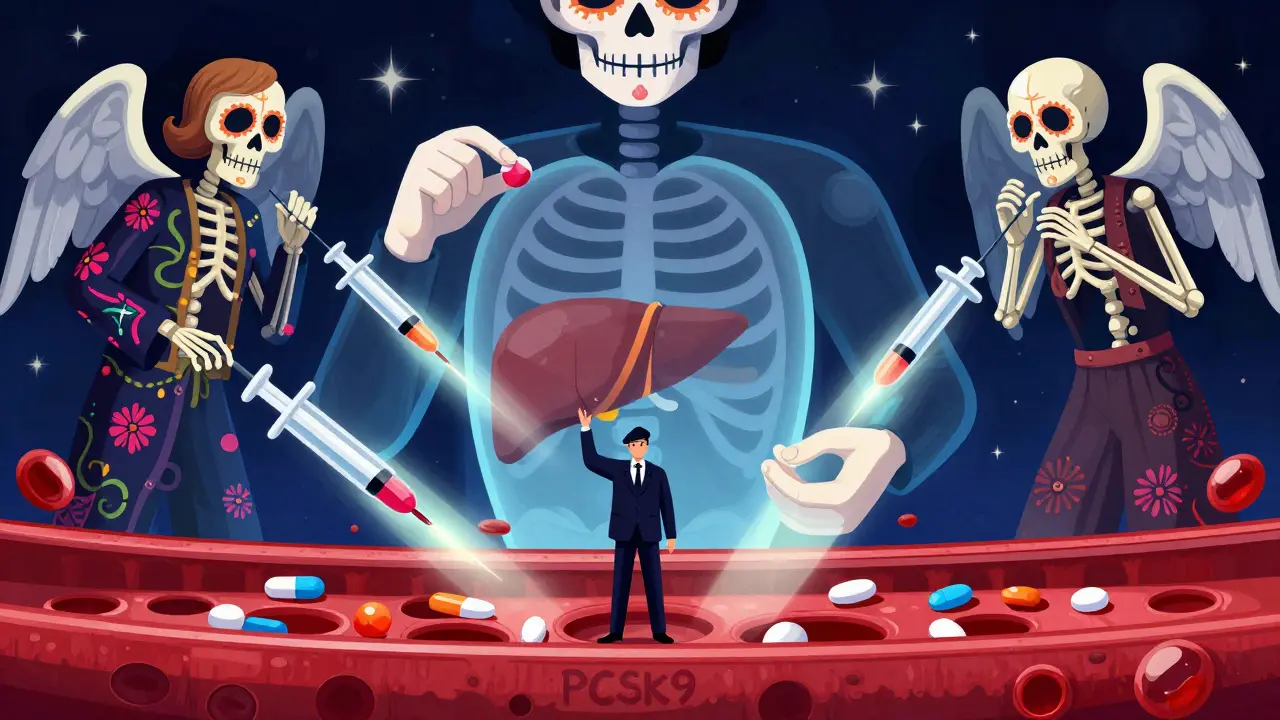
Introduced in 2015, PCSK9 inhibitors like alirocumab (Praluent) and evolocumab (Repatha) are a game-changer. These are injectable drugs given every two to four weeks. They work by blocking a protein called PCSK9, which normally tells your liver to destroy LDL receptors. When you block PCSK9, your liver keeps more receptors alive-and those receptors pull LDL out of your blood like vacuum cleaners.
On their own, they can slash LDL by up to 60%. In people with existing heart disease, they reduce the risk of heart attack or stroke by 20%. And unlike statins, they don’t increase the risk of hemorrhagic stroke-a rare but serious side effect linked to statins in some patients. UCLA researchers found that for people with a history of brain bleeding, PCSK9 inhibitors are a safer option.
But there’s a catch: cost. A year’s supply can run $5,850. Insurance often denies coverage unless you’ve tried and failed on statins and ezetimibe. One Reddit user wrote: "Repatha lowered my LDL from 220 to 60 in 3 months, but my insurance denied coverage three times before approving it." That’s not uncommon. These drugs are meant for high-risk patients-those with familial hypercholesterolemia, diabetes plus high LDL, or heart disease who still aren’t at goal.
Newer Options: Bempedoic Acid and Inclisiran
Bempedoic acid (Nexletol), approved in 2020, works in the liver like a statin but doesn’t enter muscle tissue. That’s why it causes far fewer muscle side effects. It lowers LDL by about 17% on its own. It’s taken as a pill, so it’s easier than injections. It’s often combined with ezetimibe for better results.
Then there’s inclisiran (Leqvio), approved in late 2021. This is the first RNA-based cholesterol drug. It’s injected just twice a year. It silences the PCSK9 gene at the genetic level, cutting LDL by 40-50% when paired with a statin. It’s a huge win for adherence-no daily pills, no monthly shots. But like PCSK9 inhibitors, it’s expensive and hard to get approved. Still, for someone who struggles with daily meds, it’s a breakthrough.
What About Supplements?
Red yeast rice, fish oil, plant sterols, garlic pills-they’re everywhere. But here’s the truth: none of them come close to statins. Harvard Health reviewed the data and concluded: "If you need to lower your LDL, a statin works, and these supplements do not." Red yeast rice contains a natural statin-like compound, but its dose is unregulated. Some batches are too weak. Others are dangerously strong. The FDA has warned about contamination and inconsistent potency.
Plant sterols can lower LDL by 5-10%, but only if you take them with meals, every day. Fish oil helps with triglycerides, not LDL. And no supplement has ever been proven to reduce heart attacks or strokes the way statins have. Supplements aren’t dangerous-but they’re not replacements.
Choosing the Right Path
There’s no one-size-fits-all answer. If you’re at high risk for heart disease and tolerate statins? Stick with them. They’re the most studied, most effective, and cheapest option.
If you have muscle pain, try switching statins first. Pravastatin or rosuvastatin are gentler on muscles. If that doesn’t work, add ezetimibe. It’s safe, cheap, and effective as a combo.
If you still can’t reach your LDL goal-or you have a history of stroke, or you’re allergic to statins-PCSK9 inhibitors or inclisiran may be your best bet. Yes, they’re expensive. But for people with genetic cholesterol disorders or recurrent heart events, they’re life-saving.
The bottom line? Cholesterol management isn’t about finding the "best" drug. It’s about finding the right drug for you. Your doctor should help you weigh your risk, your side effects, your cost limits, and your lifestyle. Don’t give up if the first pill doesn’t work. There’s almost always another option.
Can I stop taking statins if I feel better?
No. High cholesterol doesn’t cause symptoms, so feeling fine doesn’t mean your numbers are under control. Stopping statins lets LDL rise again, increasing your risk of heart attack or stroke. If you want to stop, talk to your doctor about alternatives, don’t quit on your own.
Are statins safe for long-term use?
Yes. Statins have been used for over 35 years. Large studies show they’re safe for decades. The most common side effects-muscle pain and mild liver enzyme changes-are rare and usually reversible. The FDA removed routine liver testing in 2012 because the risk is so low. The benefits for high-risk patients far outweigh the risks.
Do I need to take these medications forever?
For most people with high cholesterol or heart disease, yes. Cholesterol doesn’t go away on its own. Medication works as long as you take it. Some people can reduce their dose after major lifestyle changes, but stopping completely usually means cholesterol climbs back up. Your doctor will monitor your progress and adjust as needed.
What’s the difference between LDL and HDL cholesterol?
LDL (low-density lipoprotein) is the "bad" cholesterol that builds up in your arteries and causes blockages. HDL (high-density lipoprotein) is the "good" cholesterol that helps remove LDL from your bloodstream. Statins and other medications primarily target LDL. While HDL matters, raising it with drugs hasn’t been shown to reduce heart disease risk-lowering LDL has.
Why are PCSK9 inhibitors so expensive?
They’re biologic drugs-made from living cells-and require complex manufacturing. Patents and limited competition keep prices high. Generic statins cost $4/month; PCSK9 inhibitors cost over $5,000/year. Insurance usually requires proof you’ve tried statins and ezetimibe first. Patient assistance programs exist, but navigating them takes time and effort.
Can diet and exercise replace medication?
Diet and exercise help, but they rarely lower LDL enough on their own-especially for people with genetic high cholesterol or existing heart disease. A strict plant-based diet might drop LDL by 10-15%. That’s good, but not enough if your goal is under 70. Medication is often needed to reach safe levels. Lifestyle changes work best alongside treatment, not instead of it.
Cholesterol management is personal. It’s not just about numbers-it’s about your body, your life, and your long-term health. The goal isn’t to find the perfect pill. It’s to find the right plan-and stick with it.
Donnie DeMarco
March 13, 2026 AT 03:34Statins got me from 210 to 105 like a damn superhero. No muscle pain, no drama. Just chillin’ with my LDL under control. If you ain’t tried rosuvastatin yet, you’re leavin’ gains on the table. Seriously.
LiV Beau
March 14, 2026 AT 01:49OMG I JUST FOUND OUT EZETIMIBE EXISTS 😱 I’ve been on Lipitor for 5 years and my doc never mentioned combo therapy. I’m switching to low-dose + Zetia ASAP. My muscles have been screaming for years 😭❤️
Adam Kleinberg
March 15, 2026 AT 23:29Statins are just Big Pharma’s way of keeping you dependent. The liver doesn’t need to be shut down like some factory. You think cholesterol is the enemy? Nah. It’s inflammation. Eat butter. Drink cream. Your body knows what to do. They just don’t want you to know that.
Denise Jordan
March 17, 2026 AT 12:32So… you’re telling me I have to take a pill for the rest of my life just because my body makes too much cholesterol? I’m just gonna eat avocado toast and pray.
Gene Forte
March 18, 2026 AT 09:09Health is a journey, not a destination. Every step toward lowering LDL is a step toward peace of mind. Whether it’s statins, ezetimibe, or lifestyle - what matters is consistency. You’re not just managing numbers. You’re protecting your future self.
Chris Bird
March 19, 2026 AT 01:44Why are we even talking about this? Statins are poison. They cause dementia. I read it on a blog. Also, the FDA is controlled by Pfizer. You think your doctor cares? They get kickbacks. Just stop taking it. Your body will heal.
Alexander Erb
March 21, 2026 AT 00:57Been on ezetimibe + low-dose rosuvastatin for 2 years now. LDL dropped from 180 to 92. Zero muscle pain. Zero side effects. My doc said I’m basically a textbook success story. If you’re scared of statins, try this combo. It’s like a gentle nudge, not a sledgehammer. 🙌
Tom Bolt
March 22, 2026 AT 10:58Let me get this straight. You’re telling me that a $5,000-per-year injection is the "game-changer," but a $4-a-month pill is the "gold standard"? That’s not medicine. That’s capitalism dressed up in a lab coat.
Shourya Tanay
March 23, 2026 AT 17:37From a clinical perspective, the pharmacokinetic divergence between CYP3A4-metabolized statins (simvastatin, lovastatin) and non-CYP3A4 pathways (rosuvastatin, pravastatin) is critical when evaluating statin intolerance. The HMG-CoA reductase inhibition profile remains consistent, but tissue-specific distribution explains the differential myopathy incidence. Ezetimibe’s NPC1L1 antagonism provides a mechanistically orthogonal approach - hence its high utility in combination regimens.
Kenneth Zieden-Weber
March 25, 2026 AT 17:06Ohhh so now we’re using RNA to silence genes? Next thing you know we’ll be editing our cholesterol with CRISPR while sipping kombucha. Congrats, science. You’ve officially turned into a sci-fi novel. 🤖💉
David L. Thomas
March 26, 2026 AT 11:42PCSK9 inhibitors are wild. I’ve got familial hypercholesterolemia. My LDL was 310. After inclisiran, it’s 68. Twice a year. No pills. No daily hassle. I didn’t think it was real until it worked. If you’re struggling, don’t give up. There’s hope - even if your insurance fights you.
Bridgette Pulliam
March 27, 2026 AT 21:22It’s fascinating how the medical community has evolved from "statins for everyone" to personalized lipid management. The shift toward genetic markers, patient-reported outcomes, and cost-effectiveness analysis represents a maturation of clinical practice. We’re no longer treating numbers - we’re treating people.
Mike Winter
March 29, 2026 AT 21:00I wonder if we’re over-medicalizing cholesterol. Evolution didn’t design us to have LDL under 70. Maybe the goalposts moved because of industry influence rather than science. I’m not against treatment - but I’m against dogma. What if some people just thrive with 140?
Randall Walker
March 29, 2026 AT 23:20…and yet…
…people still die from heart attacks…
…even on statins…
…so what’s the point…
…I mean…
…if we’re all gonna die eventually…
Miranda Varn-Harper
March 30, 2026 AT 14:35While I appreciate the thoroughness of this analysis, I must emphasize that the absence of long-term mortality data for inclisiran and bempedoic acid renders their clinical utility speculative at best. The AHA/ACC guidelines remain grounded in robust, randomized controlled trials - not anecdotal Reddit testimonials. Please, for your own safety, do not abandon evidence-based medicine for trendy alternatives.