When you take a blood pressure pill or an antibiotic prescribed by your doctor, there is a high chance that the active ingredient inside came from China. It’s not just a rumor; it’s the backbone of the global healthcare system. As of 2023, Chinese manufacturers supplied roughly 80% of the world’s Active Pharmaceutical Ingredients (APIs). That means the raw chemicals that make drugs work are overwhelmingly produced in factories across China. But this dominance comes with a heavy price tag: persistent quality concerns, regulatory blind spots, and a supply chain so fragile that a single trade dispute could leave patients without essential medicines.
We often hear about 'generic drugs' as cheaper alternatives to brand-name prescriptions. What we rarely discuss is where those generics come from and whether the cost savings compromise safety. The reality is complex. China has become the world’s pharmacy for ingredients, but it struggles to match Western standards for finished products. This gap creates a dangerous middle ground where cheap production meets inconsistent quality control. If you rely on medication, understanding this dynamic isn’t just academic-it’s a matter of personal health security.
The Scale of Chinese API Dominance
To understand the risk, you first need to understand the scale. An Active Pharmaceutical Ingredient (API) is the biologically active component of a drug that produces the intended therapeutic effect. Think of it as the engine in a car. You can have the best bodywork (the pill coating, the packaging), but if the engine is faulty, the car won’t run. China dominates this sector because it took over the most hazardous and chemically complex steps of drug synthesis decades ago.
According to analysis by the Brookings Institution, Chinese manufacturers specialize in processes like fluorination-using highly toxic materials to create intermediates. These steps are too expensive or environmentally risky for many Western companies to handle domestically. As a result, facilities like those operated by Sinopharm and Shijiazhuang Pharma Group produce hundreds of metric tons of APIs annually at costs 30-40% lower than their Western counterparts. They achieve this through vertical integration, controlling 60-70% of the production chain internally, from key starting materials to final purification.
This efficiency is why prices are so low. A kilogram of API from China might cost $50-$150, while the same ingredient from Europe or the U.S. can range from $200-$400. For generic drug manufacturers operating on thin margins, this difference is existential. However, low cost does not automatically mean high quality. In fact, the data suggests a troubling divergence between volume and reliability.
Quality Control Failures and Regulatory Gaps
If the prices are attractive, why do experts worry? The answer lies in inspection rates and failure metrics. The U.S. Food and Drug Administration (FDA) has long struggled to monitor foreign facilities effectively. Dr. Margaret Hamburg, former FDA Commissioner, testified before Congress in March 2024 that the agency inspects Chinese facilities at one-tenth the rate of domestic ones due to access limitations. This creates what she called a 'blind spot' in drug safety monitoring.
When inspections do happen, the results are often stark. An analysis of FDA warning letters from 2022-2023 revealed specific deficiencies in Chinese plants:
- Inadequate laboratory controls: Cited in 78% of inspections.
- Insufficient process validation: Found in 65% of cases.
- Data integrity issues: Reported in 52% of facilities.
These aren't minor paperwork errors. Data integrity issues often involve falsifying records to make batches look compliant when they aren’t. A 2023 FDA study found that 12.7% of Chinese API samples failed purity tests, compared to just 2.3% for European APIs and 1.8% for U.S. APIs. While these percentages might seem small, in the context of millions of pills distributed daily, they represent significant risks for patient safety.
One real-world example highlights this danger. In 2023, Zydus Pharmaceuticals had to recall 1.2 million bottles of blood pressure medication because the API sourced from Huahai Pharmaceutical was sub-potent-meaning it didn’t contain enough active ingredient to treat patients effectively. This wasn’t an isolated incident. A survey by PhRMA found that 68% of U.S. generic manufacturers reported API quality issues when sourcing from China, with nearly half citing inconsistent purity levels.
The Illusion of Reform: The GCE Program
China is aware of its reputation problem. Since 2015, the government has pushed hard to modernize its pharmaceutical sector. The centerpiece of this effort is the Generic Consistency Evaluation (GCE) program a mandatory assessment requiring Chinese generic drugs to demonstrate bioequivalence to reference products approved in other markets, launched in 2016 under the National Medical Products Administration (NMPA). The goal was simple: force manufacturers to prove their drugs worked as well as the original branded versions.
On paper, the progress looks impressive. Dr. Liangping Liu, Director of China’s National Institute for Food and Drug Control, claimed in a 2024 *Nature Medicine* article that China closed 80% of non-compliant facilities since 2015. The number of generic drug manufacturers dropped from 7,000 to 2,500. Yet, the implementation remains incomplete. As of 2024, only 35% of approved generic drugs in China have completed the GCE process. This means the majority of drugs sold domestically-and potentially exported-haven’t been rigorously tested against international standards.
Furthermore, the NMPA’s regulations create barriers for multinational companies. Requirements for domestic Marketing Authorization Holders (MAHs) to manufacture exclusively within China complicate operations for global firms trying to maintain consistent quality across borders. While the priority review pathway speeds up approvals for originator drugs, it hasn’t significantly improved oversight for generics, which remain the bulk of the market.
Supply Chain Vulnerabilities and Geopolitics
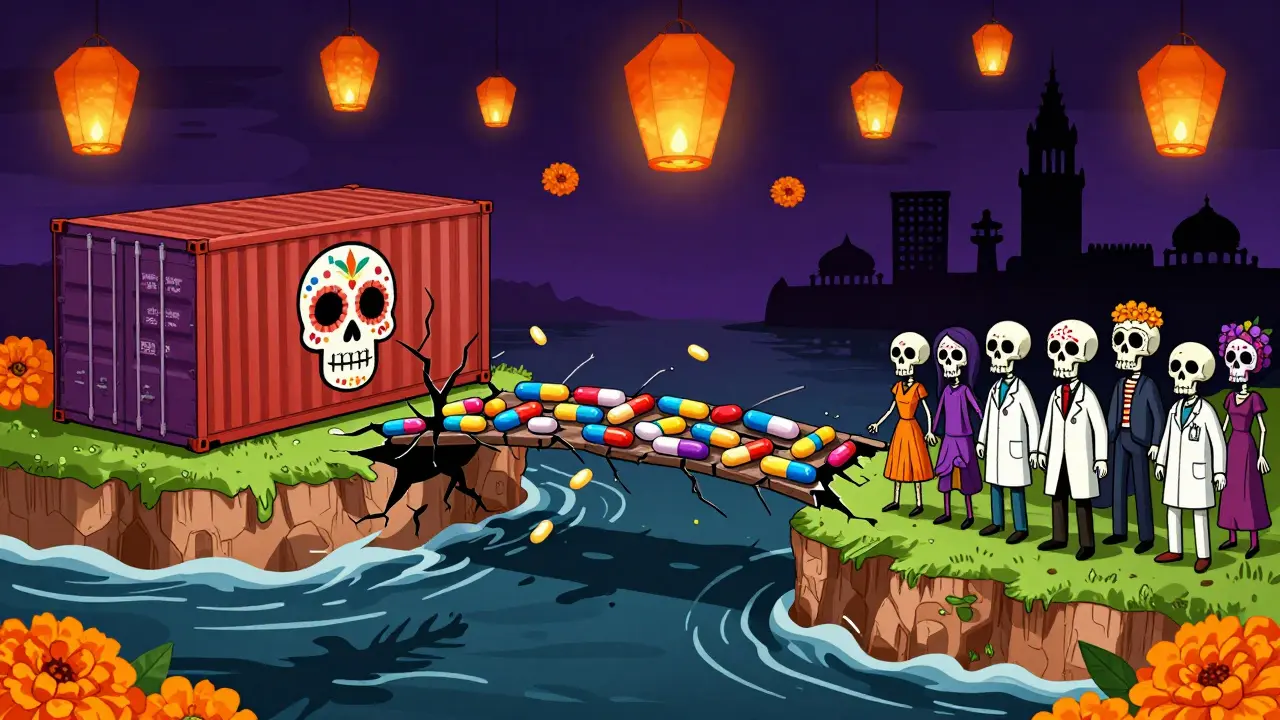
Beyond quality, there is the issue of availability. The global supply chain for pharmaceuticals is dangerously concentrated. The U.S. FDA reports that 88% of API manufacturing facilities for drugs sold in America are located overseas, with China accounting for 28% of those facilities. This concentration creates a single point of failure. As Dr. Andrew von Eschenbach warned in a 2023 Atlantic Council report, China’s dominance in Key Starting Materials (KSMs) represents a national security vulnerability for 90% of essential medicines.
Geopolitical tensions are accelerating efforts to diversify this supply chain. The U.S. CHIPS and Science Act allocated $500 million for domestic API production, while the EU’s 2024 Pharmaceutical Strategy aims to reduce API dependency on China from 80% to 40% by 2030. India, Vietnam, and Mexico are expanding capacity to fill this gap. McKinsey forecasts that China’s API market share will drop from 78% in 2023 to 65% by 2030.
However, shifting away from China is difficult. Building an FDA-compliant API facility costs $85-$120 million, compared to $50-$75 million for non-compliant plants. Plus, the learning curve is steep. Companies moving production out of China often face 18-24 months of delays for full compliance, dealing with cultural differences in documentation and inconsistent raw material quality elsewhere. Until alternative sources scale up, the world remains tethered to Chinese manufacturing.
Comparison: Global API Markets
| Region | Global Market Share (2023) | Avg. Cost per kg ($) | Failure Rate (Purity Tests) | Key Strength |
|---|---|---|---|---|
| China | 78% | $50 - $150 | 12.7% | Low cost, massive scale, complex synthesis |
| India | 12% | $100 - $250 | ~3.0% | Finished dosage forms, regulatory compliance |
| Europe/U.S. | 10% | $200 - $400+ | 1.8% - 2.3% | High quality, strict oversight, biologics |
What This Means for Patients and Providers
For the average patient, these statistics translate into uncertainty. You cannot see the source of your API on the prescription label. Most pharmacies don’t track the origin of ingredients beyond the manufacturer’s name. If you are concerned about quality, here are practical steps to consider:
- Ask your pharmacist: Inquire about the specific manufacturer of your generic drug. Some brands have better reputations for quality control than others.
- Check for recalls: Monitor FDA recall notices for your specific medications. Sub-potency issues often lead to large-scale recalls.
- Consider brand-name alternatives: If cost allows, brand-name drugs are typically manufactured under stricter, more transparent conditions, though this is not always guaranteed.
- Monitor consistency: If you switch generic manufacturers and notice changes in efficacy or side effects, report them to your doctor immediately. This could indicate a variation in API potency.
For healthcare providers, the challenge is balancing affordability with safety. Generic drugs are essential for making healthcare accessible, but relying solely on the lowest-cost suppliers introduces risk. Diversifying suppliers and maintaining robust inventory buffers can mitigate some of these vulnerabilities.
The Future of Chinese Generic Production
China is not standing still. Its 'Pharma 2035' initiative allocates $22 billion to upgrade manufacturing technology and quality systems. The target is to increase FDA-inspected facilities from 187 in 2023 to 500 by 2027. The NMPA now mandates electronic common technical document (eCTD) submissions and requires continuous manufacturing for 30% of high-volume products by 2026. Continuous manufacturing, unlike batch processing, offers better control and consistency, potentially reducing error rates.
However, achieving 95%+ regulatory compliance across major markets within five years-as Deloitte suggests is necessary to maintain market share-requires $30-$40 billion in additional infrastructure investment. Given the current economic pressures and the compression of manufacturer margins due to China’s own National Volume-Based Procurement (NVBP) program, this level of reinvestment is uncertain.
The industry is at a crossroads. China will likely remain the dominant supplier of APIs through 2030 due to its entrenched infrastructure and cost advantages. But as geopolitical tensions rise and quality standards tighten globally, the margin for error shrinks. For the rest of the world, the strategy must be pragmatic: acknowledge the dependence, demand higher transparency, and invest in resilient alternatives.
Are Chinese generic drugs safe to take?
Most Chinese generic drugs meet basic safety standards, but they carry higher risks of quality inconsistencies compared to Western-produced equivalents. A 2023 FDA study found a 12.7% failure rate in purity tests for Chinese APIs versus 1.8% for U.S. APIs. While many patients take them without issue, the risk of sub-potent or contaminated batches is statistically higher.
Why does the world rely so heavily on Chinese API production?
China dominates the API market due to lower production costs (30-40% less than Western competitors), massive scale, and expertise in hazardous chemical synthesis steps like fluorination. Environmental regulations and labor costs in the West have made it economically unviable for many companies to produce these ingredients domestically.
What is the Generic Consistency Evaluation (GCE) program?
The GCE is a Chinese regulatory program launched in 2016 requiring generic drugs to prove they are bioequivalent to reference products. As of 2024, only 35% of approved generics have completed this evaluation, meaning many drugs on the market haven't undergone rigorous international-standard testing.
How can I find out where my generic medication is made?
You can ask your pharmacist for the specific manufacturer of your generic drug. While the packaging usually lists the distributor, it may not explicitly state the country of origin for the API. Checking the FDA's Orange Book or contacting the manufacturer directly can provide more detailed supply chain information.
Is the U.S. moving away from Chinese pharmaceutical imports?
Yes, slowly. The U.S. CHIPS and Science Act includes provisions for domestic API production, and the EU aims to reduce Chinese API dependency from 80% to 40% by 2030. However, building alternative capacity takes years and billions of dollars, so China will likely remain the top supplier through 2030.