Getting the right dose of medication isn’t just about following the label. For many people, the standard dose on the bottle can be too much-or too little-because of their age, weight, or how well their kidneys are working. Too high a dose can lead to dangerous side effects. Too low, and the drug won’t work. This isn’t guesswork. It’s science. And it’s happening every day in hospitals, clinics, and pharmacies across the country.
Why One Size Doesn’t Fit All
Think of your body like a factory. Medications enter, get processed, and get cleared out. In a healthy 30-year-old, that factory runs at full speed. But if you’re 80, or overweight, or your kidneys aren’t filtering well, that factory slows down. The same pill that clears out in 6 hours for one person might stick around for 24 hours in another. That’s why dosing adjustments aren’t optional-they’re essential.According to the National Kidney Foundation, about 37 million adults in the U.S. have chronic kidney disease. That’s 1 in 7 people. For nearly half of all commonly prescribed drugs, those patients need a different dose. The same goes for older adults, who often take multiple medications and have naturally reduced kidney function. And for people with obesity or very low body weight, the volume of distribution changes-meaning drugs spread differently through the body.
How Kidney Function Drives Dosing Decisions
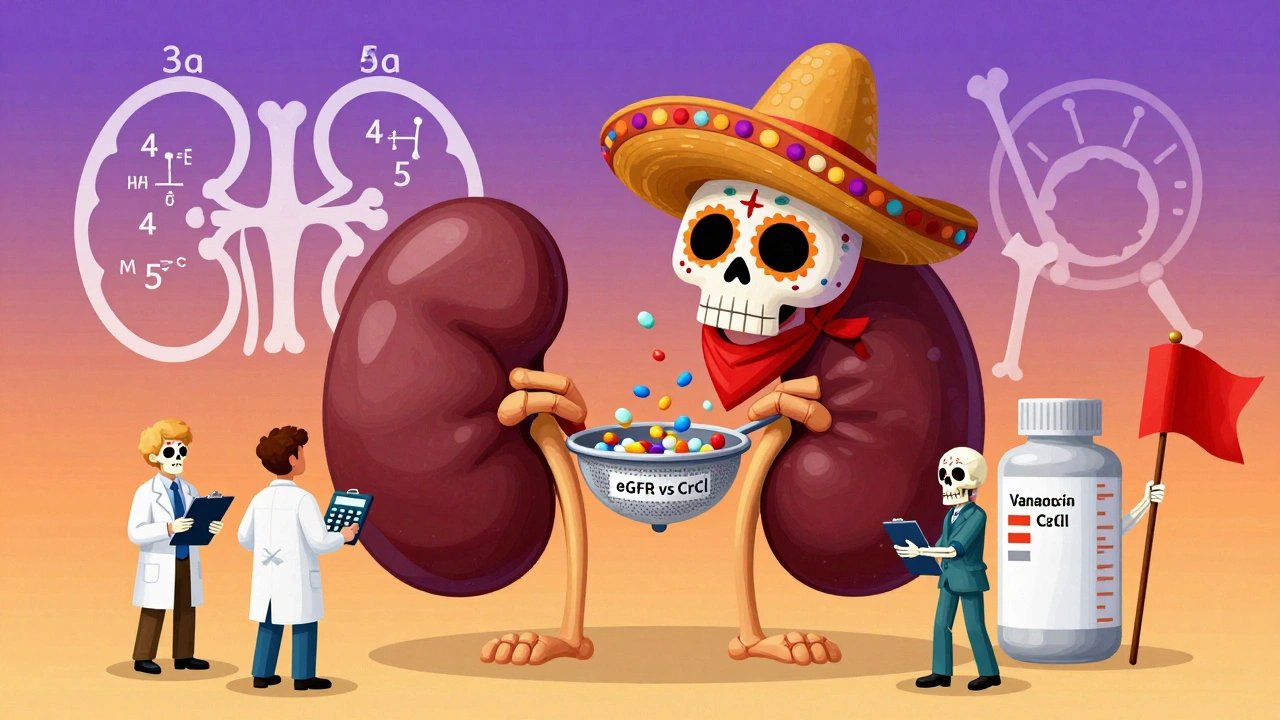
Your kidneys are the main cleanup crew for most medications. When they slow down, drugs build up. That’s why doctors and pharmacists check kidney function before prescribing things like antibiotics, painkillers, diabetes meds, and heart drugs.Two numbers matter most: creatinine clearance (CrCl) and estimated glomerular filtration rate (eGFR). They’re not the same thing, and mixing them up can lead to errors.
eGFR tells you how advanced kidney disease is. It’s used to stage chronic kidney disease (CKD). Stage 3a? eGFR 45-59. Stage 4? eGFR 15-29. But here’s the catch: drug dosing guidelines were mostly created using CrCl-not eGFR. So even if your chart says your eGFR is 40, your actual drug clearance might be lower than what the eGFR suggests.
The Cockcroft-Gault equation is still the gold standard for dosing. It uses your age, weight, sex, and serum creatinine to estimate CrCl. For example: (140 - age) × weight × 0.85 (if female) ÷ (serum creatinine × 72). The result? Milliliters per minute. That’s what pharmacists plug into drug databases to find the right dose.
But there’s a problem. The newer CKD-EPI equation gives a more accurate eGFR, especially for older adults and people with normal kidney function. It’s used for diagnosis and staging. But for dosing? Many drug labels still reference CrCl. That means clinicians have to juggle two numbers-and that’s where mistakes happen.
Weight Matters More Than You Think
If you’re overweight, your body holds more water and fat. That changes how drugs spread and how much stays active in your system. For many drugs, doctors use your adjusted ideal body weight instead of your actual weight.Here’s how it works: First, calculate your ideal body weight (IBW). For men: 50 kg + 2.3 kg for every inch over 5 feet. For women: 45.5 kg + 2.3 kg per inch over 5 feet. Then, if your BMI is over 30, use this formula: IBW + 0.4 × (actual weight - IBW). This gives a more realistic estimate of how your body handles the drug.
Why does this matter? A 2019 study found that using eGFR in obese patients overestimates kidney function by 15-20%. That means if you rely only on eGFR, you might get a dose that’s too high-and risk toxicity. For drugs like vancomycin or gentamicin, that’s life-threatening.
On the flip side, underweight patients (BMI under 18.5) can have their CrCl overestimated by up to 25% using Cockcroft-Gault. That leads to underdosing. A patient with cancer or an eating disorder might not get enough of their antibiotic, letting an infection spread.
Aging Changes Everything
As you get older, your kidneys naturally lose function-even if you’re healthy. Muscle mass drops. Creatinine production falls. That means your serum creatinine might look normal, but your actual kidney function is declining. The Cockcroft-Gault equation accounts for age. The CKD-EPI does too. But many automated systems still use the wrong one.Studies show that 30% of adverse drug events in older adults come from improper dosing in kidney impairment. That’s not rare. That’s routine. A 75-year-old on metformin for diabetes? The FDA says max dose is 500 mg daily if eGFR is below 30. But in a 2023 Reddit post, a pharmacist shared a case where a patient had been taking 1000 mg twice daily for six months-no one caught it.
And it’s not just diabetes. Blood thinners, statins, and antidepressants all need adjustment. A 2022 survey found that 68% of pharmacists see wrong renal doses at least once a week. Antibiotics top the list, followed by heart meds and diabetes drugs.
What Happens When Dosing Goes Wrong
The consequences aren’t theoretical. Too much metformin can cause lactic acidosis-a rare but deadly condition. Too much digoxin leads to heart rhythm problems. Too much morphine? Respiratory failure. Too little antibiotics? Treatment failure and resistant infections.One hospitalist in Chicago reported three cases in a single year where vancomycin doses, based on eGFR, were too low in elderly patients with Stage 3B CKD. The infection didn’t clear. The patient got sicker. Only when CrCl was recalculated using adjusted weight did the dose work.
And it’s not just patients. Pharmacists are overwhelmed. A 2023 review found that five different hospital formularies listed five different doses for cefazolin in patients with eGFR between 20-29 mL/min. No consistency. No clarity. Just confusion.
How Technology Is Helping-And Hurting
Most hospitals now have electronic health records (EHRs) with built-in dosing alerts. Epic, Cerner, and other systems flag when a dose might be too high based on kidney function. That’s good. But here’s the problem: alerts can be ignored, overridden, or based on the wrong equation.A 2019 study found that automated alerts reduced medication errors by 47% in hospitalized patients with CKD. But another study showed that over-reliance on these alerts can cause underdosing. One doctor told a podcast that in sepsis, if the system cuts an antibiotic dose because of low CrCl, the patient might die before the infection is controlled.
Real-time monitoring is coming. The NIH is funding AI tools that combine genetics, kidney function, and drug levels to predict the perfect dose. Pilot programs start in 2024. But until then, the best tool is still a clinician who knows how to use the right equation, understands the drug’s pharmacokinetics, and checks the patient’s full picture.
What You Can Do
You don’t need to calculate CrCl yourself. But you can ask the right questions:- “Is this dose based on my kidney function?”
- “Do I need a lower dose because of my age or weight?”
- “Can you check my creatinine and eGFR before prescribing?”
- “Is this drug cleared by the kidneys?”
Bring a list of all your meds-prescription, over-the-counter, supplements-to every appointment. Many interactions and dosing errors happen because no one has the full picture.
If you’re on a drug like metformin, warfarin, or lithium, ask your pharmacist to review your dose every six months. Don’t assume it’s still right just because you’ve been taking it for years.
The Bottom Line
Medication dosing isn’t one-size-fits-all. Age, weight, and kidney function aren’t just numbers on a lab report-they’re direct drivers of how your body handles medicine. Ignoring them can be dangerous. Relying on automated systems without understanding their limits can be just as risky.The best outcomes come when clinicians use the right tools-Cockcroft-Gault for dosing, CKD-EPI for staging, adjusted weight for obesity, and clinical judgment for everything else. And when patients speak up, ask questions, and stay informed.
It’s not complicated. But it’s not simple either. Getting it right saves lives.
Michael Dioso
December 5, 2025 AT 03:53Look, I’ve been in pharmacy for 22 years, and let me tell you - most of these dosing guidelines are garbage. Cockcroft-Gault? Sure, it’s old, but it’s the only one that actually predicts drug clearance in real life. eGFR is for academics who’ve never seen a patient with 300 lbs of body fat and a creatinine of 1.2. I’ve seen people on vancomycin crash because some EHR auto-filled eGFR and called it a day. Stop trusting algorithms. Trust the math - and the patient’s actual weight.
Krishan Patel
December 5, 2025 AT 22:28It is not merely a matter of pharmacokinetics - it is a moral failing of modern medicine to reduce human beings to statistical outliers. When a 78-year-old woman is given the same dose of metformin as a 30-year-old athlete, it is not an error - it is a declaration that the elderly are expendable. The system does not care. It is designed for efficiency, not humanity. And yet, we call this progress? I say - return to the wisdom of the ancients: observe, adjust, and never assume.
Deborah Jacobs
December 6, 2025 AT 21:01My grandma was on lisinopril for years, and no one ever checked her CrCl. She ended up in the ER with dizziness and kidney funk - turned out her eGFR was 28 but the system kept giving her the full dose. I cried reading this. We treat labs like gospel, but the body? It’s messy. It’s human. It doesn’t care about your EHR’s default settings. Talk to your pharmacist. Bring a list. Be the annoying one. It saves lives.
James Moore
December 7, 2025 AT 09:15Let’s be real - this whole system is a disaster, and it’s because we’ve let the bureaucrats and tech companies take over medicine. We used to have doctors who knew their patients - now we have algorithms that think a 200-pound woman with a creatinine of 1.0 is ‘normal’ and give her the same dose as a 130-pound athlete. And don’t get me started on how India and China are outsourcing our drug manufacturing while our own pharmacists are drowning in alerts they can’t trust. This isn’t healthcare - it’s a corporate circus, and we’re all clowns in it.
Kylee Gregory
December 8, 2025 AT 21:20I appreciate how this post breaks down the science without being overwhelming. I think the real issue isn’t the equations - it’s communication. If a patient doesn’t understand why their dose changed, they’ll just stop taking it. Or worse - keep taking it like before. Maybe we need a simple one-pager for patients: ‘Your kidneys are slowing down - here’s why your pill dose got smaller.’ No jargon. Just clarity. That’s the missing piece.
Laura Saye
December 8, 2025 AT 23:51There’s a quiet crisis happening in geriatric care - polypharmacy meets declining renal function, and the system just... doesn’t catch it. I’ve seen patients on 7+ meds, all cleared renally, with eGFR in the 30s, and zero dose adjustments. It’s not negligence - it’s systemic fatigue. Clinicians are burnt out, EHRs are glitchy, and there’s no time to cross-check every drug. We need better tools - but we also need to stop pretending that one-size-fits-all dosing is ever acceptable. This isn’t just pharmacology - it’s dignity.
Manish Shankar
December 9, 2025 AT 18:16It is with profound respect for the medical profession that I acknowledge the complexity of renal dosing. However, I must emphasize that the Cockcroft-Gault equation, despite its age, remains the most empirically validated tool for pharmacokinetic adjustment in clinical practice. The overreliance upon eGFR, particularly in obese populations, constitutes a significant deviation from evidence-based principles. I urge all practitioners to prioritize CrCl calculations when prescribing renally cleared agents, as patient safety is paramount.
luke newton
December 9, 2025 AT 23:22You know what’s really sad? People still think this is just about numbers. It’s not. It’s about how we treat our elders. My dad was on a blood thinner for years, and no one ever adjusted his dose. He nearly died because some intern trusted the computer. And now? The hospital won’t even apologize. They just say ‘it’s protocol.’ Protocol? That’s not a word - it’s an excuse. And it’s killing people.